
The crash of a Navy jet into San Diego Bay last February after its crew ejected was the result of human error and represents a $109 million loss for the military, according to a Navy investigation report.
The mishap occurred on Feb. 12, 2025, and involved two crew members from Electronic Attack Squadron 135 out of Naval Air Station Whidbey Island, Wash., who were participating in a joint training exercise based at North Island.
The crew members were using an E/A-18G Growler equipped with software they were not familiar with and which issued a warning advisory during aerial refueling, says the report, which the Union-Tribune obtained this week through the Freedom of Information Act.
The pilot and his electronic warfare officer also struggled with a wet runway at Naval Air Station North Island during their second attempt to land, when winds were creating a tailwind on the landing runway. They were unable to sufficiently slow the jet, forcing them to use the plane’s afterburners to pull up.
The unidentified pilot says in the report that the plane’s brakes felt “mushy” and that he felt “the jet was not going to stop in time.” He said the tower controller called out “not enough runway,” which he said “caused some confusion and concern,” and he called for the ejection.
They were carried into the harbor by their parachutes.
A nearby fishing boat pulled them aboard. They suffered minor injuries.
The plane soared upward to roughly 8,000 feet, then did a 1-minute, 15-second nose-dive into one of the busiest harbor channels in California. The report does not make clear whether the jet flew over heavily populated areas of Point Loma on its way to crashing about 250 yards from Shelter Island.
According to the report, the plane assigned for their mission was leaking fuel from its starboard engine, forcing them to use a backup E/A-18 Growler. The aircraft took off and underwent aerial refueling, but the crew noted an unexpected advisory: normal fuel transfer from the wings was unavailable.
The crew completed the fueling but were so concerned about the warning that they decided to return to North Island. Along the way, they reduced their fuel load. The report says the crew was not expecting the adverse weather conditions they found.
At the time of the mishap, some E/A-18 Growlers were transitioning to a new type of software meant to help them to conduct airborne electronic warfare, mostly to protect aircraft carriers from enemy attacks.
This drew criticism from investigators, who say in the report that, “Critical phases of training are not the time to undergo massive maintenance and aircraft overhaul. The training of aircrew and maintenance professionals should have been the priority” during the squadron’s readiness phase training.
The report also says the warning during refueling should have been expected, and the crew should have “annotated it as normal.”
“The mishap aircraft … was safe for flight and did not experience any malfunctions in flight that would have prevented the aircraft from completing the scheduled flight or from stopping safely upon return to base,” the report said.
The report says investigators could not definitively determine the cause of the crash because the aircraft was destroyed. But they ruled out mechanical failure as a “likely contributor” and added that, “The evidence instead indicates the mishap was caused by human error exacerbated by a confluence of factors: adverse weather, poor crew resource management, low aircraft currency and proficiency, and reduced familiarity with the newly instituted H18 software.
“These elements collectively compounded the severity of the pilot’s critical decision to delay a go-around or divert to a more suitable airfield,” the report says.
In a nuanced addition, the report notes that, “There is insufficient evidence to determine whether life stressors and (operational tempo) were contributing factors to the mishap, but they do generally contribute to fatigue and increased risk to operation.”
The wife of one of the crew members had recently had a baby, which he said caused him stress because he had to leave his wife and new child at home while away on assignment.
Chief of Naval Operations Adm. Daryl Caudle recently told reporters in San Diego that a long, fast operational tempo has a highly negative impact on many sailors, many of whom end up deciding to leave the military.
The reference to the weather didn’t surprise retired Navy Capt. Greg “Chaser” Keithley of Escondido, who was a crew member on F-14 and F/A18 aircraft.
“North Island Naval Air Station is not an easy place to land during adverse weather,” Keithley said. “A wet runway is a wet runway.”
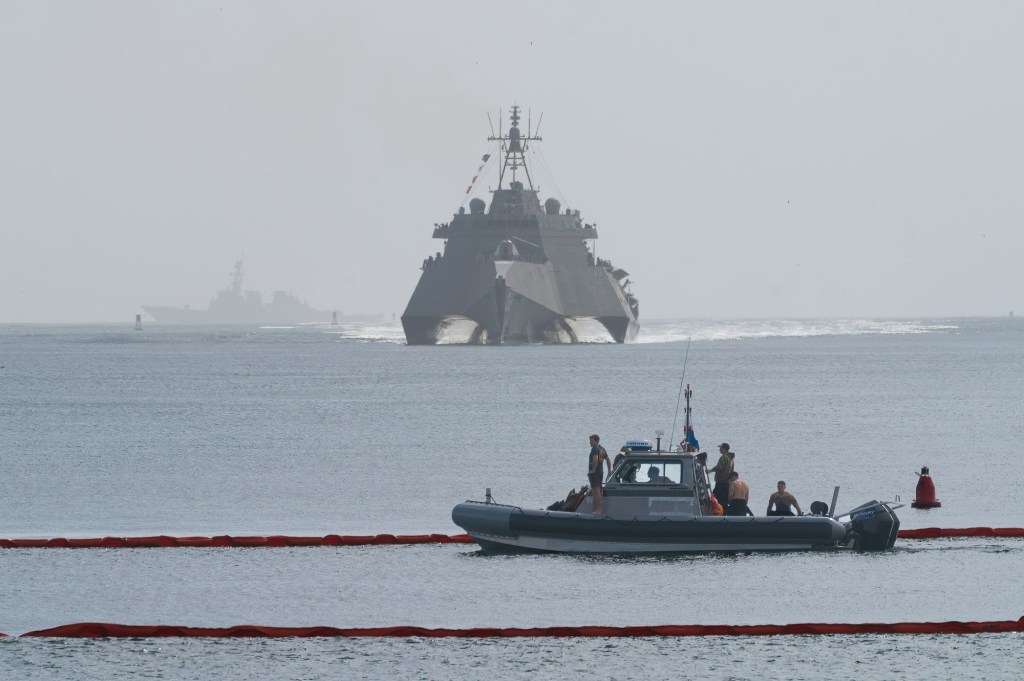
Following the crash, crane operators and divers recovered about 33,400 pounds of debris from the aircraft, which was in pieces roughly 30 feet below the surface. A safety zone was set up, which temporarily restricted the movement of boats near Shelter Island and Naval Base Point Loma.
The loss of an E/A-18G Growler is not insignificant. They are the main aircraft the Navy uses for airborne electronic attacks, especially when it comes to suppressing enemy air defense systems. Some of these planes are part of the airwing of the San Diego-based aircraft carrier USS Abraham Lincoln, which is currently patrolling in the Middle East, within striking distance of Iran.