
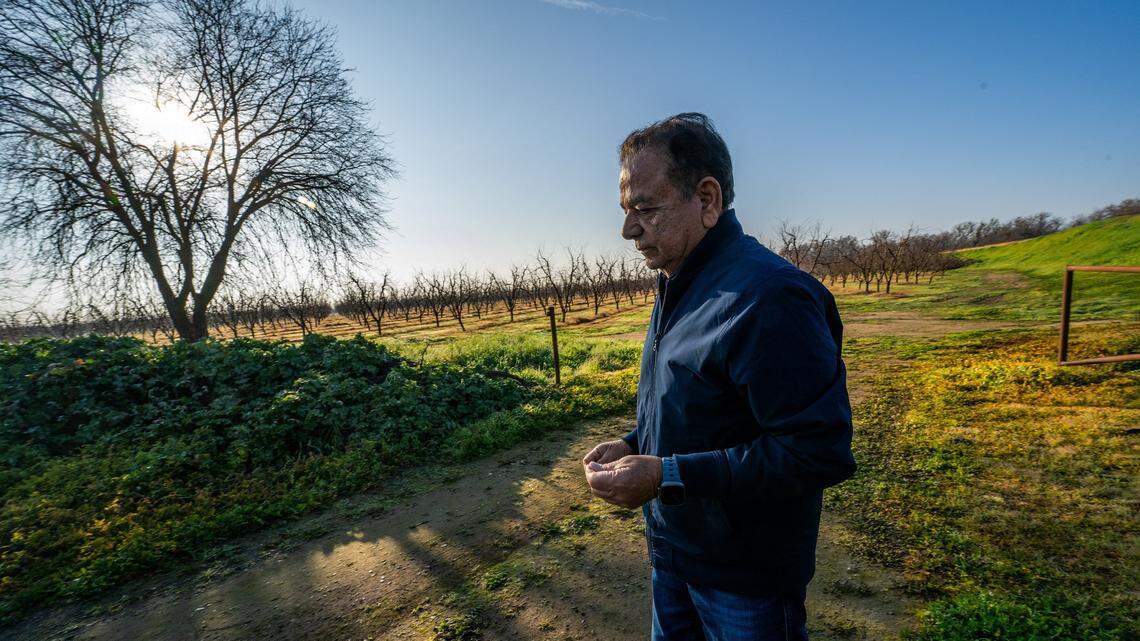
Peach trees stood lined in rows and stretched across the 20-acre plot of farmland north of Marysville, their wayward branches either lying on the ground or still reaching outward and upward, the ideal vertical shape of the variety when bearing fruit.
By that time in early February, the orchard of Ross cling peaches, considered a late variety for the time of its summer harvest, workers would have pruned each tree and sprayed the orchard in anticipation of the impending bloom.
Only part of the orchard had been pruned when Sarb Johl called off the job. The 9-year-old trees produced enough fruit to make up for the steep upfront costs of their planting and growing. Ordinary expectations, and the 20-year contract Del Monte Foods had signed, projected at least 10 more years of productivity and profitability.
But once peach growers learned in January that no one had bought the long-running Del Monte cannery in Modesto from the fruit corporation’s bankruptcy sale, Johl knew the thousands of pounds of peaches grown in that particular orchard were without a home.
Peach farmer Sarb Johl walks through a grove of 9-year-old Ross peach trees on his farm in Yuba County on Feb. 3 that were under a 20-year contract with Del Monte. Since Del Monte’s closure, he said, Pacific Coast Producers was not interested in the trees and they will have to be destroyed. RENÉE C. BYER rbyer@sacbee.com
“We were just getting into making some profits out of it, but, unfortunately, it’s gonna have to be removed,” Johl said.
Peach growers throughout the Yuba-Sutter area and Central Valley are reckoning with the fallout from Del Monte’s bankruptcy, which stranded many growers with 20-year contracts for peaches totaling more than $550 million. The company’s collapse left Pacific Coast Producers, a cooperative of growers, as the lone processor of peaches, and consequently, the only prospective buyer for nearly 75,000 tons of peaches otherwise grown for Del Monte.
Without a buyer for the cannery in Modesto, which employed up to 1,800 people including seasonal workers, the cooperative lacks the capacity to buy, can and market all the fruit soon to grow from the blooming peach orchards.
The last remaining processor, with plants in Lodi and Oroville, has offered one-year contracts to buy fruit from some of the orchards tied to canceled Del Monte contracts, granting a lifeline of sorts to some of the out-of-luck farmers. But the California Canning Peach Association estimated that the processor has offered deals for 24,000 tons of peaches — roughly a third of the 74,000 tons delivered last year to Del Monte — leaving growers to weigh the pros and cons of taking the short-term relief, or whether to rip out their orchards and start over.
“Two thirds of the growers are going to be, basically, just left out to dry,” Johl said.
As peach farmer Sarb Johl drives around his farm in Yuba County on Feb. 3, he points out an orchard that Del Monte asked him to plant two years prior. “Del Monte was asking us to plant more because they were trying to expand their grower base,” Johl said. RENÉE C. BYER rbyer@sacbee.com ‘It’s devastating’
Karm Bains, Sutter County supervisor and a fourth-generation peach farmer with Pacific Coast Producers membership, said the lost contracts would also mean lost jobs, affecting the supporting industries of farm laborers, pesticide sprayers, truck drivers and more.
“Nobody wins in a situation like this. We’re all losing,” Bains said. “Somebody might be hurting a little bit more than their neighbor, depending on the size and the scale of what you had. But it’s devastating. And we still don’t know what to expect.”
Sutter County Supervisor Karm Bains, at right, a fourth-generation peach farmer, listens to a presentation at the California Canning Peach Association’s annual conference in Sacramento on Feb. 4. Instead of a celebration, the conference was more like a funeral after the closure of Del Monte cannery in Modesto. “Nobody wins in a situation like this. We’re all losing,” Bains said. RENÉE C. BYER rbyer@sacbee.com
Many growers have orchards Del Monte asked them to grow within the past few years, meaning those trees may produce only a fraction of their eventual harvest, and are far from recouping their upfront cost.
Johl entered 20-year contracts with Del Monte in 2023 and 2024 that now lack long-term security. He recently accepted a one-year contract with Pacific Coast Producers for 20 acres of peaches, but may have to pull the other 80 acres from the ground.
“They’re the only player left. What are you going to do?” Johl said. “In the peach business, you do what the processor wants you to do. And what variety they want you to grow, you just grow it. You’re growing it for their needs. If they don’t need it — and that’s what we’re faced with now — they just don’t need all these peaches.”
Losing a half-billion dollars
The annual meeting of the California Canning Peach Association typically celebrates the history and future of the industry, but a funereal tone shrouded this year’s event, the 104th installment.
Peach growers traveled from throughout the Central Valley to meet inside a Sacramento hotel banquet room where they effectively grieved. The large screens projecting an image of a tombstone that read “Del Monte Foods / 1892-2026” explained as much.
“What we have witnessed over the last seven months is the death of an extended family member,” said Rich Hudgins, canning association president. “And we’re all feeling the loss. We’re all feeling it in different ways. But it’s real.”
Rich Hudgins, president of the California Canning Peach Association, speaks about the demise of Del Monte Foods while displaying a picture of a tombstone alongside Ranjit Davit, center, the association’s chairman and a Sutter County peach grower, and Kevin Ralph, right, AgWest Farm Credit vice president, at the association’s annual meeting on Feb. 4. RENÉE C. BYER rbyer@sacbee.com
Del Monte, the national seller of packaged and canned fruits and vegetables, filed for bankruptcy in July. Coinciding with the start of harvest for the earliest peach varieties, growers and the association — through which they collectively bargain — at the time focused on delivering peaches and receiving payments owed for the year’s crop.
The bankruptcy, a chapter 11 filing that allows a company to reorganize rather than quickly sell off and shutter, would take time for courts and attorneys to settle. Although Del Monte voided its peach contracts last summer, growers held hope that a buyer would take over the business, necessitating the thousands of tons of peaches under contract and soon to grow throughout the Central Valley.
That changed in January when growers learned the centerpiece of the Del Monte peach business, a large processing plant in Modesto, had no buyer.
“I think we all feel the depression, we all feel the sadness,” Hudgins said. “We all know that this industry is changing and not for the better.”
The Del Monte production facility in Modesto in 2025. ANDY ALFARO Modesto Bee file
Parts of the Del Monte business and brand, such as the stickers marking bananas and its red-and-yellow logo on cans, will remain on grocery shelves, as Pacific Coast Producers bought the remaining fruit inventory and brand licensing rights, which included packaging under the Del Monte and S&W brands.
When no buyer emerged during bankruptcy proceedings for the Modesto cannery, Del Monte announced it would close the plant.
A Del Monte spokesperson declined comment beyond prior news releases.
Changes in the food people buy, store at home and, ultimately, eat, have hurt the canned fruit industry, which, according to The Fresno Bee, once employed several thousand workers at Modesto canneries. But growers and industry officials also point to growing import markets and rising expenses, including some linked to recent steel tariffs.
The contracts Del Monte had with growers typically lasted about 20 years, intentionally long-term in connection to the lifespan of an orchard. Peach trees mature as they age, gradually producing more fruit through the early years of their life before reaching their full potential.
Growers had been told that Pacific Coast Producers would not seek contracts for orchards older than 16 years old, or for early and late peach varieties, which constitute the majority of peaches grown in the Yuba-Sutter area.
“Yes there will still be a peach business, but it’ll be just a few less growers going forward, and I’m sorry to say that,” Ranjit Davit, canning association chairman, said at the annual meeting. “… It’s not the first time this has happened this way.”
Kevin Ralph, vice president of AgWest Farm Credit, speaks to a packed room at the annual California Canning Peach Association meeting in Sacramento on Feb. 4. RENÉE C. BYER rbyer@sacbee.com The changing peach industry
Growers have been through this before.
Bankruptcies claimed processors in the past, including Tri-Valley Growers more than two decades ago. But past bankruptcies and consolidations left multiple processors in the marketplace. Without Del Monte, the only meaningful buyer of cling peaches in mass is Pacific Coast Producers.
For perspective, California had 11 processors in 1980, according to the canning association. Only one remains.
The canning association’s estimate that Pacific Coast Producers would pick up about a third of the peaches Del Monte had contracted, leaving about 50,000 tons without a buyer as peach orchards of the Central Valley begin to bloom, proved accurate.
Peaches ready to be transported to Tri-Valley Growers processing facilities in July 2000. Tri-Valley Growers filed for bankruptcy the same year. DEBBIE NODA Modesto Bee file
“There was a huge shock to all of us when we realized that all of the term contracts that were in place with this company were going to disappear through the bankruptcy process,” Hudgins said.
Growers said the membership structure of the Pacific Coast Producers cooperative led the processor to prioritize cash contracts for its members who lost Del Monte contracts, before then looking to other growers who may have had only Del Monte contracts.
Bankruptcy proceedings continue, but the decisions most consequential to peach growers have been made. The District of New Jersey bankruptcy court in early February approved the Pacific Coast Producers purchase of the Del Monte inventory and brand, which is expected to close by the end of March.
“(Pacific Coast Producers) is thrilled to be the winning bidder for Del Monte’s fruit business. California is our home, and we are committed to a viable agricultural community,” said Matt Strong, Pacific Coast Producers president, in a statement. “We recognize how Del Monte’s bankruptcy proceedings have been disruptive. We also see transformation occurring in the industry in response to changing consumer preferences. We are committed to being responsible stewards.
“The reality is, there is only so much production that we can absorb and that the market will justify. We are doing everything we can, while recognizing that market realities are a limiting factor.”
Workers inspect peaches during processing at Pacific Coast Producers in Lodi in 2015. ANDY ALFARO Modesto Bee file
The lost contracts, which the canning association valued at more than $550 million in its claim to the bankruptcy court, are considered an unsecured claim for damages, which are a lesser priority than secured claims, said Sarb Atwal, an attorney and Yuba County grower who had two 20-year Del Monte contracts.
“Unfortunately there isn’t a lot of money as a result of this sale,” Atwal said. “I think their debt was still significantly higher than what it was sold for, so the discharge of debt and order would not make it to a grower lawsuit.”
When the growing gets tough
Richard Lial started farming when he, as a 6-year-old, could drive a tractor.
The third-generation farmer still tends that land in Escalon, a small town north of Modesto, where he grows peaches, walnuts and almonds. But the business of cling peaches, which his grandfather entered in the 1950s, has changed.
The latest development includes the shuttering Modesto cannery not far from where he farms, a town known as “the land of peaches and cream” to some.
“There’s a Del Monte plant sitting over there with all the equipment in it to run, and it’s not going to run,” Lial said. “And there are growers who have acres of trees that could produce fruit that are not going to get picked. To me there should have been some effort to try to preserve that.”
Lial has 105 acres of peaches, all planted under Del Monte contracts. Fifty acres of three different varieties the company had him plant in 2024 concern him most. Those varieties, studied and modified by researchers at UC Davis, were engineered to achieve specific characteristics when harvested at particular times, and to hold those qualities when preserved in a can.
They were also specifically requested by Del Monte before being planted two years ago.
“This was something that Del Monte asked me to plant for them,” Lial said. “I think the bankruptcy court should have put more emphasis on these contracts. I’m not the only grower Del Monte did this to. I think the court should have had more emphasis on making sure those contracts got picked up.”
The Del Monte production facility in Modesto in 2025. ANDY ALFARO Modesto Bee file
Tony and Laura McGrath farm three different peach varieties, totaling about 40 acres in Yuba County, under contract with Del Monte. They also farm almonds and prunes, and operate a prune dehydrator. But the peaches in their crop portfolio have been top of mind.
For example, they have 12 acres of an Andross variety, which had another 10 years under contract, entering the most profitable part of its lifespan.
“We’ve just gotten to the sweet spot,” Laura said.
A cling peach orchard producing 20 tons per acre, based on the 2024 price, brought in about $12,500 per acre. Many farmers diversify the types of crop they grow to hedge against commodity prices that fluctuate based on a host of market conditions. In recent years, peaches offered stability while tree-nut prices wavered.
Growers maintain collective bargaining power when shopping for a per-ton price, but with only one processor with which to negotiate, that power weakens.
“(Pacific Coast Producers) now is going to have the monopoly of what goes on in the fruit industry,” Laura said. “… When you have one person who has a monopoly, or one company, then they set the price.”
The McGraths were not offered contracts to pick up any of their Del Monte acreage. They lease the peach orchards they farm, and have an added layer of uncertainty when factoring in what their landlord chooses: remove the orchard or which crop to plant. .
Tony and Laura McGrath, who have about 40 acres of peaches formerly contracted to Del Monte, stopped to chat with peach farmer Sarb Johl on Feb. 3. The McGraths said Pacific Coast Producers did not offer them contracts to continue producing that acreage. RENÉE C. BYER rbyer@sacbee.com
“There’s really nothing that you can move into,” Tony said. “Walnut prices aren’t that great. You can do prunes, but it takes you seven to eight years to develop it and start getting money back from it. Almonds, there’s quite a few of them also, and it’s very expensive to start an almond orchard.”
The McGraths have a farm portfolio similar to the average Central Valley peach grower. Hudgins said the canning association’s average grower farms about 40 acres of peaches plus another crop, such as almonds or walnuts.
“The notion that these are all large corporate farming entities would be totally incorrect,” he said. “These are small family farmers.”
What’s a grower to do?
By the time peach growers, local and state officials and a member of Congress met recently in Yuba City, the winners and losers of the Pacific Coast Production contracts had been mostly sorted.
That left a key, complicated question to parse: What are the options for the growers without a home for roughly 50,000 tons of peaches?
“I have lived through cannery closures, I have weathered uncertainty, dead and dying trees from too much rain,” said Jeff Stephens, a Sutter County supervisor who farmed peaches for more than 40 years. “But I have never experienced anything of this magnitude.”
More than a hundred people, many of whom wore work boots, hats or traditional Sikh turbans, attended in hope of answers for which they are still waiting.
Sarb Johl, left, seated in back, was among a packed room of concerned peach farmers at the California Canning Peach Association’s annual meeting in Sacramento on Feb. 4. Del Monte, the national seller of packaged and canned fruits and vegetables, filed for bankruptcy in July, causing havoc among peach growers who had depended on its production facility in Modesto. RENÉE C. BYER rbyer@sacbee.com
Officials messaged the importance of unity among the growers when seeking means of relief, namely from the U.S. Department of Agriculture, and more specifically, to pay millions toward the cost of ripping out orchards.
“This is probably the worst environment for agriculture that we’ve ever lived through. Everybody is looking for help right now,” said Rep. Mike Thompson, D-St. Helena, whose congressional district shifted to include Yuba and Sutter counties after the passage of Proposition 50.
“There’s not a single commodity that’s not being impacted by something, and they’re looking for help,” he added. “So we’re going to be standing in a long, long line trying to figure this out.”
The canning association has pitched a $12 million tree-pull program to USDA, suggesting $9 million of federal funds and $3 million from the canning association and industry. Growers with canceled Del Monte contracts would be eligible to remove orchards, up to 3,000 acres, at a $250-per-ton rate based on peaches delivered in 2025.
That proposal, which pre-dated the mid-January announcement that the Modesto cannery would close, follows a similar structure used for a tree-pull program in 2005, in which the government assisted to correct an oversupply of cling peaches.
Hudgins said that the canning association is still waiting to hear back from the USDA.
Adding to the challenges faced by the cling peach industry is a 50% steel tariff imposed by President Donald Trump , Hudgins said, which applies to the tinplate used for cans, and a growing import market that sources peaches from overseas at prices lower than the California-grown equivalent.
“The disconnect is this country imports 100,000 tons of peaches a year and has 50,000 tons of peaches growing in California without a home,” Hudgins said.
Rich Hudgins holds up the 100th anniversary catalog at the California Canning Peach Association’s annual meeting in Sacramento on Feb. 4 to remind peach farmers the organization is there to help after Del Monte’s closure. In 1980, 11 canners operated — now there is just one: Pacific Coast Producers. RENÉE C. BYER rbyer@sacbee.com To pull or not to pull?
Prospective buyers had the opportunity to own the only cannery able to process the volume of unaccounted peaches and they all passed. But with the plant expected to eventually go up for sale publicly, scant hope remains that a buyer would keep it in operation.
Harinder Dhanota, a Yuba and Sutter county peach farmer who had 100 acres of Del Monte contracts, said officials need urgency to match the timetable of growers faced with deciding whether to rip out orchards without financial assurance.
The program 20 years ago required farmers to gain approval before removing orchards. But that program had more time to administer. Learning about the cannery closure in mid-January gave growers a brief window before peach trees bloom, or a new orchard would need planting.
Growers are optimistic that a tree-pull program, if approved, would subsidize them based on their Del Monte acreage even if the orchard was already removed. An alternative entails investing in orchards without a buyer to eventually qualify for the potential federal support, which is not promised.
“We’re in limbo,” Dhanota said. “We have trees that are there, and we’re wasting space on the ground. If we need to pull them out we need to know. We can’t wait for the cannery to open next year. We need to know now.”
Cutting losses
Driving through Johl’s farmland north of Marysville you see a mix of orchards, with walnut trees blending into rows of peach trees blending into one or the other of different varieties and ages.
The walnut orchards now stand where peaches likely had grown before.
The family started farming peaches in the 1970s, after Johl’s father, Gurbax Johl, immigrated from the Punjab region of India and saved enough to buy land. Their property expanded, and now includes 1,000 acres of orchards.
Peach trees on farmer Sarb Johl’s farm in Yuba County on Feb. 3. Johl said he stopped pruning his 9-year-old Ross peach trees, which were under a 20-year contract with Del Monte, when he learned of the cannery’s closure. He said Pacific Coast Producers was not interested in the trees and they most likely will have to be destroyed. RENÉE C. BYER rbyer@sacbee.com
Walnut orchards now cover 90% of the acreage, and only a fraction of the peaches have a buyer.
“We had built everything around here just for peaches,” Johl said. “It’s sad to see us exit from something we started with. But that’s life.”
At least one of his peach orchards had once grown walnuts. He planted the 15-acre plot of the Vilmos variety in 2024 under contract with Del Monte, and ripped out an orchard of 6-year-old walnut trees to do so.
Pacific Coast Producers offered him a one-year contract for that orchard, which Johl said may only produce 20% of its potential harvest due to its young age. He would rather have the walnut orchard he ripped out a couple of years ago, but he accepted the short-term deal, in hopes that it could lead to a long-term one next year.
“I love growing peaches, and it’s been part of our heritage, really,” Johl said. “That’s where we started, and I’d like to continue, but I’m not sure if it’s going to be possible.”
Peach farmer Sarb Johl walks though his 100-acre peach farm in Yuba County, north of Marysville, on Feb. 3. Johl worries about how many acres of peach trees he will be able to keep after Del Monte’s bankruptcy announcement. RENÉE C. BYER rbyer@sacbee.com
He, like many Central Valley peach growers, doesn’t know when or if that long-term deal will materialize. But the peach trees, so long as they stand in the ground, will bloom and bear fruit regardless of the industry forces around them.
For those offered the one-year lifeline, that makes the decision, for as complicated as the underlying problems are, relatively simple.
“There’s no other option,” Johl said. “No place left to go.”
This story was originally published February 26, 2026 at 5:00 AM.
Related Stories from Sacramento Bee

The Sacramento Bee
Jake Goodrick covers Sutter County for The Sacramento Bee as part of the California Local News Fellowship Program through UC Berkeley. He previously reported and edited for the Gillette News Record in northeast Wyoming.