
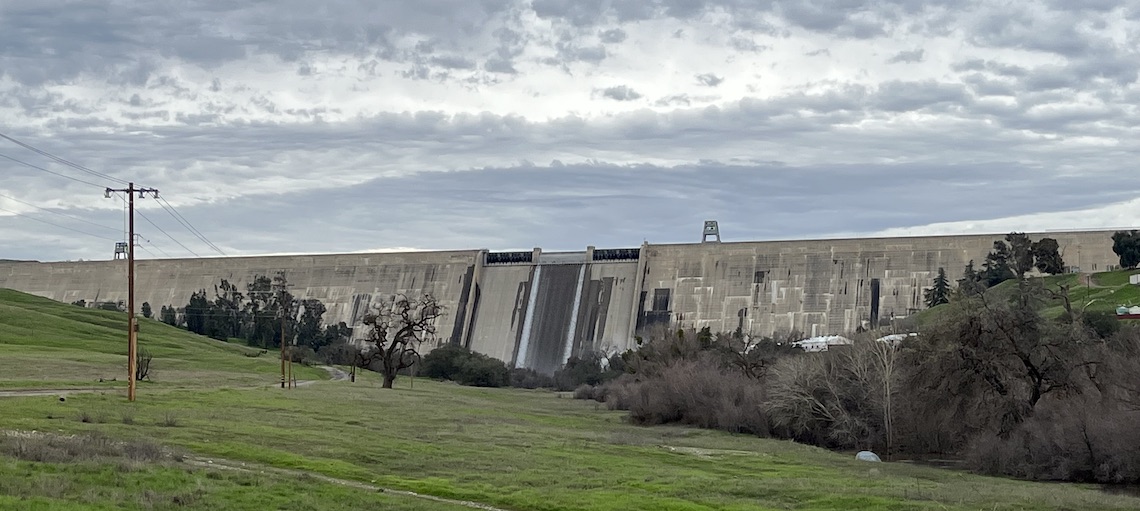
Friant Dam, part of the federally run California Water Project. Photo by Ben Hensley
Local farmers and Valley congressmen pushed back Thursday after the Bureau of Reclamation announced a meager 15% initial water allocation for Westlands Water District and other south-of-Delta Central Valley Project (CVP) irrigation contractors — a figure critics say defies current conditions on the ground.
Westlands General Manager Allison Febbo acknowledged the Trump administration’s stated commitment to water reliability while making clear the number falls short. “A 15% water supply allocation does not reflect current hydrologic conditions and falls well short of what is needed to sustain the District’s nearly 700 family-owned farms that feed the world,” Febbo said, pointing to recent storms, improved snowpack and increased reservoir storage as evidence the allocation should be higher.
The response from Capitol Hill was sharper. Reps. Jim Costa (CA-21) and Adam Gray (CA-13) — both Democrats facing midterm races in swing districts that cut through the heart of the Valley — issued a joint statement that took direct aim at the White House. “The President claimed he could deliver more water and yet that pledge rings hollow today,” the congressmen said. “The Trump Administration’s allocations are offensive to the farmers of the San Joaquin Valley.”
The Bureau of Reclamation cited a dry and warm January that significantly reduced Sierra Nevada snow accumulation, with statewide snowpack sitting at roughly 59% of the historical average, as justification for the conservative opening number. Reservoir storage, however, remains above average thanks to recent wet years, and federal officials noted that operational changes driven by executive order have already delivered more than 200,000 additional acre-feet to CVP contractors this cycle.
Acting Regional Director Adam Nickels said the agency is watching closely. “As we receive and analyze updated data from these storms, particularly snowpack and runoff forecasts, we are hopeful conditions may improve,” he said, leaving the door open to revised allocations as the spring runoff season develops.