
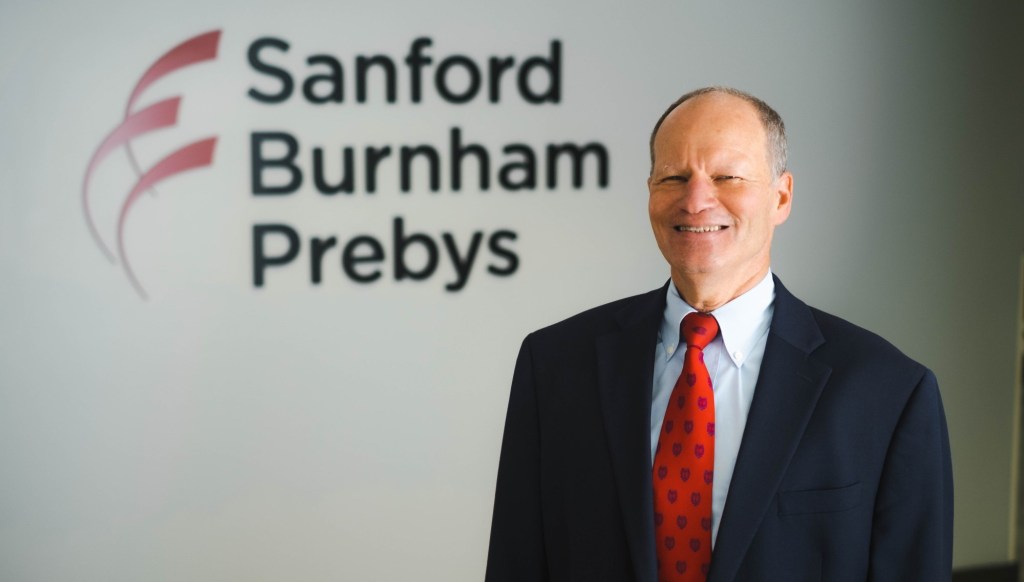
La Jolla-based medical research institute Sanford Burnham Prebys, founded on the principle of collaboration across multiple fields, is celebrating its 50th anniversary this year.
“The institute was founded to develop new ways of doing cancer research,” said Dr. David Brenner, the current president and chief executive. “The founders felt the medical schools weren’t collaborative and discouraged collaboration. So they moved to La Jolla and started it 50 years ago. For the first few years it was a cancer research institute. Over time, as it grew, it went into other areas.”
Now there are four “disease-focused” centers, Brenner said: the Cancer Center, Center for Cardiovascular and Muscular Diseases, Center for Neurologic Diseases and Center for Metabolic and Liver Diseases.
The centers work alongside two “enabling technology” centers: the Center for Therapeutics Discovery and Center for Data Science and Artificial Intelligence.
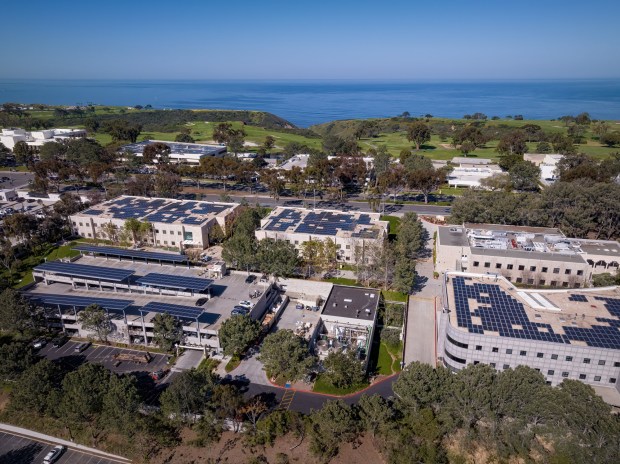 The Sanford Burnham Prebys campus in La Jolla is pictured in 2024. (Nelvin C. Cepeda / The San Diego Union-Tribune)
“We decided on the four [disease centers] because those are areas of extreme medical importance and areas that we have expertise in and things that are fundable,” Brenner said. “We also have themes such as aging. Almost every disease goes up with aging. So getting smart cellular biologists is the answer to make some advances.
“We want to create an environment focused on difficult biomedical problems in a collaborative manner with the most advanced technology.”
The beginning
The institute, originally named the La Jolla Cancer Research Foundation, was founded by William Fishman in 1976 in 500 square feet of converted motel space leased from the Scripps Research Institute on Coast Boulevard.
Two years later, Freddie Deming and Fishman’s wife, Lillian, founded the Group of Friends of the La Jolla Cancer Research Foundation.
“This group of community volunteers led fundraising efforts to help the foundation purchase critical research equipment and support educational programs,” according to the Sanford Burnham Prebys website.
In 1979, the National Cancer Institute awarded the foundation a two-year grant that enabled it to move and expand its facilities onto the Torrey Pines Mesa. The same year, the foundation arranged the donation of 4.7 acres on the mesa, which was being leased to the foundation under a 20-year renewable agreement.
The NCI designated La Jolla Cancer Research as a basic laboratory cancer center in 1981.
Campus evolution
Throughout the 1990s, the campus at 10901 N. Torrey Pines Road expanded its laboratory space and brought in more faculty from diverse fields.
In 1990, the California Foundation for Biochemical Research donated laboratory buildings to the foundation. Subsequent donations more than doubled the lab spaces.
In 1992, Dr. John Reed was named director of the Program on Oncogenes and Tumor Suppressor Genes and Dr. Kristiina Vuori was recruited as a postdoctoral fellow in Reed’s lab.
Four years later, the La Jolla Cancer Research Foundation was renamed The Burnham Institute after San Diego businessman Malin Burnham, who gave a $10 million gift along with an anonymous donor.
In 1999, a large gift from the Del E. Webb Foundation established the Del E. Webb Center for Neuroscience and Aging with the goal “to exploit the scientific synergy between the institute’s NCI-designated Cancer Center and the ways in which the same mechanisms play a role in cancer and neurodegenerative diseases,” according to the institute.
‘A new era’
At the turn of the 21st century, the institute reported it had entered “a new era” of collaboration and exploration of different fields.
In 2001, Reed assumed leadership of the institute as president and CEO.
“Following the passing of the California Stem Cell Research and Cures Act in November 2004, Reed led an effort to create a shared co-laboratory in San Diego focused on stem cell research and regenerative medicine,” according to the institute. “In 2006, the institute would be joined by UC San Diego, the Salk Institute [for Biological Studies] and Scripps [Research] in establishing the San Diego Consortium for Regenerative Medicine.”
In 2008, the consortium was renamed the Sanford Consortium for Regenerative Medicine in recognition of a $30 million donation from philanthropist T. Denny Sanford. The La Jolla Institute for Immunology joined the consortium in 2011.
The Graduate School of Biomedical Sciences was created in 2006 to educate and train new, diverse groups of scientists.
In 2007, the Sanford Children’s Health Research Center was established following a $20 million donation from Sanford.
Two years later, philanthropist Conrad Prebys made a $10 million donation to create the Conrad Prebys Center for Chemical Genomics.
Sanford later donated $50 million, and the institute became the Sanford-Burnham Medical Research Institute in 2010.
Vuori was named president of the institute working under Reed, who implemented a focus on expanding drug discovery efforts. A 10-year strategic vision combined “expertise in human biology with state-of-the-art drug discovery to fuel bench-to-bedside research,” according to the institute.
In 2015, the facility’s name changed again to the Sanford Burnham Prebys Medical Discovery Institute following a $100 million gift from Prebys.
Modern methods
Brenner was brought on as president and CEO in 2022 after more than 15 years as vice chancellor for health sciences at UC San Diego.
“The paradigm is shifting to discoveries in different fields,” Brenner said. “A lot of basic biology is the source of new approaches to diseases. People would start not with a disease target but a cellular process and understanding how those processes affect which diseases. … If we learn something new in biology, we can use it for insights into disease.
“It’s a novel approach. It’s different from most cancer centers and requires a lot of collaboration. It takes a village to put together a project.”
As part of that effort, the institute seeks to “selectively recruit” scientists to study in its four research centers. In 2023, the first six of 20 planned new scientists were recruited.
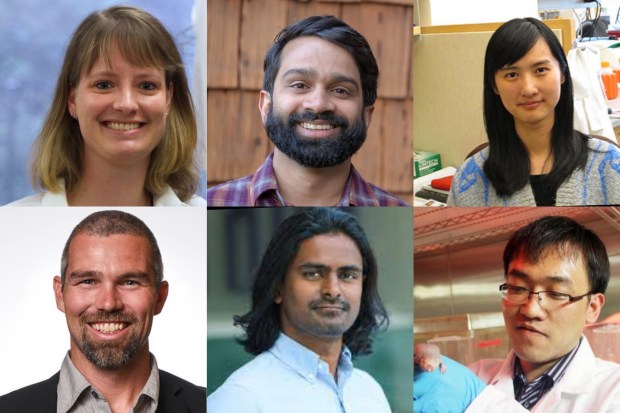 Sanford Burnham Prebys’ newer scientists include (top from left) Kelly Kersten, Sanjeev Ranade and Shengjie Feng, and (bottom from left) Kevin Tharp, Sanju Sinha and Xiao Tian. (File)
“The best thing I can do is create an environment where they can be successful,” Brenner said. “They want to tackle hard problems. This place creates an opportunity to extend your research. … That’s unprecedented. They don’t do that in other medical schools.”
Brenner said he also wants to find ways to make it easier to commercialize drugs and make drug discoveries to get them to patients faster.
Success from the beginning
Researcher Jose Millan has been at Sanford Burnham Prebys through all the changes, having joined at its inception.
Before the institute opened, “I had written to [William] Fishman because I was finishing my biochemistry degree and was interested in research,” Millan recalled. “[Fishman] was at Tufts University at the time, and he accepted me to join him but told me he was moving to La Jolla to create a new institution.”
Millan said he aligned with the goal of gaining information about “the biology of cancer and vice versa” and that he saw it as a theme for the institute.
“Bill didn’t want to restrict investigators with too many meetings or one director that would tell investigators what to do,” Millan said. “He wanted them to be free to do their science, and that has been maintained to this day. We do have a structure, but we are free to collaborate, and bureaucracy has been kept minimal. You can teach if you wish, you can be on committees if you wish or allocate most of your time to research.”
Millan said he has worked at the institute for so long because of that freedom. He joined as a student and stayed for three years, departing briefly to get his Ph.D. in Sweden. When he returned, he made some groundbreaking discoveries.
Among them was a treatment option for infantile hypophosphatasia, a rare form of rickets that makes children’s bones dangerously fragile. Having been involved in early studies to develop an enzyme replacement therapy that is aiding children, he is now involved in developing alternatives for adults.
Millan said he has been inspired by colleagues and the discoveries they’ve made in their fields.
With those discoveries in mind, Brenner is compiling a list of the institute’s top 50 achievements over the past 50 years. Millan’s work on infantile hypophosphatasia is on the list. Others include:
• The prostate-specific antigen (PSA) test, which is considered the global standard for screening and monitoring prostate cancer
• A mechanism for killing cancer cells called apoptosis, which is used in many anti-cancer drugs
• Identification of a “navigational” protein complex that helps recycle proteins in the brain. When that system fails, toxic amyloid-beta plaques (the hallmark of Alzheimer’s disease) are more likely to form.
• A drug to treat T-cell lymphoma
“We’ve reached 50 years now, and hopefully the institute will grow and be significant in the next 50 years,” Millan said. “For me, this is the place I call home and where I love to work. I am part of the history of this place, so I hope we continue to have a bright future.” ♦