
California‘s housing crisis is forcing communities to get creative when it comes to helping their residents.
Thousands of San Francisco Bay Area residents are living in RVs because a full-time paycheck no longer covers a one-bedroom apartment. Where to safely and legally park these RVs is another challenge.
“The Bay Area is one of the least affordable parts of the country, with rents and home prices significantly higher than what everyday families can afford,” says Joel Berner, senior economist at Realtor.com®. “The median rent in the San Francisco metro is $2,785. In the San Jose metro, it’s a whopping $3,319, and the national level is just $1,672 for comparison.”
Berner says that even though incomes tend to be stronger in the Bay Area, “housing costs are so high that some residents are forced to live with family or roommates, commute long distances from more affordable locales, or even turn to alternative housing options like RVs.”
In December, Palo Alto passed ordinances prohibiting detached trailers from parking on public streets and banning “vanlording”—or the renting out of RVs.
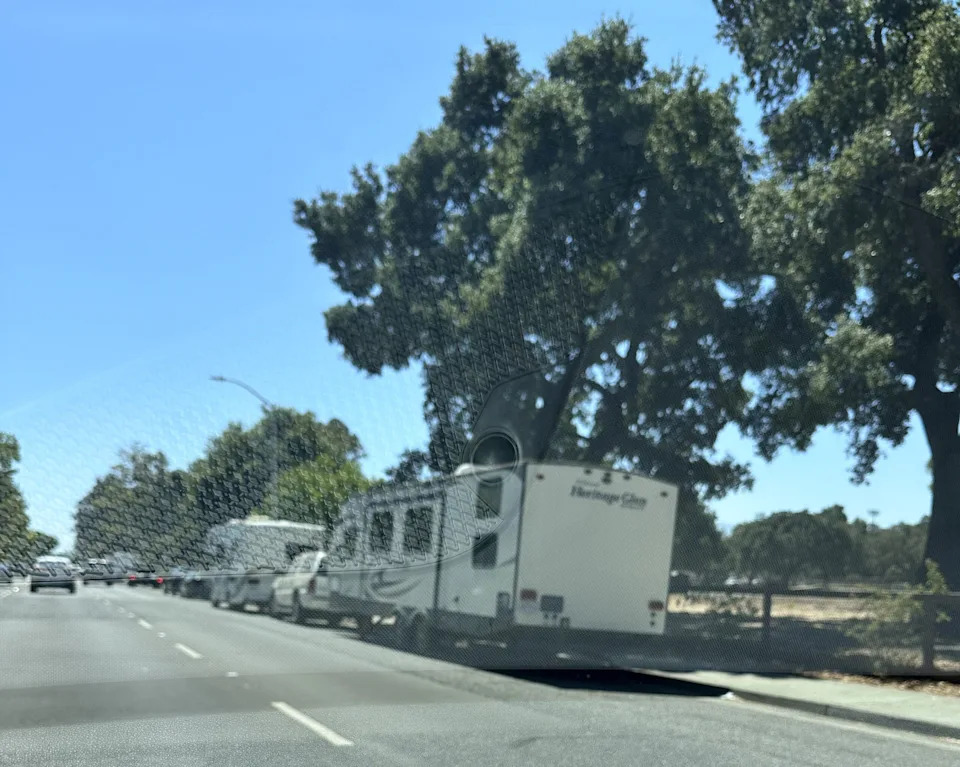
RVs can be seen parked next to Stanford University along El Camino Real in Palo Alto, CA. (Joy Dumandan for Realtor.com®)
The city of Palo Alto is exceptionally expensive, with a median listing price of $2,641,500. Just 13.3% of homes for sale were priced below $1 million in January. Inventory remains tight in Palo Alto, and it is growing more slowly, at 6.5% year over year.
“Palo Alto is likely trying to maintain these very home values by banning trailer parking, but they are effectively keeping middle-class Californians out of the city,” says Berner.
Palo Alto resident Kate Bridget Li told the San Jose Spotlight that she previously rented out a half-dozen RVs in Palo Alto for $800 to $1,200 per month, and lives in an RV herself because she is unable to afford rent.
“This whole RV community feels like a family,” Li told the outlet. “There are a lot of nice people, a lot of talented people, that just need a little bit of help. A lot of them come from unfortunate backgrounds and not a warm and loving home that a lot of the fortunate people living in this area have.”
Julie Lythcott-Haims, a member of the Palo Alto City Council who sits on the ad hoc committee that is addressing the impact of oversized vehicles (OSVs) on city streets and the needs of vehicle dwellers, tells Realtor.com, “The city has heard from residents and business owners who are increasingly frustrated by the impacts of OSVs and encourage us to ban them, as other cities have. We understand and appreciate those concerns, which revolve mostly around traffic safety, garbage, and sanitation.”
However, she says, “Most of the OSV dwellers I know are employed, pay taxes, and contribute in other ways to the functioning of our society. Yet their wages aren’t enough to cover even a spot in an RV park, which goes for a minimum of about $1,700 a month around here, let alone an apartment.”
Lythcott-Haims voted “no” on the city ordinances prohibiting public RV parking and RV “vanlords.”
“When wages for full-time work aren’t sufficient to pay for shelter, that’s a macroeconomic failure at the regional and societal level, not the fault of the individual,” says Lythcott-Haims. “It’s high time we accepted that this is the state of things, and build more housing, and in the meantime stop criminalizing people who have no better option than to live in a vehicle.”
Two safe parking sites in San Jose
“The correlation between housing costs and rates of homelessness is stronger than any other driver of homelessness,” Adrian Covert, senior vice president of public policy at the Bay Area Council, tells Realtor.com.
In the city of San Jose, the median listing price is $988,000—over double the national median.
“It remains a huge challenge for San Jose residents to become homeowners,” says Berner.
“California’s lack of shelters leaves people with few places to go,” Covert adds. “The majority wind up in tents on the streets, but some end up in RVs.”
Although San Jose has temporarily banned RVs in designated areas, it also operates two safe parking sites with a combined 128 RV spaces.
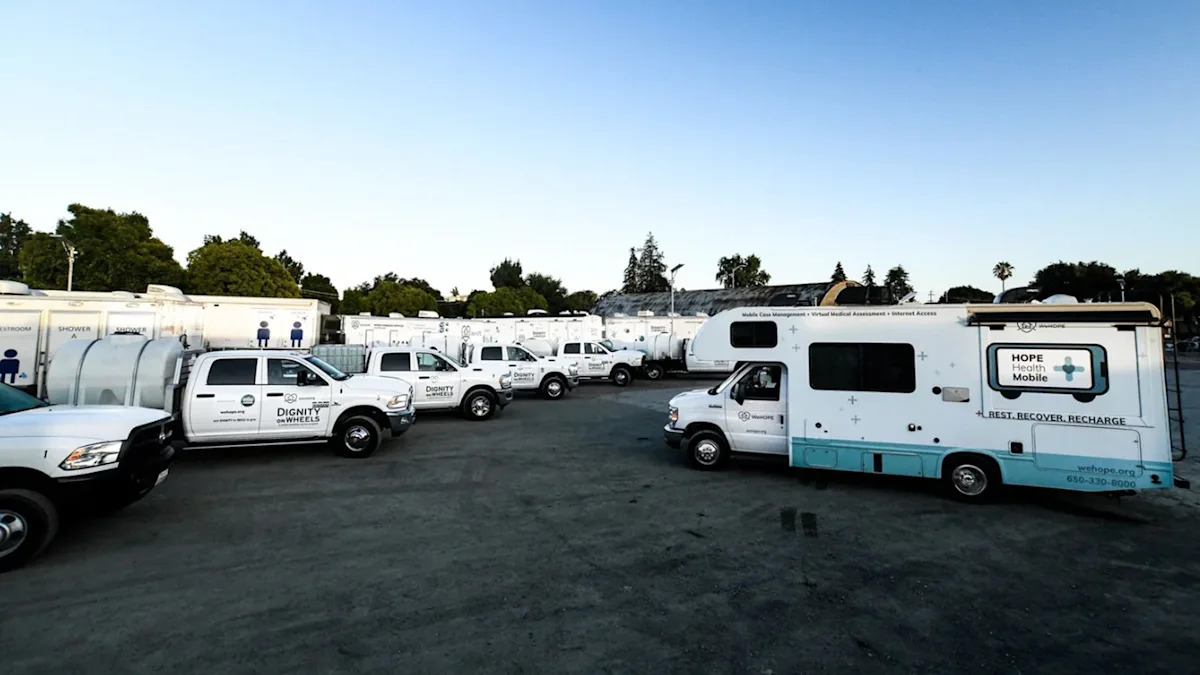
The 6-acre Berryessa Safe Parking Site opened in 2025 and is funded by the city and run by WeHOPE, a nonprofit homelessness organization.
“This program provides critical support for individuals experiencing vehicular homelessness, offering them an opportunity to regain stability,” Whitney Prather, marketing and communications director for WeHOPE, tells Realtor.com. “The safe parking environment helps residents save money and make necessary arrangements while they work toward more permanent housing solutions.”
Prather says the lot, which has a full waiting list, offers comprehensive resident support, including free parking with on-site security, two daily meals, showers, laundry facilities, a community garden, and a dog park.
According to San Jose officials, the site will cost the city $24 million over five years.
District 4 Councilmember David Cohen, who represents the area, told the San Jose Spotlight that the safe parking sites “provide a safe, secure place for our unhoused neighbors to park while connecting them with vital services.”
Meanwhile, in Palo Alto, Lythcott-Haims says the ad hoc committee she serves on has proposed a pilot permit program that would allow a limited number of OSV residents to park in designated areas of the city.
In return, participants would receive trash and sewage services and agree to be a “good neighbor” while actively working toward securing permanent housing.
“We got feedback from the public and our Council colleagues, and we will continue to refine that concept further with staff,” she says.
Tackling the homelessness problem, one RV at a time
About 24% of people experiencing homelessness nationwide reside in California, a recent study reports.
“Californians are more likely to become homeless than are Americans in all but four other states,” says Covert. “After becoming homeless, Californians are more likely to end up on the streets than any other state.”
California’s lack of shelters leaves people with few places to go, he adds. “The majority wind up in tents on the streets, but some end up in RVs.”
“We know that many, if not most, OSV dwellers are unable to afford shelter due to the lack of affordable housing in our region, and most are not ‘bad actors,'” Lythcott-Haims says.
Covert believes cities should prioritize scaling up inventories of emergency shelter and interim housing, including sanctioned RV parks with proper utility connections.
Cities should also consider creating RV buyback programs to purchase RVs from people who accept referrals to housing, he adds.
When it comes to how local governments in California treat RV parks, Covert says, “We’ve seen a diversity of approaches, depending on the city. There is no one-size-fits-all approach.”