
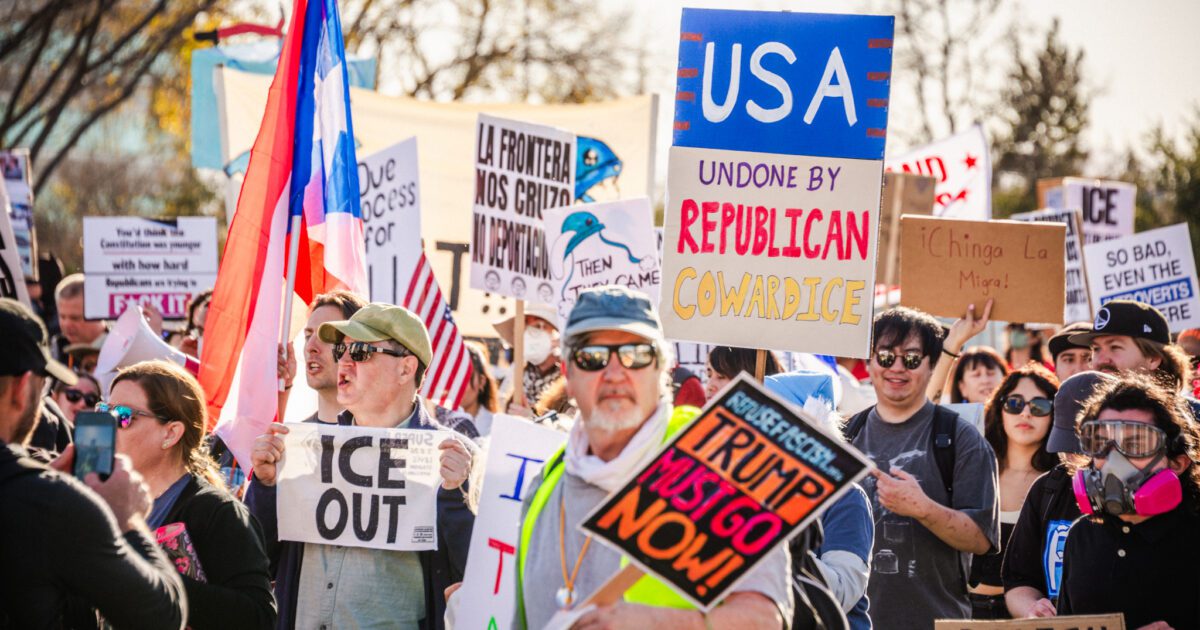
State and federal lawmakers from Silicon Valley are gearing up to push back against immigration enforcement in their home districts and beyond.
Several Bay Area lawmakers have introduced legislation this year to tamp down on U.S. Immigration and Customs Enforcement (ICE) by imposing more taxes on immigrant detention centers, enforcing more oversight and ensuring people can sue federal agents for monetary damages.
Assemblymember Alex Lee, who represents parts of San Jose, Milpitas, Fremont, Newark and Sunol, has put forth Assembly Bill 1675 to ensure ICE contractors like private prisons do not get tax breaks. The bill was introduced this month.
“I believe in a time like this, when ICE is killing American citizens in broad daylight, kidnapping young children and breaking into homes, I think it’s important that we get companies to make the right choice,” Lee told San José Spotlight. “This is a financial leverage to get them to do so.”
Last month, ICE agents killed two American citizens in Minneapolis while they were observing ICE activity. ICE has conducted large-scale operations in cities such as Los Angeles and San Francisco since President Donald Trump took office last year.
While mass enforcement actions like the federal deployment in Minneapolis haven’t occurred in Santa Clara County, the region is already one of the most impacted areas for targeted ICE operations, according to Huy Tran, executive director of Services, Immigrant Rights and Education Network (SIREN).The organization is part of the Rapid Response Network, a group of volunteers that documents ICE activity, sends alerts to the community and provides free emergency legal support for immigrants.
Tran previously said the network’s hotline gets more than 120 calls on some days. Fears of ICE have kept San Jose students from attending class and slowed foot traffic at Latino-owned businesses. Some undocumented residents have chosen to self-deport.
Corporations in California, which include ICE contractors, are getting about $40 billion in tax breaks subsidized by taxpayers, according to data provided by Lee’s office. In addition to private prisons, industries profiting from ICE contracts include software companies, armed security services and transportation companies, among others.
“We’re hoping that corporations would end all complicity with ICE and stop supplying the paramilitary force that is ICE,” Lee said. “So if it is all gone, they are going to be vastly inhibited from doing their campaign of terror.”
At the federal level,Congressmember Ro Khanna, has put forth a 10-point plan to place more guardrails on ICE. Khanna’s district covers North San Jose, Cupertino, Santa Clara, Sunnyvale, Milpitas and parts of Alameda County.
His “End ICE Abuse” bill, or H.R. 1030, entails stripping ICE of its funding, initiating impeachment hearings against U.S. Attorney General Pam Bondi and Department of Homeland Security Secretary Kristi Noem, ensuring immigrant detention centers are humane by having independent inspections, medical care and reporting requirements and more. The bill has just been introduced and will be heard by the House Judiciary Committee at a later date.
“I will not authorize an additional dollar for ICE,” Khanna said in a statement.
Pomaikai Neil, a nurse at Kaiser Permanente in Santa Clara and a member of California Nurses Association, supports Khanna’s plan.
“Those funds that are allocated to ICE and (U.S. Customs and Border Protection), the $75 billion that is being spent on militarizing our communities, should be spent on Medicaid, Medicare, food insecurity, education,” Neil told San José Spotlight. “It should be put toward supporting the infrastructure of our communities.”
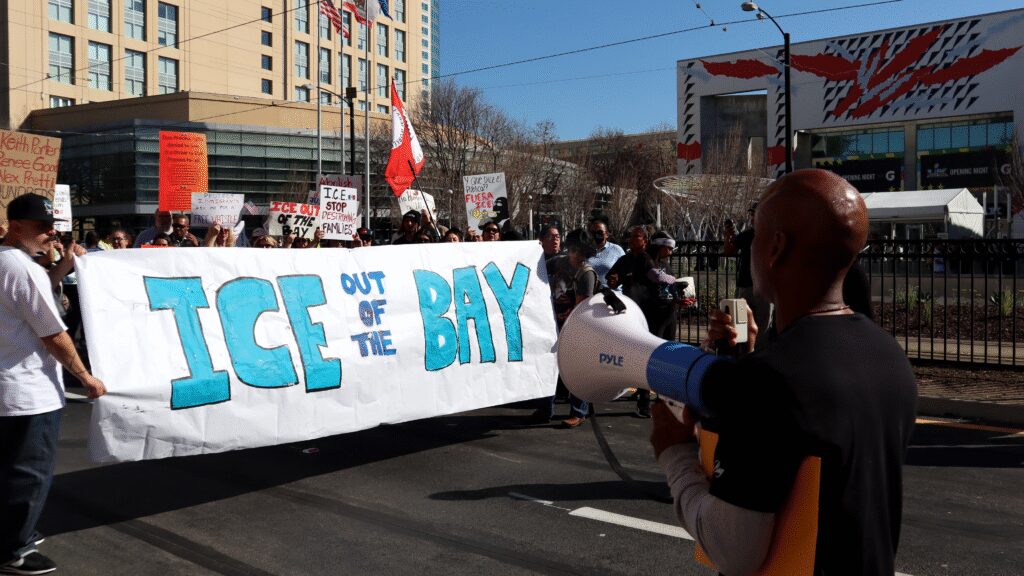 Protesters rallied in downtown San Jose on Feb. 2, 2026. File photo.
At a recent news conference, Khanna pledged to refuse future donations from software company Palantir Technologies, which has contracted with ICE to create a platform to track and target immigrants. Khanna accepted nearly $50,000 in campaign contributions from Palantir since 2011, including nearly $7,000 last year, according to a website tracking donations. Khanna said he will donate the money to organizations advocating for immigrants.
“Ro (Khanna) is the first Bay Area member to take the pledge to refuse all future individual contributions from Palantir,” Khanna’s spokesperson Sarah Drory told San José Spotlight.
State Sen. Scott Wiener of San Francisco has introduced Senate Bill 747, the “No Kings Act,” which will allow people to sue ICE for monetary damages, including for First Amendment rights violations. The bill has passed the Senate floor and is making its way through the Assembly.
He also proposed Senate Bill 627, the “No Secret Police Act” to require federal agents to unmask and co-authored Senate Bill 805, the “No Vigilantes Act” to require law enforcement to wear badges. Although Gov. Gavin Newsom signed those policies into law in September, they are held up in federal court.

Earlier this month, the San Jose City Council voted in support of Assembly Bill 1633, introduced by San Francisco Assemblymember Matt Haney. The policy seeks to levy a 50% tax on profits gained by private companies operating immigration detention centers. A new detention facility opened in Kern County last fall, run by private prison operator CoreCivic. The 2,560-bed facility is the largest ICE detention center in California.
“If a detention model relies on extracting profit from incarceration, it should not also benefit from taxpayer incentives,” Miriam Arif, spokesperson for SIREN, told San José Spotlight. “These legislative efforts signal that our region is serious about aligning fiscal policy with our values and about ensuring that immigrant communities are treated with fairness, transparency, and respect.”
Contact Joyce Chu at [email protected] or @joyce_speaks on X.