
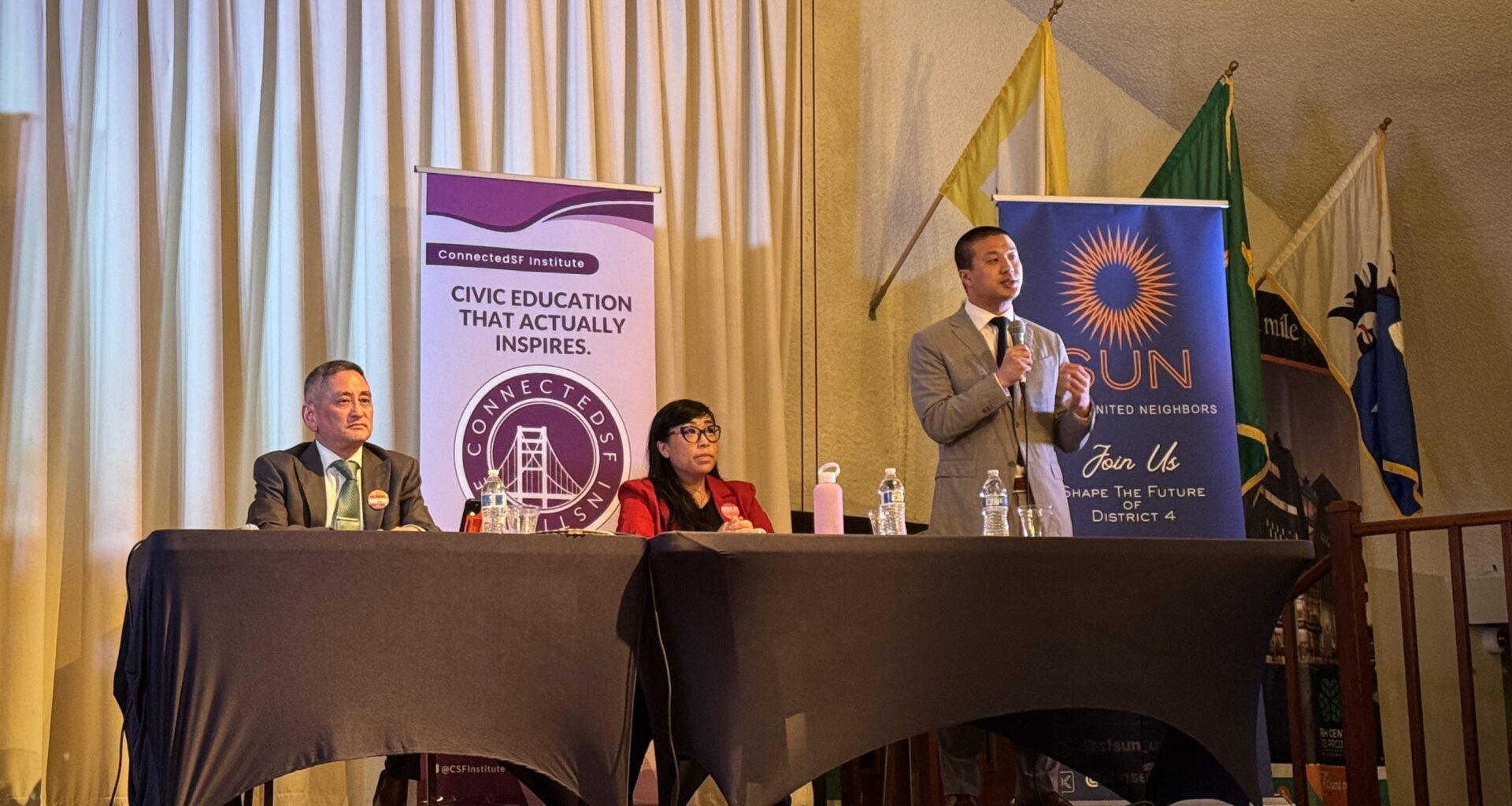
Everyone knew the question was coming: How would you have handled the closure of the Great Highway?
It was an inevitable query for the moderator at last night’s District 4 forum to pose, considering district residents handily recalled their former supervisor, Joel Engardio, over his active promotion of closing the coastal road to create the Sunset Dunes park. The winner of June’s special election will fill out his term.
But all three candidates at Thursday’s debate have the same position on the Great Highway: They want it back open to cars.
Yet, the forum at the United Irish Cultural Center became heated as Supervisor Alan Wong, who led an effort for a ballot measure to bring cars back to the Great Highway but failed to secure enough signatures from his colleagues, blamed rival Natalie Gee for kneecapping him. District 10 Supervisor Shamann Walton, Gee’s boss, was one of eight supervisors who did not sign on.
“Natalie Gee and her boss sabotaged my legislation through their own political ambitions,” Wong said on Thursday night. “Do we have to bend our knees and kiss the ring in order to get you to support something that you already publicly claim to support?”
In a rebuttal, Gee countered Wong’s account, saying Wong never talked to Walton in person about the legislation, even though their offices are across the hall from each other. “So instead of blaming it on me, make sure you take accountability for things you didn’t do.”
Wong, raising his voice, reiterated that he called Walton on the phone and that the eight-page legislation was simple to understand. “Clearly, somebody’s not listening to the neighborhood and supporting the reopening of the Great Highway.”
Albert Chow, another candidate, who is a hardware store owner and organizer of the Joel Engardio recall, was also given an opportunity to weigh in. After a pause, he blurted out “I’m good,” breaking the tension in the room. The crowd laughed. Gee gave Chow a fist bump.
Some 60 people, mostly familiar faces involved in Sunset politics, gathered for the first public District 4 candidate forum, hosted by the public pressure group ConnectedSF and Sunset United Neighbors. It was moderated by Tara Moriarty, a spokesperson for the sheriff’s department and former KTVU reporter.
The 80-minute forum only featured three out of five candidates who filed to run — David Lee and Jeremy Greco were not invited. The organizers pointed to the time limit and a survey sent out to their members, which indicated that less than 2 percent of them were interested to hear more about Lee and Greco.
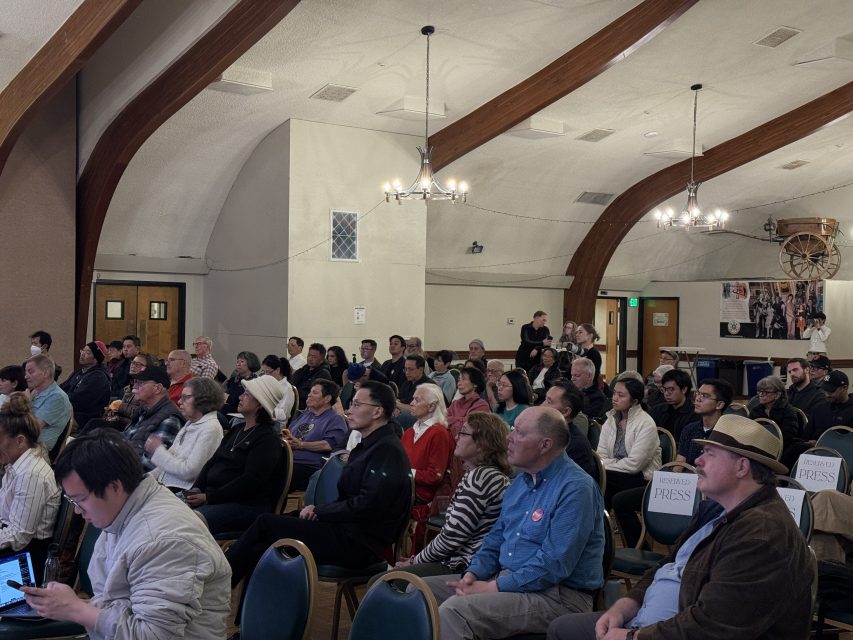 Some 60 people gather at the United Irish Cultural Center for the first public District 4 candidates forum on Feb. 26, 2026. Photo by Junyao Yang.
Another inevitable topic of discussion was the city’s upzoning plan, a key issue during the recall of Engardio and during Mayor Daniel Lurie’s lengthy appointment process to name Engardio’s successors, plural.
Gee and Chow both opposed the upzoning plan, and said during Lurie’s appointment process, they made clear that they would vote no on it.
But Wong voted for it, and Gee took a jab at the new supervisor: “I’m not going to get appointed to something and vote yes on that the second day.”
Wong, who voted for the plan a day after he was appointed by Lurie, said he understood neighbors who want to be in a “safe and quiet neighborhood” with lower density. But he supported the plan because “that is a pragmatic and responsible approach to maintain local control,” echoing Lurie’s pitch for the upzoning plan.
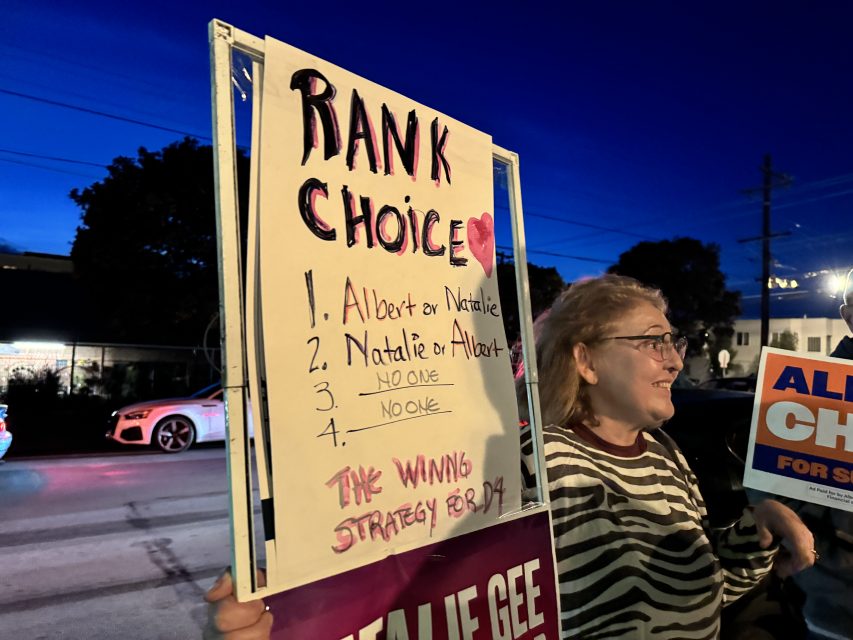 Heather Davis holds a handmade sign showing her preferred ranked-choice voting strategy for the District 4 race on Feb. 26, 2026. Photo by Junyao Yang.
For Heather Davis, a lead volunteer of the Engardio recall, who strongly opposes the upzoning plan, this made all the difference.
Twenty minutes before the forum, Davis held a hand-made sign reading “rank choice” outside the venue.
No. 1 choice, Albert or Natalie.
No. 2 choice, Natalie or Albert.
No. 3 and No. 4, no one.
While campaigns say there is no ranked-choice alliance formed just yet, Chow and Gee’s campaign staffers and supporters were friendly, gathering outside the venue minutes before the event, taking pictures for each other and at times with each other, signs mixed.
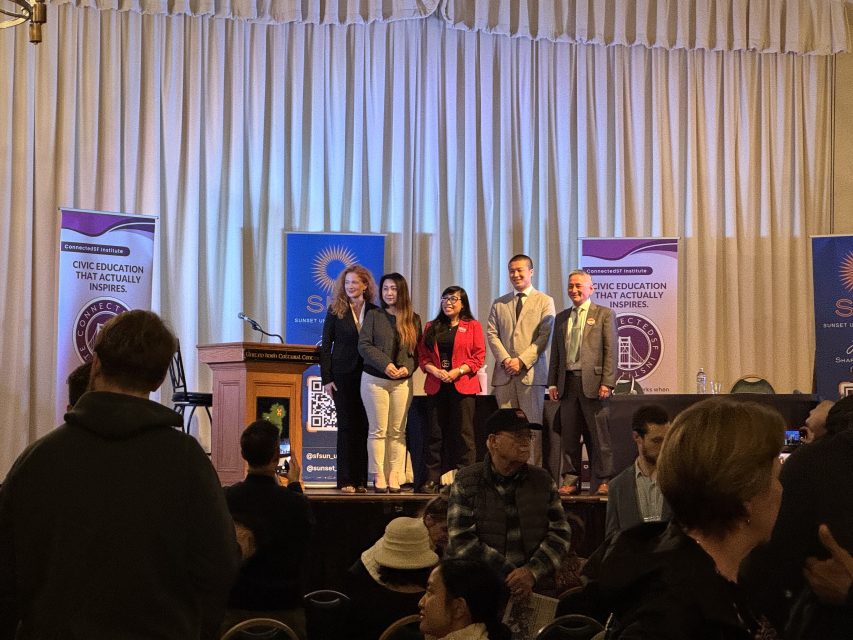 District 4 candidates pose for a group photo, next to leader of the Sunset United Neighbors Selena Chu and moderator Tara Moriarty after the forum on Feb. 26, 2026. Photo by Junyao Yang.
Candidates also discussed other topics, like transit — both Chow and Wong support bringing cars back on Market Street — waste and fraud in government, and the city’s budget crisis.
Facing a two-year budget deficit of nearly $1 billion, Moriarty asked, what services will they cut and what will they keep?
All said they would consolidate duplicate or unnecessary services and contracts.
Gee said the city should make sure the city doesn’t outsource services, but keep work within the city employees as much as possible, a demand that labor unions such as SEIU 1021 — a Gee backer — have advocated in recent years.
Gee also said the city needs to fully staff the police department, so that it doesn’t need to pay tens of millions in police overtime. Gee was on thin ice with the San Francisco police union, which wrote a letter to Lurie in November against appointing Gee as the District 4 supervisor, citing her 2024 questionnaire response supporting weakening the police union.
The police union has endorsed Wong (who in 2020 wrote in a questionnaire that he supported reducing the SFPD budget by 25 percent).
The controllers office should conduct reviews and set benchmarks to cut out ineffective programs, Wong said. He would also cut executive management positions — managers who “make twice the rate of frontline workers,” — as well as “eliminate inherent corruption in the bureaucracy.”
Both Chow and Wong believe the city can balance its budget without new taxes, while Gee disagreed — although all three candidates support the CEO tax ballot measure in June.