
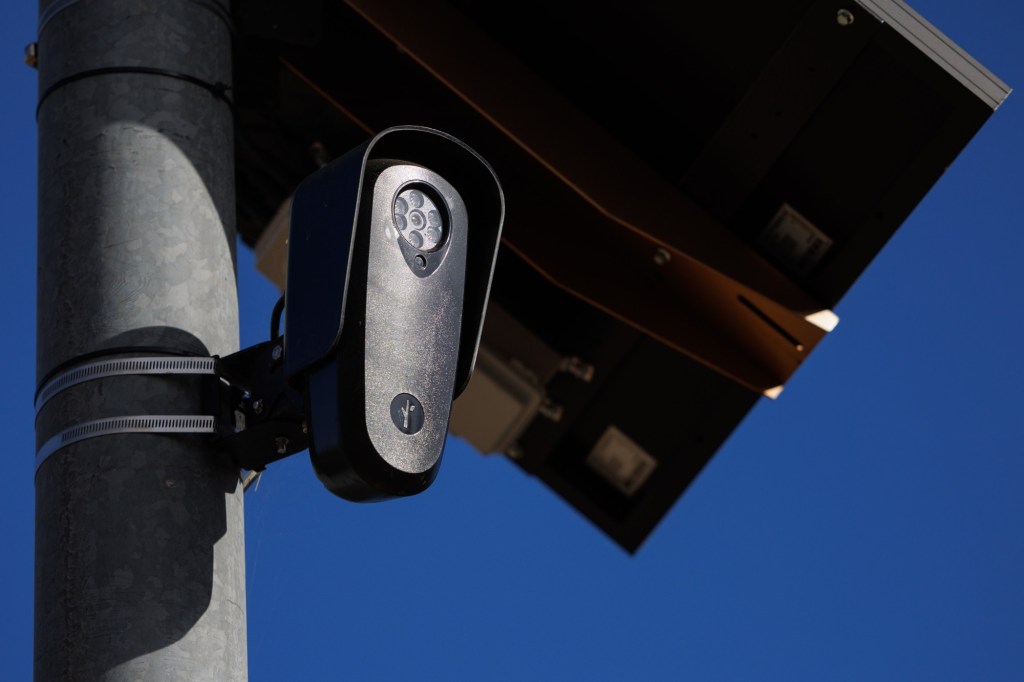
SAN JOSE — Amid blowback to the spread of automated license-plate readers surveilling Bay Area cities and fears about such technology enabling more immigration enforcement, the San Jose Police Department is reining in its data retention and access for outside agencies.
The move by the region’s most populous city was one of several taken by municipalities and agencies in the past week, an acceleration of growing concerns in recent months over privacy and federal use of data and photos.
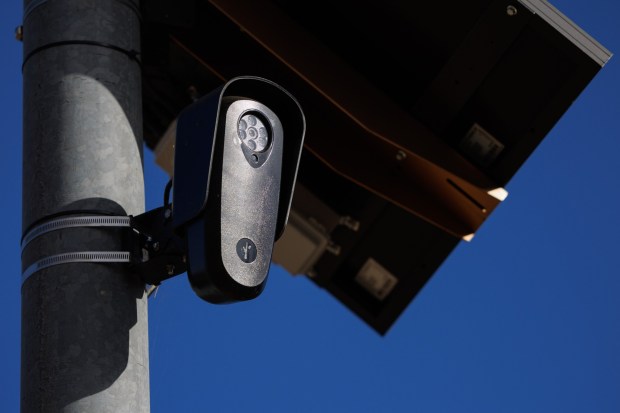 A license plate reader on Santa Teresa Boulevard is seen in Morgan Hill, California, on Oct.10, 2023. Neighboring San Jose has 474 such cameras installed throughout the city, and SJPD has proposed reining in retention and outside access policies as controversy has swirled around the surveillance tech elsewhere in the Bay Area. (Dai Sugano/Bay Area News Group)
In a policy memo released Thursday, San Jose Police Chief Paul Joseph asked the City Council to shrink the retention period for plate data from one year to 30 days, and ban cameras from recording vehicles entering and leaving houses of worship and reproductive health clinics.
Joseph also wrote that his department is requiring more information from outside agencies seeking plate data, with the aim of preventing inadvertent cooperation with agencies from out of state, which are not subject to California law. California’s sanctuary law prohibits local police from participating in immigration-related actions, but federal officials have been trying to find ways around the law amid President Trump’s mass deportations.
In an interview Thursday, Joseph said the revisions are aimed at preserving the utility of the city’s 474 Flock Safety automatic license-plate reader (ALPR) cameras as a force multiplier for a thinly staffed police department, while addressing privacy objections that have prompted other municipalities to disable or ditch the technology.
“We have to have the tools that are available to law enforcement these days to make us as effective and efficient as we could possibly be,” he said, “while at the same time acknowledging that there are legitimate concerns about privacy, and legitimate concerns about misuse of the data.
“The ALPR cameras are the linchpin of everything we’re trying to do with technology here at San Jose PD,” Joseph said. “To lose these cameras would just be so devastating to our public safety.”
The changes outlined in the memo — set to be heard by the council March 10 — require California police to provide detailed reasoning for their data requests; agencies that don’t already have data access must get approval from a police commander. Joseph also says SJPD has disabled a “Federal Sharing” setting in the police data portal to block requests from federal agencies.
In November, the Electronic Frontier Foundation and ACLU of Northern California, representing the immigrant-rights organization SIREN and the Bay Area chapter of the Council on American–Islamic Relations, sued the City of San Jose, Joseph and Mayor Matt Mahan, arguing that continuous searches through the data without judicial warrants violated the California Constitution.
EFF Surveillance Litigation Director Andrew Crocker called the SJPD policy revisions “extremely limited reforms that fall far short of what is necessary.
“By holding on to ALPR data for a full month, San Jose still possesses detailed files about anyone who drives in the city, revealing their patterns of travel, who they associate with and much more,” Crocker told this news organization. “San Jose Police and (their) sharing partners can still search this data indiscriminately without any proof that the results are connected to an actual crime.”
An array of cities in the greater Bay Area have grappled with concerns over the cameras, attempting to balance touted public safety benefits with the surveillance-state threat the cameras pose.
On Tuesday, the Mountain View City Council voted to end its contract with Flock Safety, a major vendor of the plate readers, after the police chief said that federal agencies had unauthorized access to a city camera in 2024, owing to a “nationwide” search setting enabled by Flock.
Santa Cruz leaders voted last month to stop using the cameras under similar circumstances after their police department revealed camera data was accessed by out-of-state agencies. Richmond did the same in December.
Santa Clara County supervisors voted this week to prohibit the sheriff’s office — which carries out policing contracts in Cupertino and Saratoga — from pulling data from the Flock cameras. El Cerrito police acknowledged that ALPR data was errantly made available to federal agencies, but said they have since instituted “safeguards” to prevent unauthorized access.
The pendulum didn’t swing quite as hard in other Bay Area cities, including in Oakland, which last December approved a two-year, $2.25 million Flock contract. The Oakland chapter of the NAACP supported the cameras as a useful crime-fighting tool, pitting them against privacy advocates who initially convinced city leaders to reject the contract.
 San Jose Police Chief Paul Joseph, talks during an interview in his office on Tuesday, Oct. 22, 2024, in San Jose, Calif. Joseph has recently instituted and proposed changes to data retention and outside access regarding the city’s 474 automated license plate reader cameras, in part to address privacy concerns about the rapidly growing use of the surveillance technology. (Dai Sugano/Bay Area News Group)
In San Jose, the cameras are frequently lauded by Joseph and Mayor Matt Mahan for their roles in solving crimes, particularly homicides. Joseph cited several high-profile cases in which he said ALPR cameras led to relatively swift arrests, including a teen charged with shooting three people at Westfield Valley Fair mall on last year’s Black Friday, a registered sex offender in the January abduction of a teen girl downtown, and two men in the fatal shooting of a 17-year-old boy earlier this month.
Flock Safety contends that its technology can maintain both public safety and civil liberties with robust policies and oversight, and limits on data access.
“We respect that Bay Area communities are having thoughtful conversations about public safety, privacy, and the role of technology,” Flock spokesperson Paris Lewbel said in a statement. “Ultimately, decisions about deployment and policy should be made locally, with public input.”
In addition to the civil-rights lawsuit, research conducted for this news organization by a security analyst who requested anonymity out of fear of professional retaliation indicates that as recently as June 2025, San Jose police fulfilled plate data searches requested by other California agencies in instances the analyst described as tied to federal authorities, including inquiries related to ICE protests. Civil rights advocates have argued such “side-door” searches could conflict with state laws and First Amendment protections.
The police department and city maintain that despite the appearance of terms like “DEA,” “ICE” and “HSI” — the abbreviations for the federal Drug Enforcement Agency, Immigration and Customs Enforcement and Homeland Security Investigations — in searches by external agencies, they found no evidence any data was used for immigration enforcement.
“I think when you take a sober look at what’s going on, you’re going to see that our data has not ever fallen into the hands of anyone that’s used it for immigration purposes,” Joseph said.
The chief said the polarizing nature of the technology is why he has requested that the council review and codify his proposals, both to ensure their longevity and to allow for public discussion of the merits.
“We want to assure you that we’re putting even greater safeguards in place so that you, the community, and you, the elected officials, can feel confident in this program.”
Nick Hidalgo, a senior staff attorney at the ACLU of Northern California, reiterated the crux of their lawsuit in saying anything short of a warrant requirement is insufficient.
“ALPR systems threaten our civil rights when they indiscriminately collect and stockpile our location information, creating the risk that law enforcement or surveillance vendors like Flock will misuse or illegally share this personal information,” he said in a statement. “They must require their officers to obtain a warrant before searching through ALPR databases, but an even better solution is to shut off the cameras entirely.”
Bay Area communities and license-plate readers
A number of local agencies have used automatic license-plate readers. Some have praised the devices’ role in investigations, while others have faced pushback.
San Jose: Police announced they are limiting camera placement, reducing how long photos are retained and seeking more information from outside agencies requesting access.
Mountain View and Santa Cruz: Leaders voted to end their cities’ contracts with Flock Safety, a major vendor of the readers.
Santa Clara County: Supervisors will not allow the sheriff’s office to pull data from license-plate readers in Cupertino and Saratoga, where the county provides policing services.
Oakland: City leaders voted down a $2 million contract with Flock in November, then approved a modified contract in December.
El Cerrito: Police said some data was accessed by federal authorities in 2023 before a Flock software change.
Richmond: Police suspended use of the system in December after noting similar misuse.