
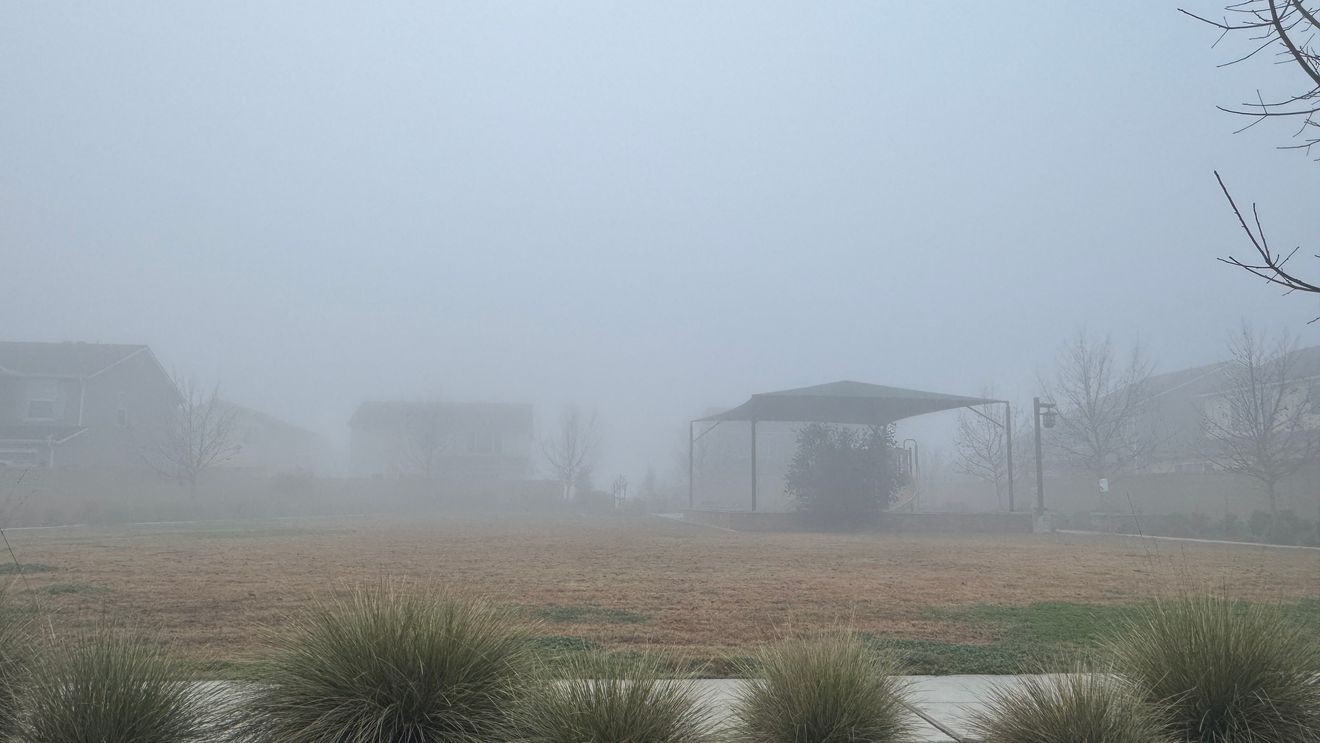
Foguary could finish hot.
In the past 140+ years of record keeping, Fresno has reached 80 degrees only 13 times before in February. Saturday could be the 14th.
That’s after a mild morning in the Valley that could feature dense fog as well! There’s a Dense Fog Advisory for the southern half of the Valley until 10 a.m., including Fresno, Kings, Tulare, and Kern counties. Any fog that forms should burn off quickly, and the rest of our day will see mostly sunny skies.
Fog in the morning, and afternoon temperatures approaching 80 reminds me of a late summer day in Santa Barbara!
We are approaching the beginning of Spring, but it’s still too early for this kind of warmth to happen consistently. We’ll cool back down to near normal temperatures next week, which will be in the 60’s. And with no rain in sight, it looks like this March will come in like a lamb, not a lion.
Fog IS still possible in March, although it’s not very common. We average only 1 day of dense fog in March, so we’re not going to add much (if anything) to our total of 40 days of dense fog for the season. Still… that’s a lot! Since the early 1990’s, we’ve been averaging only 24 days of dense fog per season in Fresno. Compare that to what we used to see in the 1960’s, 70’s, and 80’s: 40 days! So, 50 years ago, fog like we saw this winter was typical, not unusual!
Dense fog days in Fresno have dropped 40% in the past 30 years, going from an average of 40 per year to only 24 (this year notwithstanding). Dense fog days in Bakersfield have dropped 33%, going from an average of 24 to only 15 now. Why?
It’s not from just one reason alone, but a combination of reasons. The first is agriculture. Back in the 1960s and 70s, row crops (like tomatoes or cotton) ruled the San Joaquin Valley. Times have changed since then, and orchard acreage in the Valley of almonds, pistachios, and walnuts have soared, growing from around 200,000 acres grown in the 1970s to over 1,700,000 acres now.
Forming dense fog requires two main ingredients: long, clear, cool nights, and plenty of moisture. After row crops are harvested in the fall, the fields often sit fallow through the winter. The tilled soil absorbs rain easily, which evaporates on a sunny winter afternoon, loading the atmosphere up with moisture to form fog later that night. However, many times the soil of an orchard is more hard packed by harvesting and other farm equipment, making it harder for rain to soak into the ground. Instead, it runs off into storm drains, and leaves the surface drier, giving the atmosphere less moisture to work with to form fog.
The second major reason for less fog lately is that our temperatures have warmed up in the past 30 years. To form fog at night, you need the temperature to cool down to the dew point. When it does, the humidity reaches 100%, and fog begins to form. If you raise the overnight temperatures, you’ll cool down to the dew point less often in the winter… which will lead to less fog. In the past 30 years, Modesto has seen their average overnight low temperature in the winter months (November through February) warm almost 1.5 degrees! Fresno has seen their average overnight low in the winter months rise 2.4 degrees in the past 30 years… leading to a dramatic reduction in fog.
This season, rain started early, and by Thanksgiving we were off to our wettest start to a rain year ever… which led to our very foggy winter. We’re not going to do that every year, so foggy winters like this one will become increasingly rare going forward. Eventually, we’ll be able to tell our kids, “I remember when the fog was so thick for days on end…” and they may not believe us!
So don’t delete those fog pictures in your camera roll… while our fog won’t disappear entirely, it may become harder and harder to find our once thick Tule Fog.