
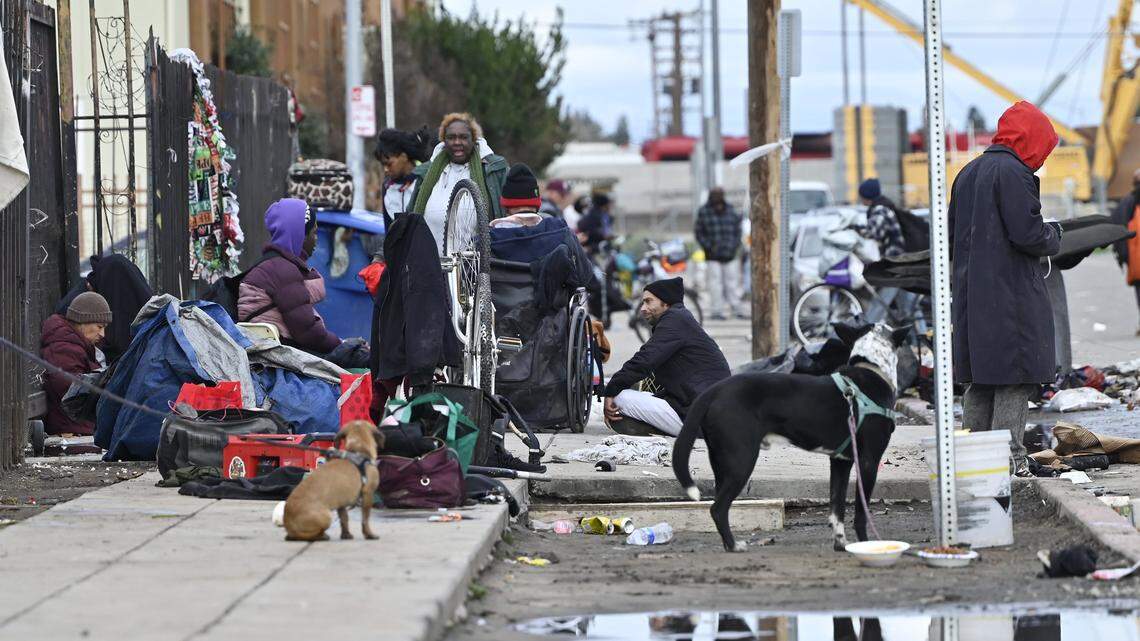
Homeless individuals gather outside the Poverello House entrance on Santa Clara Street on Friday, Dec 26, 2025 in Fresno. Interviews with 743 unsheltered people in Fresno reveal food insecurity, lack of safe water, sleep disruption and effects of the 2024 anti-camping ordinance.
ERIC PAUL ZAMORA
ezamora@fresnobee.com
Homeless people in American cities lead precarious lives when it comes to finding safe shelter, obtaining enough food and surviving in a harsh street environment. Their plight has been rendered more difficult by Fresno’s anti-camping ordinance, enacted in 2024. One of California’s toughest camping laws, this ordinance prohibits sitting, lying or sleeping on public property — including streets, sidewalks and parks, and along highways and canals.
As a retired researcher in public health and social science, I wanted to understand the homeless situation in Fresno. So, between May 15 and December 14, 2025, I interviewed 743 unsheltered people in Fresno about their challenges in obtaining adequate and safe food and water.
I share my results to give Fresno residents some insights into the daily struggle for survival of their homeless neighbors.
I learned that homeless individuals obtain food from a wide variety of sources: other homeless people, relatives or housed people donating food and drinks, stores with food stamps, charities, food pantries and panhandling as well as dumpsters and trash cans.
Many face issues accessing certain resources because their ID cards have been confiscated by police or stolen by other homeless people, they have no means of getting to where the resources are or their immigration status hinders them. In addition, most have no facilities to cook or store food. The great majority of people I interviewed ate only once or twice a day, and many said they had eaten little or nothing in the previous 24 hours.
I found two other issues affecting the ability of the homeless to obtain food: widespread mental illness, particularly depression and anxiety, and the use of recreational drugs. People using methamphetamine and marijuana experienced more food insecurity than those who did not use these drugs. Methamphetamine is used primarily to boost energy, stay awake at night and overcome hunger, whereas marijuana is smoked for its calming and sleep-promoting effects.
Relatively few people I interviewed use Fentanyl, heroin or prescribed drugs.
The other issue affecting eating and overall wellness is lack of or irregularity of sleep. Few people had slept an uninterrupted seven hours, and many had not slept at all the previous night. They cited harassment by the police or other homeless persons, street noise, anxiety, hunger, recycling at night and low temperatures in the winter as reasons why.
Furthermore, sleeping during the daytime makes it difficult to find food.
Finding drinking water is also a problem for the homeless individuals I met. In addition to stores, restaurants and food pantries, they generally obtain water from hoses and hydrants in residential areas and around businesses or from faucets and drinking fountains in food establishments.
However, access to these free water sources is increasingly being cut off by homeowners and businesses. Thus, many of the unhoused are at risk of dehydration, especially during the summer months. Two homeless people said they suffered heat stroke last July.
My interview with one 38-year-old woman illustrates the challenges Fresno’s unsheltered population faces in obtaining enough safe food and water. Someone had stolen her ID card, resulting in her food stamps being cancelled. In order to feed herself and her two dogs, she resorted to dumpsters and garbage cans, panhandling and stealing. She reportedly had contracted dysentery from contaminated food from either a dumpster or a water hose.
The difficulties the homeless population encounters in meeting their food and water needs are many, but they can be solved with adequate commitment and political will. The solutions are simple: low-cost shelters, mobile food distribution services, public drinking fountains and improved access to health services and substance use treatment. These are within the purview of our housing authority and social services agencies and organizations.
If we work together — collaborating on resource allocation and integrating housing, food, water and social and medical services as several charities already do — we can make life far less precarious for our homeless population. This would give them the stability they need to take the next steps to improve their lives.
Helmut Kloos is a retired associate professor of medical geography who has carried out survey research on public health, social science and environmental issues since the 1970s.
Related Stories from Fresno Bee