
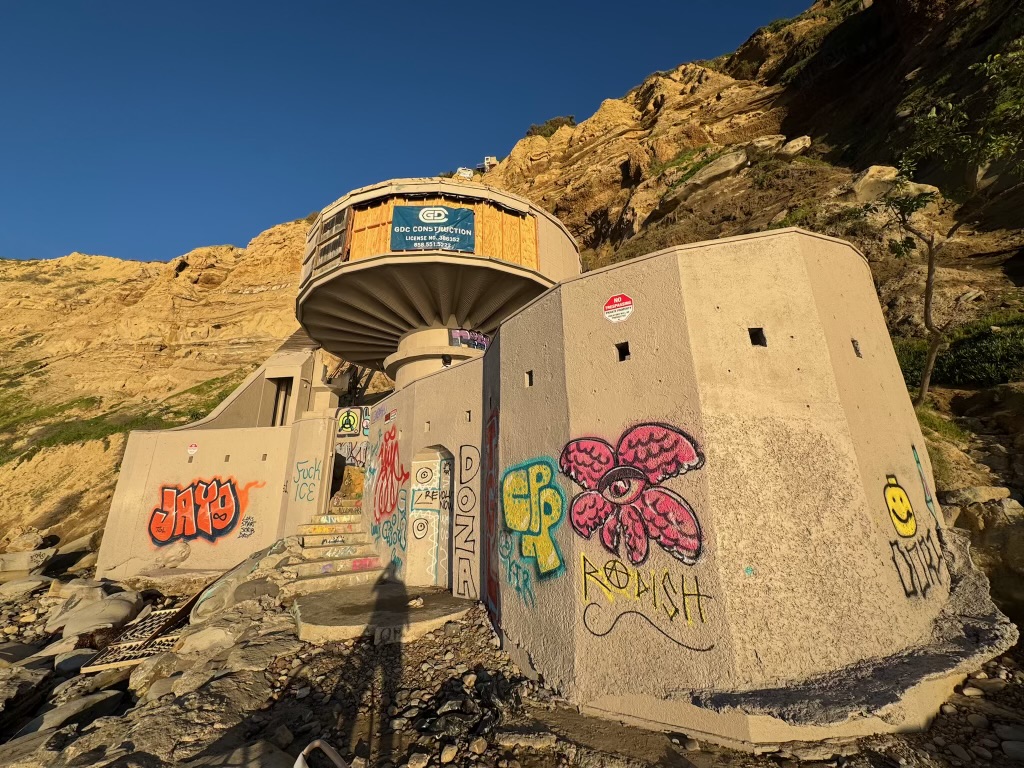
An effort to protect a social media marvel and architectural oddity on La Jolla’s Black’s Beach is underway. Whether the cleaning and maintenance serves as a long-term deterrent to vandals and other trespassers remains to be seen.
The “Mushroom House,” so nicknamed for its shape, is also known as “Bell’s Pavilion.” It was designed and built by architect Dale Naegle in the 1960s as a guesthouse for Sam Bell of Bell’s Potato Chips and General Mills. It is down the bluff from the main house at 9044 La Jolla Shores Lane.
Conditions at the vacant seaside landmark worsened after a bluff failure in 2020 sent more than 100 cubic yards of material down around the house and damaged the tram system that connects it to the home above.
In recent years, the Mushroom House has become a tourist attraction, the subject of many social media posts and a hot spot for graffiti.
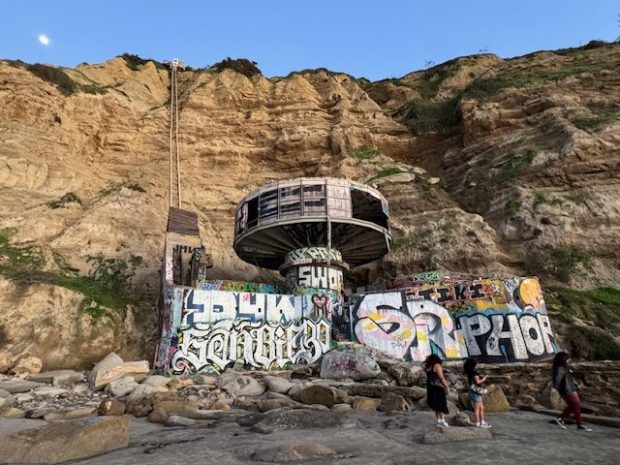 The “Mushroom House,” pictured Jan. 29, has long been a target for graffiti, vandalism and social media posts. (Mike McCormack)
La Jolla-based GDC Construction was recently tapped by current owner Buzz Woolley to clean up the ever-growing problem at the Mushroom House. The company banner is now plastered near the top of the structure.
GDC’s involvement, which began in early February, represents a more proactive approach to maintaining the unique building.
“Seeing it pop up on the internet is what really did it,” said Heath Akers, GDC’s vice president. “That’s when it started becoming a really big issue for Buzz.
“We do have a presence down there 1772296387 and we’re telling people they can’t come in.”
Woolley could not be reached for comment.
According to Akers, cleanup crews have been painting over graffiti, boarding up exposed windows and hauling out “load after load” of alcohol bottles, spray paint cans and food trash. Because of the Mushroom House’s remote location on the beach, crews have had to do the work by hand.
“We are bagging everything up, cutting things down into manageable sizes and then we have electric wheelbarrows that we’re loading everything into,” Akers said. “And we are trekking it in 600-pound loads at a time.”
Akers estimated the process, which involves loading the trash into pickup trucks and hauling it to a dump, takes an hour per trip.
The cleaning will be an ongoing effort, he added.
“It looks like it could be a very long fight, and that’s kind of how I’m looking at it,” Akers said. “We’re fighting the worst force the Mushroom has seen in its years since ‘68, when it was built. It’s the teenagers, and not just the teenagers but the vandals.”
Contrary to speculation by some and a viral social media post, the work on the Mushroom House is focused only on cleaning and restoration and not on renovation, Akers said. Changing the scope would require further permitting and a green light from the California Coastal Commission.
No active permit explicitly allows construction or improvements on the property.
Another rumor, that the house will be transformed into a lifeguard tower, was dispelled by San Diego Fire-Rescue Department spokeswoman Candace Hadley, who said the department, which includes city lifeguard services, “is not involved in any negotiations regarding the purchase or potential conversion of the Mushroom House into a lifeguard facility.”
Despite much of the graffiti being painted over and windows being boarded up, the space has already seen the return of taggers. And crews cannot use pressure washers or sandblasting to remove the graffiti because of concern of contaminating the beach or ocean.
La Jolla resident Mike McCormack expressed skepticism about cleanups getting the job done, saying “Even if they paint it, someone shows up and they say ‘Oh, great, I have a fresh canvas.’”
“Simply repainting the graffiti and relocking the building is unlikely to diminish public fascination or prevent continued attempts to enter and tag the structure,” said McCormack, a trustee of the La Jolla Shores Association. “Without a broader strategy, this may turn into years of repetitive cleanup and re-securing efforts. It may be more productive to make decisions that have a realistic chance of succeeding long-term.”
McCormack has expressed concern about the Mushroom House at several LJSA meetings, describing it as an under-addressed issue.
Akers said GDC plans to “try to do everything we can to legally get people repercussions” for trespassing on and vandalizing the property.
“If we can get somebody arrested [and] … brought up on charges … for trespassing and vandalizing someone’s private property … that’s the message I have,” he said. ♦