
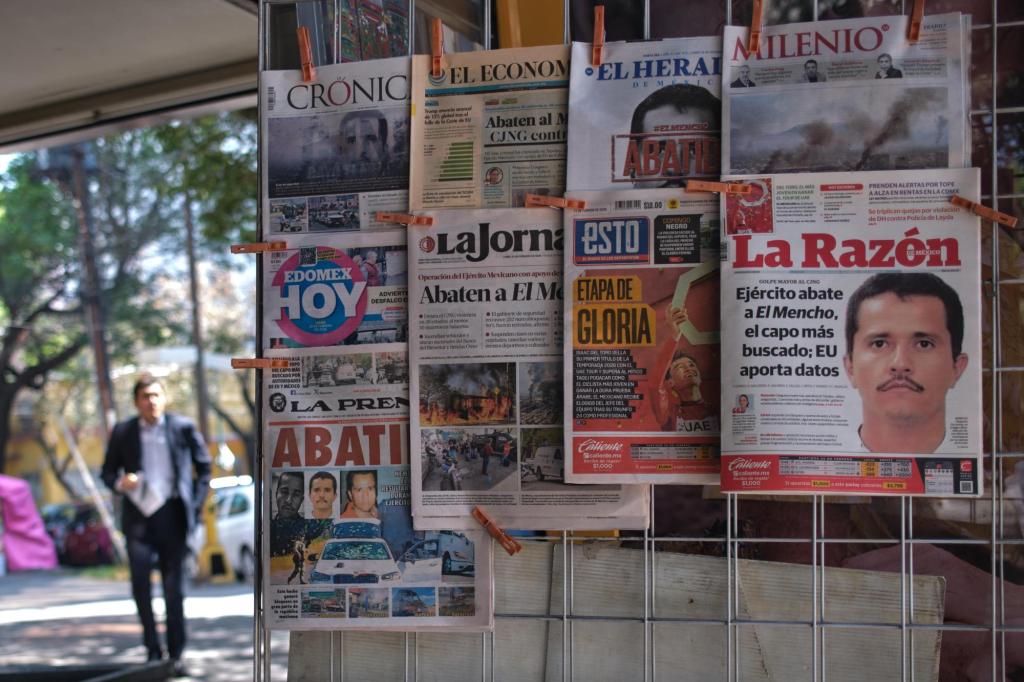
The recent death of the leader of the Jalisco New Generation cartel has been hailed as a major blow to organized crime in Mexico and the United States. Now, many are questioning whether the ramifications could lead to an escalation of violence.
In Baja California, state officials said this past week that they are considering all possibilities as they assess the risk. Similar concerns have been raised in many Mexican states following the killing of cartel kingpin Nemesio Rubén Oseguera Cervantes, also known as “El Mencho,” in a Mexican military operation in Tapalpa, Jalisco, one week ago.
The cartel’s response was immediate last weekend, playing out across 20 Mexican states. In Baja California, the turmoil lasted nearly 30 hours. On Sunday, reports of burned vehicles and stores emerged statewide, prompting a security alert from U.S. authorities and forcing many residents to stay home and businesses to close early.
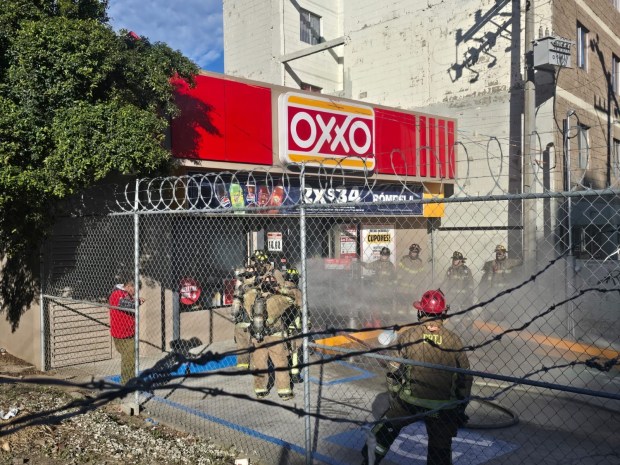 Firefighters extinguish a fire that was set to a convenience store in Tijuana on Feb. 22 amid a series of violent attacks following the killing of “El Mencho.” (Tijuana Public Safety Secretariat)
Although state officials said the situation has calmed down, the inevitable question remains: What effect will the loss of the ultra-violent cartel’s feared leader have on the Tijuana border, a key drug-smuggling route into the U.S.?
Despite its control in other parts of Mexico, authorities and experts said the Jalisco New Generation cartel, known by its Spanish acronym CJNG, has never been the dominant force in Baja California, though that’s not for lack of trying. For more than a decade, authorities have attributed at least some of the violence in Tijuana to fighting between CJNG and factions of the Sinaloa Cartel.
Oseguera was one of the most wanted cartel kingpins in Mexico and the United States. Last year, the Trump administration designated the Jalisco New Generation cartel, along with several others, as a foreign terrorist organization.
The Mexican military raid that resulted in Oseguera’s death came as the Trump administration increased pressure on Mexico to crack down on drug cartels. President Donald Trump made mention of the operation, in which the U.S. provided intelligence support, during his State of the Union address Tuesday.
Whenever a cartel leader is taken down, a shakeup in the criminal organization’s leadership usually follows, which could potentially escalate violence, noted Gen. Laureano Carrillo, Baja California’s secretary of public security.
Former Tijuana Public Safety Secretary Alberto Capella said the situation could lead to two potential outcomes in some Mexican states: internal fragmentation of the cartel, which could result in a dispute over control, or intensified warfare between rival groups.
“The perception of weakness or a strategic opportunity may prompt other cartels to launch offensives for control of routes, plazas or markets, resulting in intense confrontations,” he said Sunday in a video posted on social media.
“Without a doubt, this is great news for Mexico, and we must not dismiss it. But hopefully, as in the recent case of Sinaloa, the consequences will not lead to a permanent escalation — particularly in Jalisco, Michoacán and areas where the Jalisco (New Generation) cartel is most powerful,” he added.
On Friday, Mexico Secretary of Security and Citizen Protection Omar García Harfuch said that four CJNG regional leaders, whom he did not identify, are under investigation as possible successors to Oseguera.
Coordinated attacks
The cartel’s initial response to their leader’s killing was widely felt across Mexico, as vehicles and buildings burned, even in tourist zones such as Puerto Vallarta.
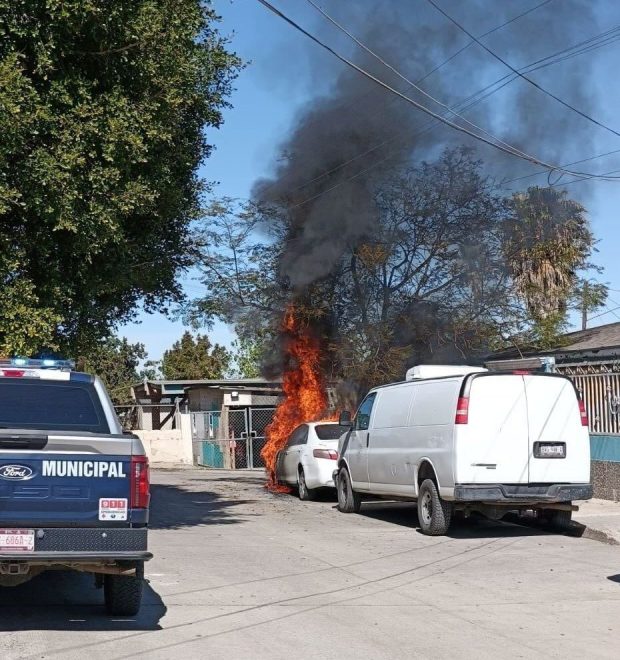 A vehicle burns in Tijuana on Feb. 22. (Tijuana Public Safety Secretariat)
“Fear is the prestige of the cartel,” Capella said in an interview. “Hitting the boss cannot go unnoticed because it affects the cartel’s prestige.”
Thirty-one incidents were reported in Baja California in all, with around half in Tijuana. Twenty-six people were arrested. No injuries were reported locally.
In Baja California, home to nearly 4 million people, cartel members were trying to “confuse the authorities and send a message to other criminal organizations that they are still present,” Carrillo said.
The first reported incident in Baja California took place at 7:33 a.m. Sunday on the Ensenada-San Quintín highway. News reports state that suspects forced the driver of a cargo truck out of his vehicle and set the truck on fire.
The Mexican National Guard and other law enforcement agencies were deployed to the state’s main roads, highways and busy avenues to stop the fiery blockades, officials said. The effort was dubbed Operation Shield.
In an effort to prevent more attacks, government officials notified transportation leaders to restrict commercial trucks from roads. Public transit also temporarily suspended operations.
Carrillo said this allowed authorities to maintain control of the roads and focus on reports of burned vehicles and stores emerging from within the cities.
Incidents in Tijuana included three vehicles set on fire on Avenida Internacional, a busy corridor that runs alongside a stretch of the U.S.-Mexico border fence. Five local businesses, including convenience stores, supermarkets and pharmacies, were set on fire, but firefighters quickly brought the situation under control.
Tijuana-based news site Punto Norte reported on Thursday that five individuals were charged with attacking an Uber driver’s vehicle parked near the San Ysidro Port of Entry on Sunday. According to the news outlet, prosecutors said the group surrounded the vehicle, ordered the driver out and stated they were going to set the vehicle on fire.
The suspects then poured gasoline onto the hood and windshield of the vehicle and set it on fire.
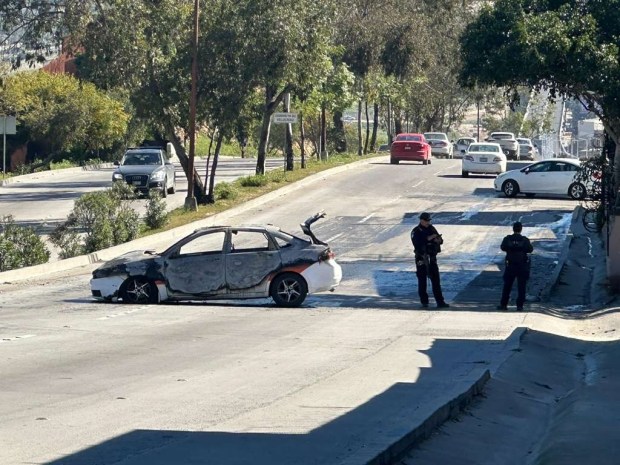 A taxi burns on Avenida Internacional on Feb. 22. There were no injuries. (Yolanda Morales)
Some of those arrested statewide, including minors, allegedly received between $175 and $290 to set the fires, Carrillo said. Baja California prosecutors have brought charges ranging from property damage by arson to terrorism, authorities said on Thursday.
Baja California Gov. Marina del Pilar Ávila said this week that all available police officers from local, state and federal law enforcement agencies were called, including those who were off duty or on vacation.
On Wednesday, Ávila assured residents and tourists that “your safety, tranquility and peace” were the state’s top priority.
The U.S. Embassy in Mexico issued a security alert for Mexican states where criminal activity was reported, including Baja California. The U.S. General Consulate in Tijuana closed their offices on Monday as a precaution.
“It’s a fight that will continue, without a doubt,” Christopher Teal, the U.S. Consul General in Tijuana, told the Tijuana media in Spanish. “The Mexican government is looking closely at organized crime and seeking to prevent further crime. We are here to support our neighbors and friends. This is a commitment we have, especially on the border.”
CJNG at the San Diego-Tijuana border
Sunday’s “narcobloqueos,” the road blocks of burning vehicles and other incidents favored by drug traffickers, helped authorities in Baja California pinpoint where CJNG is active, down to certain areas and neighborhoods, authorities said.
It remains to be seen if that brief display of violence would catapult into something more serious.
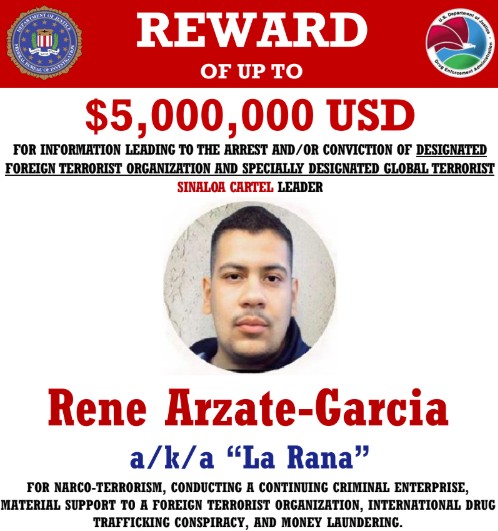 A Drug Enforcement Administration wanted poster offering a $5 million reward for information leading to the capture or conviction of René “La Rana” Arzate (Courtesy of DEA and U.S. Department of State)
Statewide, authorities said that law enforcement officers would be deployed in areas where the cartel’s presence has been detected, and intelligence efforts would be stepped up to track down the regional groups’ leaders.
For years, the Sinaloa cartel has largely held control in Baja California since the decline of the Arellano Félix organization, according to David Shirk, director of the Justice in Mexico program at the University of San Diego. That group, so named for the four brothers who controlled it, was severely weakened about two decades ago through fighting with Sinaloa operatives and a systematic dismantling by federal investigators and prosecutors in San Diego.
Of late, the most powerful group in Baja California has been a faction of Sinaloa loyal to Ismael “El Mayo” Zambada, one of the cartel’s longtime leaders who is now in U.S. custody, and his sons, who are known as “Los Mayitos.”
That power dynamic was reinforced Thursday when federal prosecutors in San Diego announced narco-terrorism charges and a $5 million bounty for René Arzate Garcia, who is accused of being a violent Sinaloa lieutenant loyal to the Mayitos. Prosecutors alleged that René Arzate, known as “La Rana,” and his brother Alfonso Arzate Garcia, known as “Aquiles,” have operated for the past 15 years in Tijuana and used extreme violence and corruption of politicians, police and military officials to maintain their standing as the most powerful drug traffickers in the region.
However, Shirk said the rise of CJNG in Baja California over the past decade has complicated the Sinaloa cartel’s ability to consolidate power, especially after the arrest and eventual extradition in 2017 of Sinaloa’s other longtime kingpin, Joaquín “El Chapo” Guzmán.
“The CJNG partnered with remnants of the Arellano Félix Organization to kind of gain a foothold in Baja California, so we know there are CJNG operatives in Baja California,” Shirk said. “They made themselves known by the violent manifestations we saw on Sunday and in previous years.”
Authorities have said that in addition to Sunday’s narco-blockades, CJNG was responsible for similar incidents that shut down Tijuana on a Friday night in August 2022 in apparent retaliation for the arrests of several cartel figures.
Shirk said the low number of civilian casualties on Sunday across Mexico was remarkable, given the widespread use of blockades in states across the country.
“CJNG went out of its way to not harm people — they removed people from their vehicles before burning the vehicles (and) they did not target people in their homes,” Shirk said. “They basically focused their outrage and their violent acts on government officials and on objects.”
Shirk said that was a positive sign going forward for ordinary Mexican citizens and foreign tourists, though he predicted Oseguera’s death would lead to volatility as various factions of CJNG and Sinaloa battle for continued control of Baja California.
“I think we’re going to see … a significant uptick in violence over the next, let’s say, six months, as some of this sorts itself out,” Shirk said.
In addition to the more visible narcobloqueos in recent years, federal prosecutions in San Diego have revealed details about the CJNG’s presence in Baja California.
In 2017, the U.S. Department of Justice unsealed 15 indictments nationwide aimed at taking down CJNG, including a San Diego indictment against a man described as being CJNG’s top operative in Tijuana. He was in custody at the time but reportedly died under unclear circumstances in a Mexican prison before he could be extradited to San Diego.
In 2021, San Diego prosecutors unsealed an indictment attributing an explosion of violence in Tijuana to a criminal cell known as Los Cabos, who allegedly acted as a brutal enforcement arm of the CJNG. The leaders of Los Cabos were accused of planning more than 150 murders in a roughly six-month period, including the killings of at least three police officers and two San Diego teens.
Prosecutors in San Diego have also spent more than a decade quietly litigating a criminal case against a dozen suspected drug traffickers with alleged links to CJNG. Two of those defendants were sentenced to federal prison in 2022, and the lead defendant was sentenced in 2024, though his attorney adamantly denied his client had any connection to the group.
It’s not believed that Oseguera was ever indicted in San Diego.