
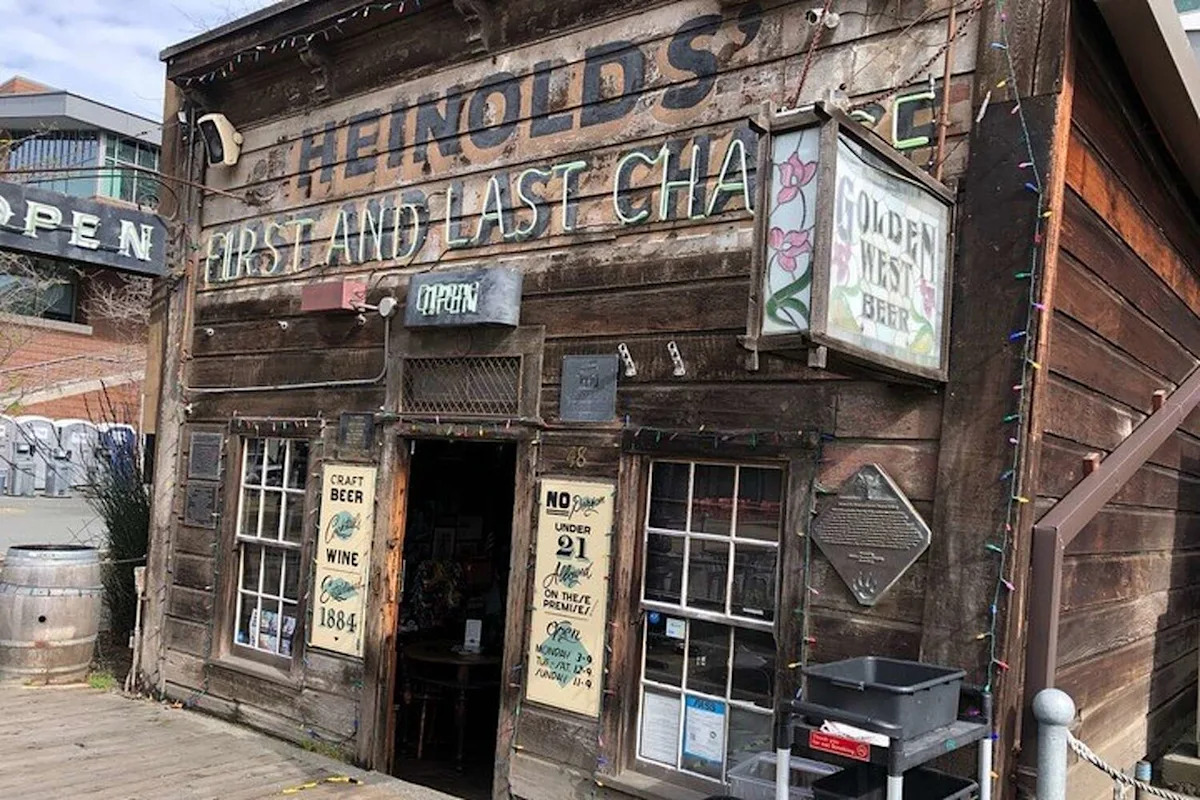
A gray February is behind us, and Sunday is the First of March. It’s spring – well, almost. Time for a trip combining history, literature and strong drink. We’re thinking of Heinold’s First and Last Chance Saloon in Oakland’s Jack London Square.
For my money, it’s the best preserved saloon around. It’s a weathered old building right on the edge of the Oakland Estuary – sailboats and big ships on one side, railroad tracks on the other – the bar’s interior packed with curiosities, sailor’s hats, pictures, life rings. The floor is slanted, the bar stools are kind of crooked, and the ceiling is black with the smoke from a million cigarettes. The bar looks pretty much like it did when Johnny Heinold opened it in the spring of 1884 and Jack London bought his first drink there in 1890 when he was about 14.
“It’s a museum where you are lucky enough to get a drink,” Carol Brookman once said. She was the owner for many years and is semiretired now.
Heinold’s First and Last Chance also has the special something that makes a saloon distinct: It’s full of stories. And one of the best of the resident storytellers is Elliott Myles, a medium-size man who wears a ponytail, like an old-time sailor.
“I’m an attorney by trade,” he said the other afternoon. He also did some stints as a bartender at Heinold’s, did some legal work for Brookman and bought into the place. “I’m only the fifth owner in 142 years,” he said. “That’s a story.”
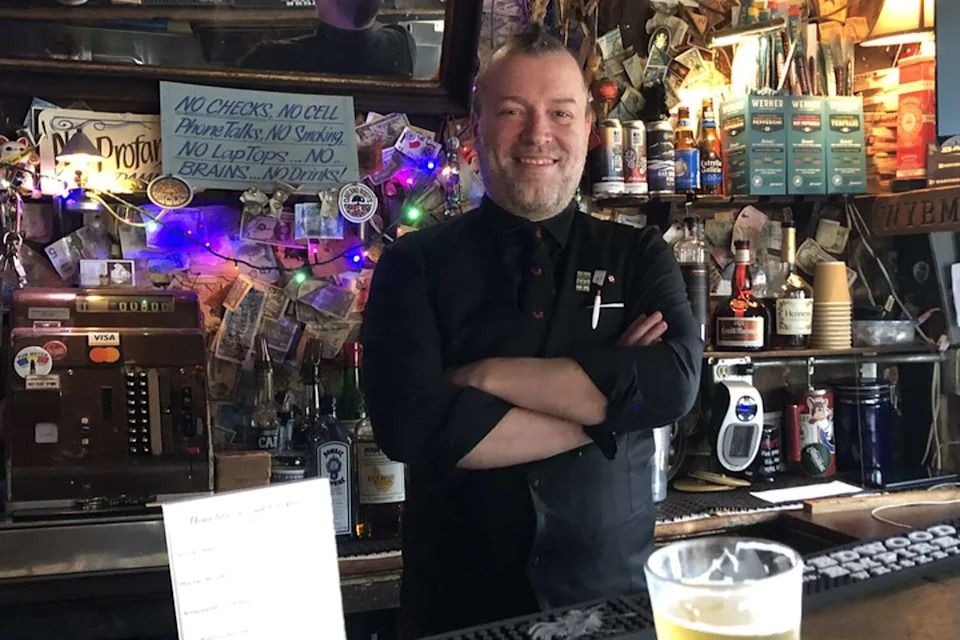
George Stafford is a bartender at Heinold’s, which was named a National Literary Landmark in 1998. (Carl Nolte/S.F. Chronicle)
But the main story at Heinold’s is Jack London. He was born in San Francisco, and in his short life before dying at 40, he wrote 54 books and 198 short stories, and received 10,000 letters in an average year.
He was an adventurer, a seafarer and a self-taught writer. At one point he was the highest-paid author in the country, a celebrity.
But his life and his writing were shaped by the Oakland Estuary. He learned to sail on it; it gave him his first taste of the sea and changed his life. Jack and his family lived in Oakland in the 1890s and were desperately poor. His father was sickly, and Jack had to work in a cannery in West Oakland. He was only 14 and once worked 36 straight hours in what he called “a hellhole.”
It was an impossible life. His biographer, Earle Labor, quotes London: “I wanted to be where the winds of adventure blew.”
The winds of adventure blew on the Oakland waterfront, where young men hung out in bars. Broadway, Oakland’s main street, was lined with saloons – “poor men’s clubs,” London called them – but his favorite, at the foot of Webster Street, was Johnny Heinold’s place, “a saloon for the transactions of men,” London called it.
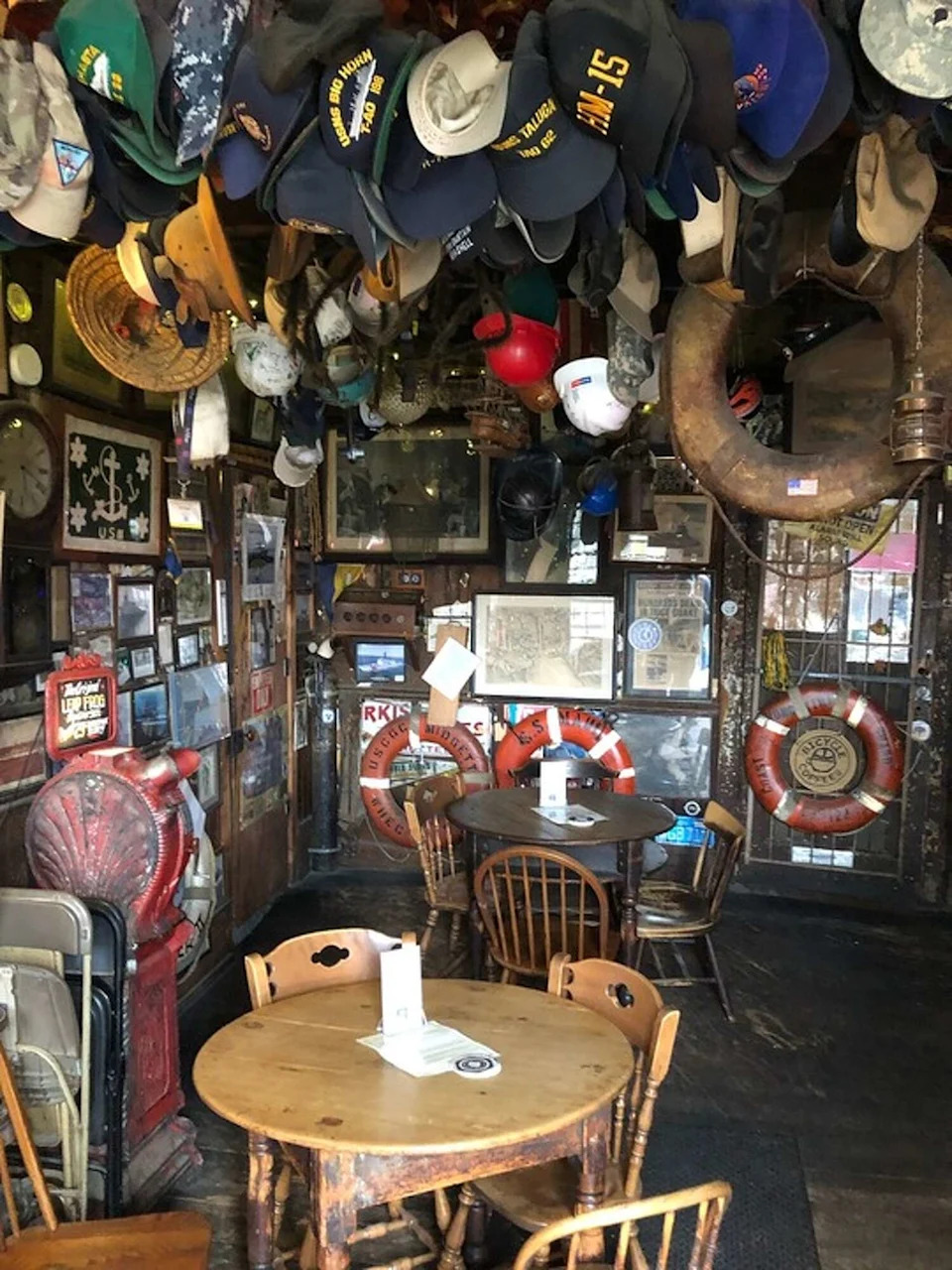
The ceiling and walls relay the history of Heinold’s First and Last Chance Saloon in Oakland, which opened in the spring of 1884. (Carl Nolte/S.F. Chronicle)
It was also a hangout for young men who made a living stealing from the oyster beds that lined the east side of the bay. The oyster beds were privately owned, and the oysters brought a good price in hotels and restaurants. Young men in small boats would raid them, and they called themselves oyster pirates.
“They sailed at night,” Myles tells the story. It was a tough and dangerous business. Stealing game was a felony.
Myles loves the story of how Jack used to come into Heinold’s and read books and hang out, looking for adventure. How when Jack was 15 he borrowed $300 from his friend Virginia Prentiss, a Black woman who raised him. How he bought a gaff-rigged sloop named Razzle Dazzle from a man named French Frank and sealed the deal with a drink in the bar at Heinold’s. London got the boat and sailed off: “The sunwash was on the crisping water and life was big … tomorrow I would be an oyster pirate … as free a freebooter as the century and the waters of San Francisco Bay would permit,” he wrote.
The bar is still there, a bit worn after all those years. I sat there and drank a beer as Myles told the story.
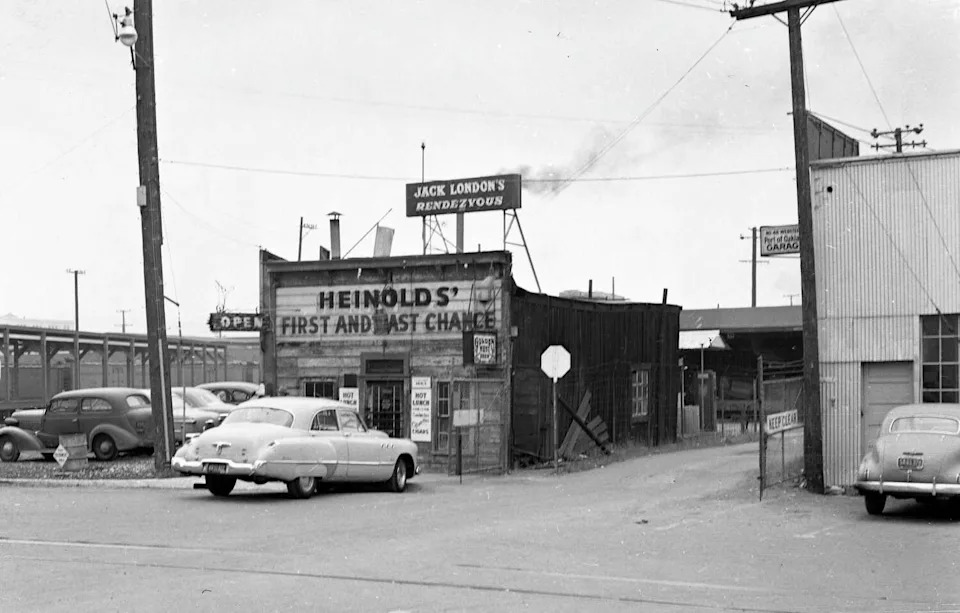
Heinold’s First and Last Chance Saloon, shown in April 1952, has attracted literary luminaries in addition to Jack London. (Art Frisch/S.F. Chronicle)
Looking around the room in the gray afternoon, one could see the table where Jack London would sit reading when he was a kid, the places where the captain of the schooner Sophia Sutherland stood talking to Johnny Heinold. The captain was bound for the North Pacific to hunt seals, and he was short-handed.
Heinold remembered: “So I speaks to the skipper and tells him there’s a kid I’ve been watching and he’s got good stuff and wants to go to sea and will he take him … and keep an eye on him?” The kid was Jack London, and the voyage was the basis for “The Sea Wolf,” London’s other classic.
When he came back from the sea, London decided to make something of himself, and Heinold lent money to London so he could go to UC Berkeley. “Without interest, without security, without buying a drink,” London wrote.
The years went by, and London became rich and famous. But he always remembered the Oakland waterfront and the First and Last Chance.
“Jack never forgot a friend,” Heinold told Westways magazine in 1933 toward the end of his life. “He always found time to come around here for his little two-finger drink and bring me his latest book with his name in the front.”
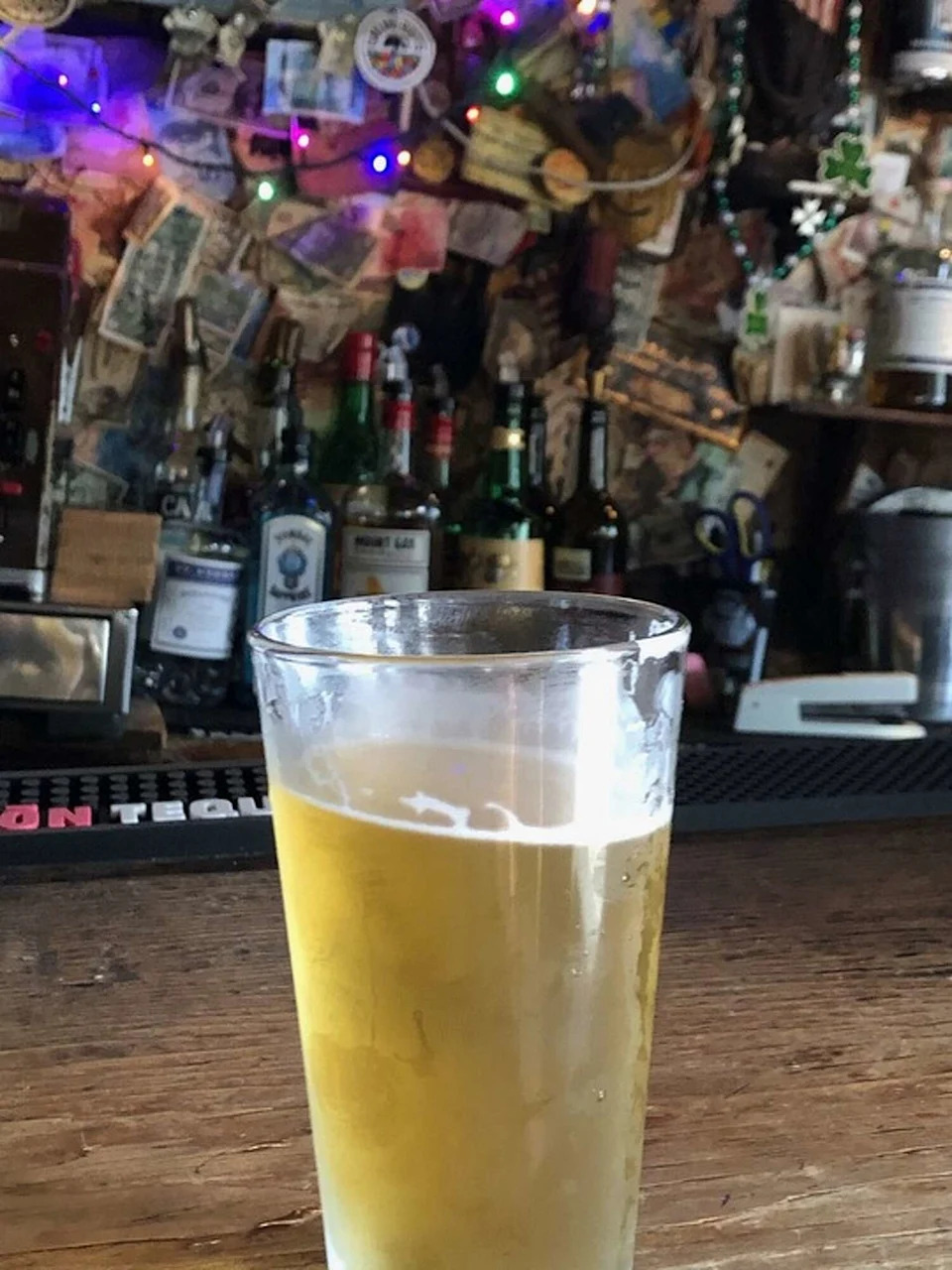
The bar slants at Heinold’s First and Last Chance Saloon, so the beer appears crooked. (Carl Nolte/S.F. Chronicle)
Besides Jack London, other luminaries have stopped by the saloon: Robert Louis Stevenson, whose wife was from Oakland, Myles says; Joaquin Miller, the self-styled poet of the Sierra who “always bought a round for the house,” Myles was told; and writers Earl Gardner, Erskine Caldwell, Rex Beach, Ambrose Bierce and Charles Markham. Heinold’s was named a National Literary Landmark in 1998.
But enough old tales. Now, said bartender George Stafford, the First and Last Chance is a neighborhood bar for the Jack London Square community – people who live in waterfront apartments and condos or on boats in the estuary. Nothing fancy.
“It’s a forgotten part of Oakland,” said Gaby Moreno, who was sitting at a table with friends out by the front door. She lives nearby and likes it. She feels good about the town. “Oakland,” she said, “is an amazing place to live.”
Jack London may have been born in San Francisco and died in Sonoma County’s Valley of the Moon, but the Oakland waterfront helped shape his life.
This article originally published at Stories flow like beer at Oakland saloon where Jack London charted his adventures.