
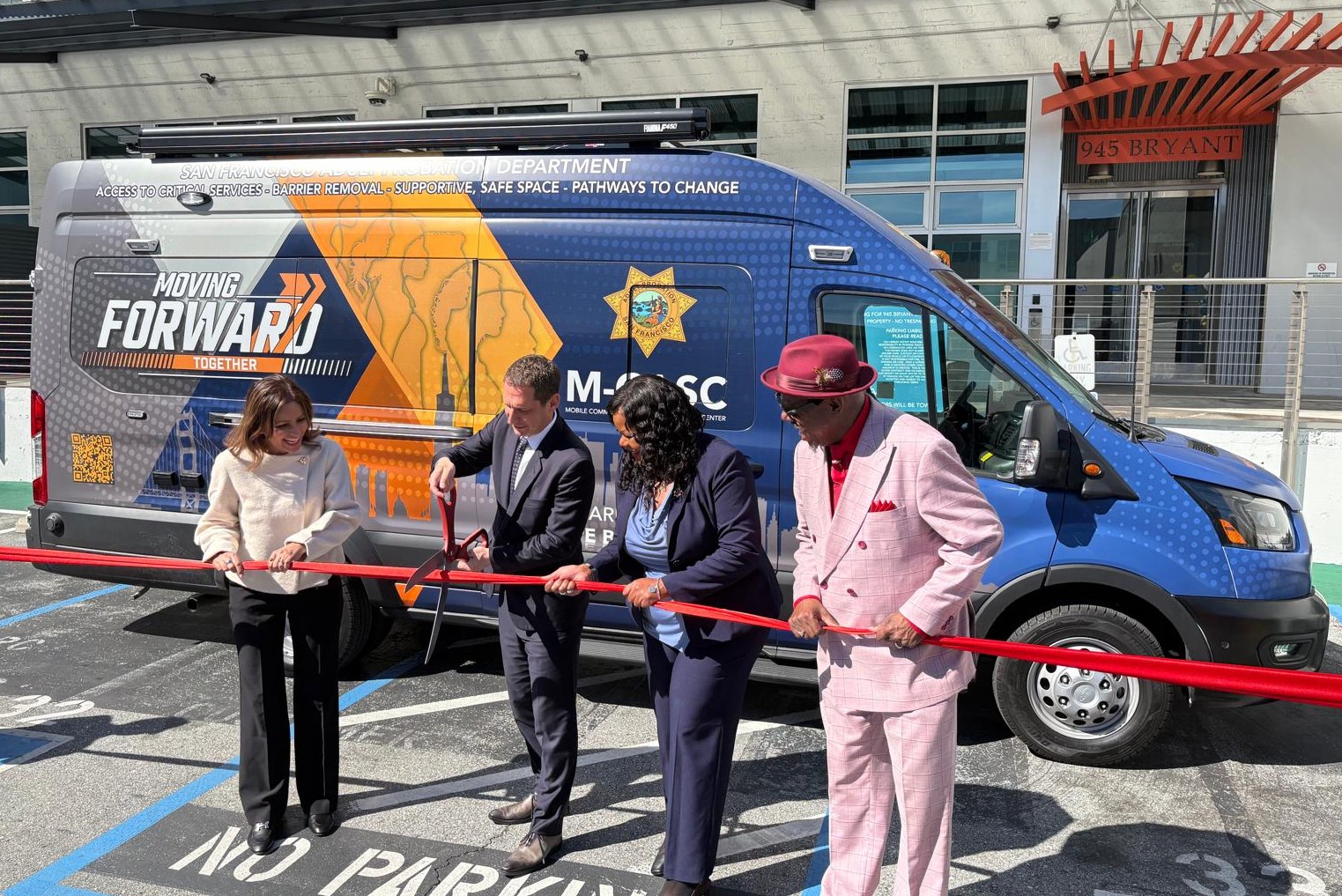
The San Francisco Adult Probation Department this week launched a mobile unit that will travel to “high-poverty and high-crime communities” across the city to reach people on probation in the streets.
Cristel Tullock, chief of the adult probation department, said the van will go to neighborhoods like the Mission, Tenderloin, and Bayview-Hunters Point, where probation staff will set up a table with chairs out front. Officers will circulate on bikes to tell those nearby that the van is in the area.
The unit aims to serve the roughly 15 percent of those on probation in the city who are experiencing housing instability, based on the most recent data shared by the probation department. The program will offer a variety of services, like connecting people to housing, job programs, therapy, education programs, and behavioral health services, among other resources.
It is an extension of the Community Assessment and Service Center, a physical reentry center offering similar referrals.
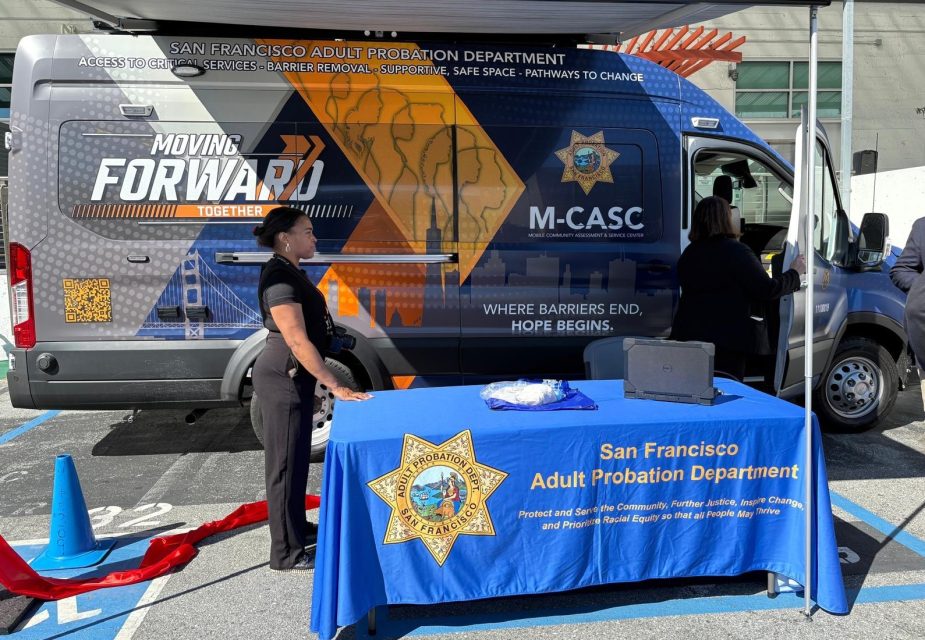 Probation staff demonstrate the van’s setup with a table and chairs for meeting with people. Photo by Alice Finno.
The program was announced Thursday at noon. Richard Beal, director of recovery services at the Tenderloin Housing Clinic, stood in front of a small crowd at the Adult Probation Department and described how, back in 1995, an outreach van run by the Mobile Assistance Patrol picked him up and took him to St. Anthony’s treatment program.
“The whole trajectory of my life changed because of that van ride,” he said. Beal had four felony warrants at the time, he said, but when he got into treatment and completed it, his charges were reduced to misdemeanors. They were eventually dismissed, and he only had to complete his probation.
“One connection can interrupt years of pain,” Beal said.
The van is equipped with outlets to charge devices, including ankle monitors, which can create problems for people on probation when they run out of battery. There will also be a laptop available for use on-site and phones people can borrow. The initiative was funded through a $507,470 grant from California’s Board of State and Community Corrections, part of $20 million in disbursements to 25 county probation departments.
Although the van services are primarily aimed at people who have been impacted by the criminal justice system, Tullock said that if other individuals — like homeless people who are not on probation — come to the van, staff can provide hygiene kits and refer them to other partners, like the Human Services Agency and the Department of Public Health.
Aman Lail, chief administrative officer for the Department of Public Health, said on Thursday that the van will serve as another tool to connect people with treatment services. By simply “removing the barrier of requiring someone to travel across town to access care,” she said, the mobile unit may keep people from “falling out of care.”
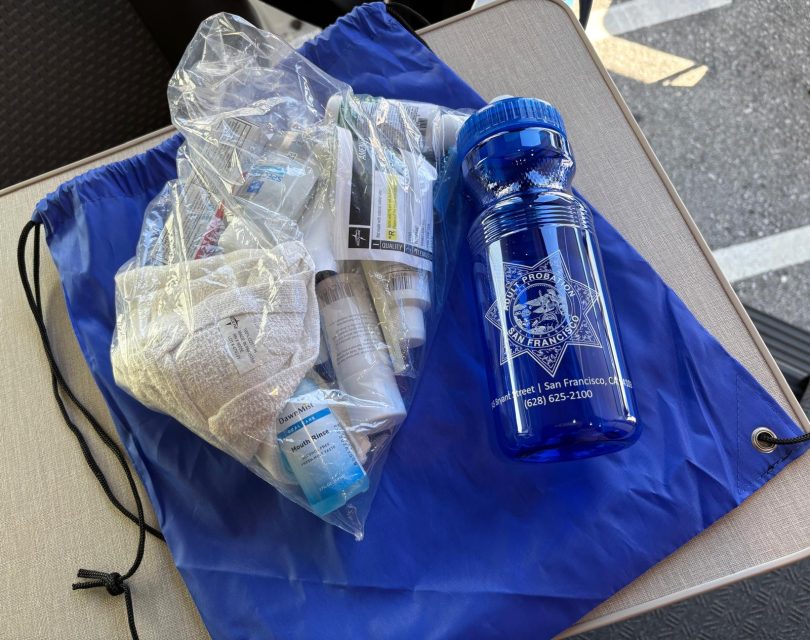 A hygiene kit and water bottle that probation staff will give people who go to the mobile unit. Photo by Alice Finno.
Mayor Daniel Lurie at the Thursday presser said curbing public safety, a major focus of his administration, means ensuring people released from jail and prison have the tools to succeed.
“When people on probation have that support, it limits the possibility of repeat offenses, which makes our city safer,” he said.
Jonathan Simon, professor of law and criminal justice at U.C. Berkeley, told Mission Local he thought reducing the burden for those on probation to get themselves to appointments or services might be positive: Transportation can be a barrier for those without a car or means to pay for public transit, he said, as well as for people with disabilities, chronic illnesses or mental health issues.
But he said he will continue to be skeptical until there is evidence that the program reduces incarceration and addresses the challenges faced by people on probation.
“To the extent that it sort of prevents the potential for an additional violation to go on their record or to be arrested, that’s probably a good thing; the devil will be in how they use this in practice,” he said.
Criminal justice experts said the city’s problems run deeper than outreach. Signing people up for services is helpful, they said, but only marginally so if the services aren’t there.
“We are in full support of connecting justice-involved people to opportunities that enhance their lives,” said David Mauroff, CEO at the San Francisco Pretrial Diversion Project, which helps people navigate court processes and avoid future arrests.
But, he said, “the high demand for limited treatment beds, housing, clinicians and related resources far outweighs the need to make referrals to services that don’t exist.” Those services are being eliminated due to budget cuts, he said, in turn impacting public safety.
The Department of Public Health, for instance, recently announced $17 million planned cuts in contracts with community-based organizations and is expected to identify an additional $40 million to cut from contracted and staffed programs.
Brian Cox, who leads police accountability work at the San Francisco Public Defender’s Office, questioned relying on law enforcement for outreach.
“People need to know about the resources, but the question is whether funding police to share that information is the right approach,” he said.
Cox said having more officers on the streets will increase surveillance and inevitably lead to more arrests. “We’re not funding the systems that keep people out.”
Mobile probation units have already been implemented in several counties, including Los Angeles County and Alameda County, but data on their effectiveness is not readily available. Jana Sanford-Miller, communications director at the Board of State and Community Corrections, said that is partly due to delays in purchasing and launching the vehicles in several counties.
Alea Brown-Hoffmeister, director of policy and legislation at the San Francisco probation department, said the van will be evaluated based on how effectively it reaches those who are unable to access traditional offices or virtual appointments, linking them to services while ensuring they remain engaged in supervision.
The van’s location and hours are posted online, and people can scan the QR code on the exterior of the van for more information.