
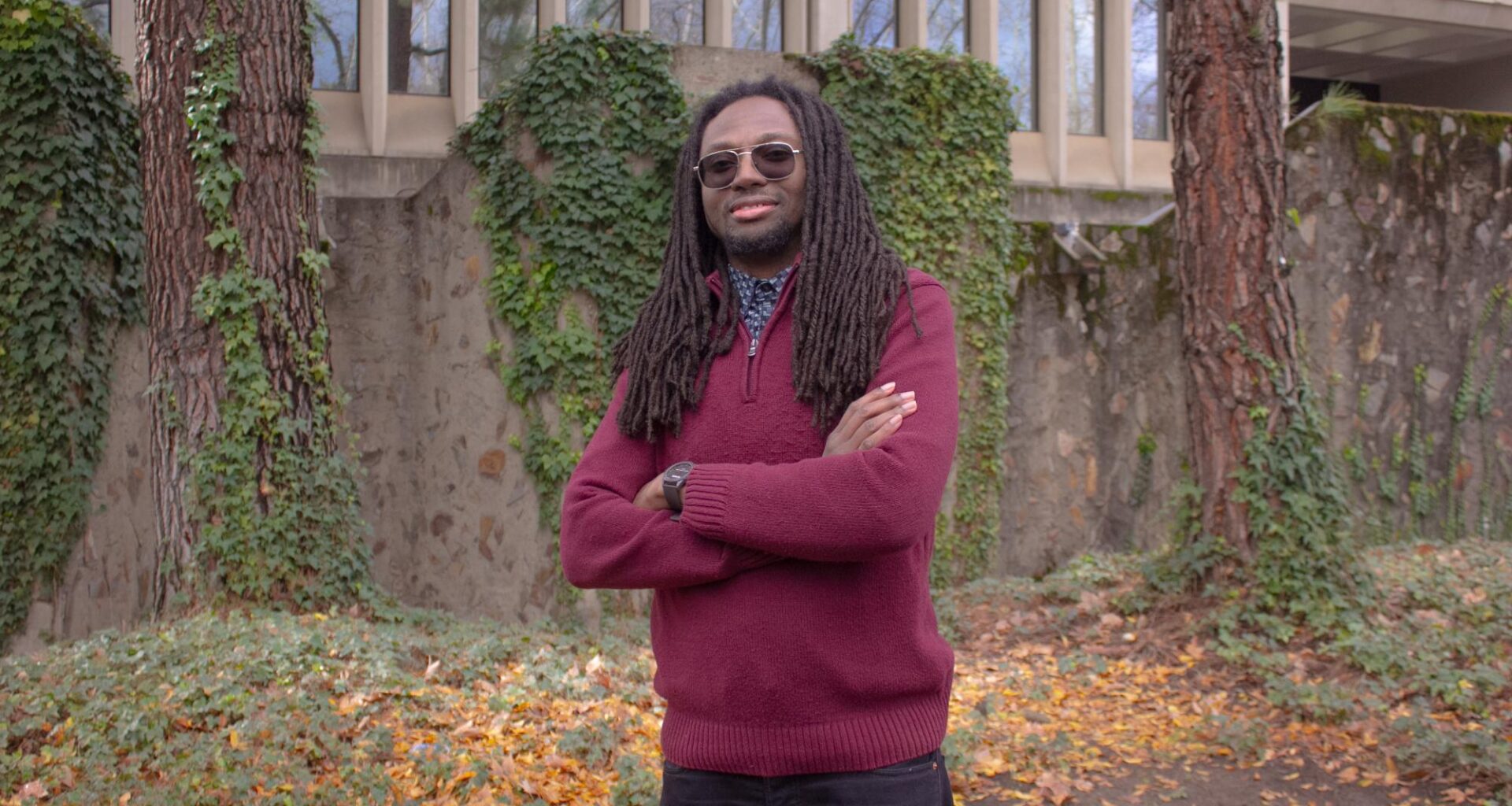
David Player is a part-time lecturer in deaf studies and Black educator who communicates through American Sign Language and deliberate hand movements that carry historical and cultural significance for himself and the Black Deaf community.
Player has taught ASL courses at Sacramento State for about three years. As a researcher and writer, Player said he has spent his life positioned between Black and deaf worlds.
Born hearing, Player became deaf by the age of four following spinal meningitis, where inflammation affected his auditory nerve. It wasn’t until he learned to sign that he began developing his identity as a deaf person.
Growing up in Louisiana, Player lived in a household that relied on spoken language, communicating with his family primarily through gestures. Player said he often code-switched to navigate the two communities.
“I think that what impacted me the most was just noticing that I had two identities,” Player said. “I had to figure out how to navigate the educational system, whether I was rooted in one culture or another. I had to navigate across all these platforms, so I found myself having to code-switch.”
Balancing those two spaces, Player said, often left him feeling split between two worlds. He noticed the cultural differences between the hearing Black church he attended and the language used in the Deaf program at his mainstream school.
“Looking in the Deaf world, they use sign language and it was more accessible to me,” Player said. “Although in Black culture, I can see that it’s my race, the food, the clothing, the movies, everything. And of course, the language.”
He said that he felt most connected to the Black community through shared race and culture but struggled with a language barrier. Without access to sign language in many of those spaces, inclusion felt incomplete.
“From what I could see within the black community it was a more auditory base,” Player said. “It’s our human right to have access to communication.”
Player said he had to explain that the Black Deaf community has its own language and history.
“For those in that community who didn’t know about the Black Deaf history, they just noticed that I couldn’t hear and that I couldn’t talk.”
RELATED: Students showcase ‘sociological imagination’ through intercultural oral and Deaf research
As Player entered adulthood, his challenges shifted from identity to access, representation and opportunity for the Black Deaf community in educational and professional spaces.
Player said that many Black Deaf students face lowered academic expectations early, often limiting their exposure to higher education opportunities and steering young black men toward athletics.
“Once you hit the sixth grade, that is the glass ceiling for them, for Black Deaf students,” Player said, “For the white Deaf individuals, they had no limits.”
Player enrolled in Gallaudet University, historically known as the first higher education institution for deaf students since its founding in 1864. Many other Deaf students enrolled at Gallaudet as well.
“It’s a well known University for the Deaf community. Once a deaf individual graduates from high school, they go on to Gallaudet.” Player said.
Despite this, Player said he still struggled to fully connect within the Deaf community.
“I would recall seeing at Gallaudet University all of these pictures along the hall, though they’re all deaf, they were white,” Player said.
To him, the absence of Black faces among Deaf historical figures reflected a broader issue within Deaf education. This experience encouraged Player to begin studying systemic racism hiding within Deaf academia.
“You see documentaries all over the place that talk about these same issues. When you look at it from our lens, there’s no spotlight on us,” Player said.
The same structural racism present in the hearing communities, is embedded within Deaf spaces, he said.
During his time at the Rochester Institute of Technology, home to the National Technical Institute for the Deaf, Player experienced a moment that stayed with him.
Excited for an introductory course titled “Diversity in the Deaf Community,” he walked into class surprised to see his professor was a white Deaf man.
“I thought it was weird, but I wanted to keep an open mind,” Player said. “We were all sitting in a U-shaped formation, and he opened up and said, ‘The deaf community belongs to the white people,’ and I lost it.”
Not afraid to call out racism, he wrote an article titled “The Power of White Gaze: Erasure of Black Signers,” recounting his experience and examining struggles of the Black Deaf community. In it, he shared his story and critiqued a sociocultural framework centered on white perspectives while marginalizing others.
After completing his graduate studies, he became an educator and researcher in linguistics.
“I love analyzing this work, talking about linguistics. The ideology, the history and the variations between Black ASL and ASL. I love having all these conversations,” Player said.
Michele Vincent is an ASL staff interpreter who works primarily with Deaf and Hard of Hearing faculty and close colleague of Player. Vincent recalls memories with Player where they would come together to read articles and highlight research papers together.
“It’s always fun and educational,” Vincent said. “Being in his presence, I always feel like I’m learning things. That’s a really unique trait.”
Vincent shares the impact Player role plays as a Black Deaf educator. Not involved in most of Player’s research, Vincent mostly supports interpreting needs.
“I think that bringing that depth of understanding to Deaf studies is really important,” Vincent said.
Player never intended to become a professor, but said that growing up witnessing the diversity of language guided Player in his journey toward becoming a Black educator. His research spotlights the history and cultural background of ASL and the ideology of language.
Player, now a researcher and co-author, accepted The Willie Brown Legacy Award presented by The California Black Caucus on Feb. 21 for his work in preserving Black Deaf History.
“It’s a big deal,” Vincent said. “There aren’t that many people like David. He has punched through all the ceilings,” Vincent said.
Player said that many students enroll in his ASL class solely to satisfy Sac State’s foreign language requirement. He said the attitude needs to shift toward recognizing ASL history and culture rather than just a language.
To understand a language, Player suggests it is not simply to learn how to sign or speak it, but to uncover the culture and identity that shape it. Standing in front of his classroom, Player signs with intention; teaching not only how to communicate in ASL but also to understand the history and lived experiences embedded in it.
“Often, identities correlate back to language,” Player said. “How can you acquire language without culture?”