
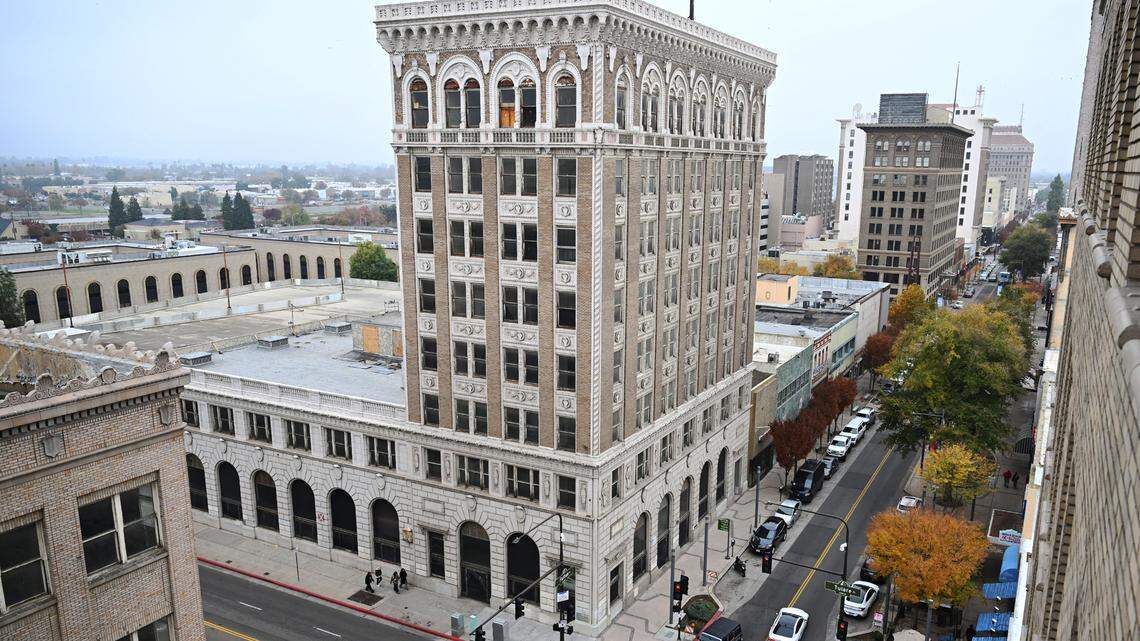
Downtown Fresno’s Bank of Italy building. Reimagining downtown Fresno by looking into the past.
ERIC PAUL ZAMORA
ezamora@fresnobee.com
Will a new identity save downtown Fresno?
No longer a shopping hub, Mayor Jerry Dyer recently suggested creating an “entertainment center.”
Along with the existing Chukchansi Park baseball stadium, Convention Center, Selland Arena and Saroyan Theatre, will a new soccer field revitalize downtown? Dyer believes it will, with federal government funds transporting downtown into an economic center with new housing, hotels, restaurants, parking garages and rebuilt infrastructures.
In order to imagine a revitalized downtown Fresno, let’s first take a look at past iterations of this area.
In 1872, Fresno’s homes and churches sat near the railroad. By 1880, saloons, banks, retail establishments, restaurants and the Grand Central Hotel arose on dirt streets and wooden sidewalks.
By 1889, the streets were paved, a Central Pacific Depot was constructed at H and Tulare streets and San Francisco real estate investor Fulton G. Berry bought the hotel. Upon his passing in 1910, J Street was renamed Fulton in his honor.
Within a few years, the Grand Central Hotel became the Fresno National Bank, then the Bank of Italy and, finally, the Bank of America.
My memories begin in 1950, when my family and I moved from farm to city. Fulton Street, the heart of downtown, was lined with banks, department stores, jewelers, shoe stores, clothing specialty shops, drug stores, five-and-dime stores, movie theaters and restaurants. In the mid-‘60s, as builders pushed north with custom homes, tract homes, apartments, Fig Garden Village and Manchester Center, downtown lost its allure.
To compete with shopping centers, Fulton Mall was installed in 1964, transforming six blocks into a pedestrian-only area with benches, sculptures, a fountain, clock tower and trams. I witnessed this transformation during my college years, as a salesgirl on Friday nights and Saturdays at Rodder’s Mademoiselle, an upscale women’s shop on Fulton Street.
In those days, downtown was anchored by department stores — Gottschalks, Berkeley’s and Penny’s to the south, and Roos/Atkins and Cooper’s to the north. Also on Fulton were upscale men’s stores — Harry Coffee’s and Walter Smith’s.
I. Magnin & Company, a luxury department store chain based in San Francisco, stood alone on Van Ness. I remember sitting on a circular velvet sofa as my Aunt Diane shopped. Afterward, we walked to The Hotel California for a Monte Cristo sandwich.
During lunch hour, downtown employees rushed out of glass doors to eat, shop and bank. Some headed to Rexall Drugs. Bank of America always had a line of waiting customers, as did Fresno Guarantee Savings, where I deposited my dollar-an-hour wage. Others headed to Security Bank, a 16-story neoclassical landmark on Fulton, the tallest building between Los Angeles and Oakland.
My sales job at Rodder’s included lunchtime elevator operator, a service for those unable or unwilling to walk up the elegant, curved staircase (which I once tumbled down in my high heels). In larger department stores, a bank of elevators served shoppers, with operators cautioning folks to “watch your step.” Eventually, elevators were self-operated and escalators were installed.
I sometimes lunched at the Milky Way, Woolworth’s or Newberry’s. Afterward, I sauntered past window displays of Capezio shoes and Lanz dresses, neither of which I could afford on my dollar-an-hour salary, dedicated to California State University, Fresno’s $50 semester fee plus $50 for books.
Women in high heels and men in suits strolled Fulton Street — bankers, office workers, shoppers and salesmen. But by 6 p.m., Fulton stood empty (except on Fridays when stores closed at 9 p.m.).
On Saturdays, farming families drove to town to shop, eat and attend a movie at Warner’s, Crest, Wilson or Hardy theaters. Saturday nights, teenagers dragged “the main.” Cars with mirror-perfect paint, chrome wheels and lowered rear or front ends cruised Fulton, ending at Mars or Stan’s Drive-in. The cars — Pontiacs, Fords, Oldsmobiles and Chevys — were purchased from downtown dealerships.
Recently, part of the mall was removed to allow cars to cross and park. Fulton Street houses boutiques, antique and thrift shops, bars, cafés and restaurants. Downtown is now home to different businesses and attractions.
Reimagining our downtown is an ongoing endeavor. Yet, it seems there is hope: With a focus on creating an entertainment mecca, along with the convention center venues, Dyer’s vision of sports fields, dining facilities and hotels is very realistic.
Perhaps it should no longer be referred to as “downtown” Fresno, but rather our city’s “entertainment district.”
Dr. Pauline Sahakian is founding director of the UC Merced Writing Project. She is a former high school English teacher and university writing instructor.
Related Stories from Fresno Bee