
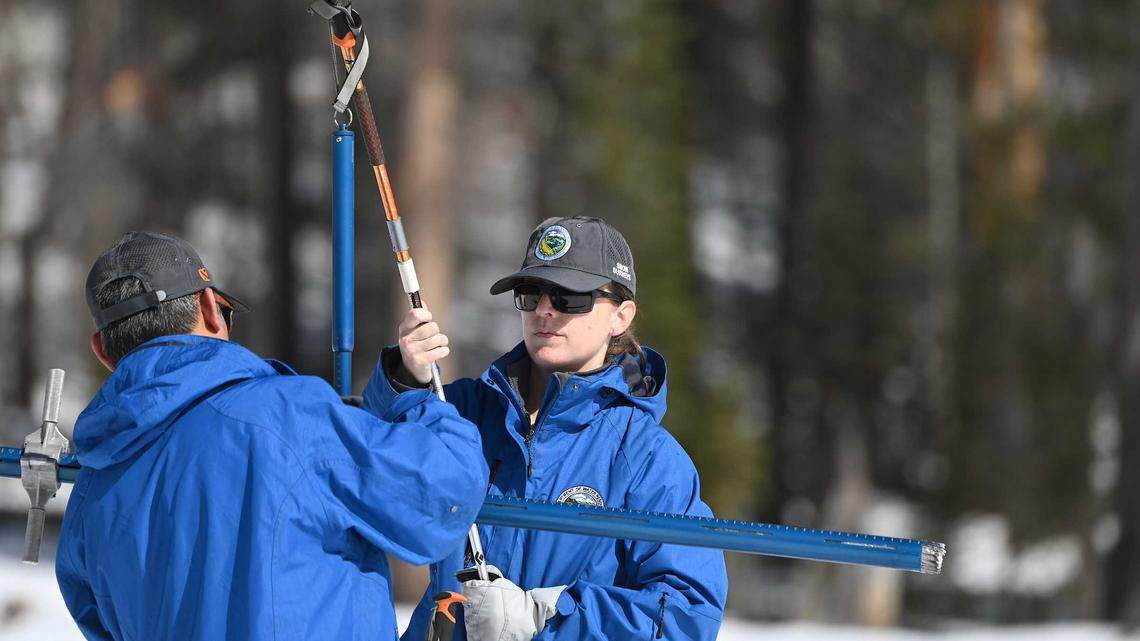
From left, Department of Water Resources engineers Derick Louie and Jordan Thoennes conduct the third snow survey of the 2025-26 season at Phillips Station on Friday, Feb. 27, 2026. State officials said the survey measured snowpack at 47% of average this time of year as California remains below normal despite recent storms.
Ken James
Department of Water Resources
The third snow survey of the season was conducted Friday at Phillips Station near Tahoe, showing snowpack levels remained below average despite a recent stretch of storms.
At Philips Station, snowpack measured 47% of average for this date and 45% of the April 1 average. Statewide snowpack stood at 66% of average for this date as of Friday, a sharp drop from 85% at the same time last year.
“Last week’s storms were quite cold and delivered significant snowfall throughout the mountains of California, including right here. This is one of the storms that I talked about last month, that we hoped for that would give us a boost and get us back towards average,” said Andy Riesing, a manager of snow surveys at the Department of Water Resources.
“But it also shows how quickly things can change, because this week, we had a wet storm that rained on top of this snow, melted a lot of it away.”
According to Riesing, the state is ahead of where it was last month but still “way behind” where officials had hoped to be, particularly in Northern California.
From left, Department of Water Resources staffers Derick Louie, Angelique Fabbiani-Leon, Andy Riesing and Jordan Thoennes conduct the third media snow survey of the season at Phillips Station on Friday, Feb. 27, 2026. The measurement showed statewide snowpack at 66% of average for this date as officials monitor water supplies ahead of the April 1 peak. Ken James California Department of Water Resources
Friday’s measurement showed a slight increase from the second snow survey on Jan. 30, as the season approaches April 1, when snowpack typically reaches its peak. The second snow survey measured snowpack at the same location stood at 46% of average and just 33% of the typical April 1 level, with 59% of the average statewide.
As of Friday, data from the Department of Water Resources shows that in the Northern Sierra, snowpack was 40% of average for this time of year and 46% of the April 1 average. In the Central and Southern Sierra, levels were 58% and 78% of average for this date, respectively, or 69% and 90% of their April 1 averages.
Reservoirs are above average
California’s reservoirs are currently above average after recent rainfall, but experts are warning of warmer temperatures causing storms to fall as rain rather than snow, contributing to low snowpack. Snowpack acts as a natural reservoir, slowly releasing water that sustains rivers and supplies reservoirs during the dry season.
As of Feb. 26, Shasta Lake, the state’s largest federal surface storage reservoir, was at 83% of capacity and 116% of its historical average.
Folsom Lake stood at 63% of capacity, or 127% of its historical average. New Bullards Bar Reservoir was at 83% of capacity, or 120% of average. Lake Oroville was at 84% of capacity, San Luis at 85%, and Trinity at 87%, representing 130%, 105%, and 129% of their historical averages, respectively.
When surface reservoirs reach their capacity, they cannot capture and store additional runoff from incoming storms. As a result, excess water is released downstream into rivers and becomes unavailable for later use.
While climate change is driving the most noticeable warming in the summer months, winter temperatures are also rising. In Sacramento, the average winter temperatures have increased by about 2 degrees over the past 50 years.
“It is definitely a reflection of the fact that most of our warmest years on record have occurred in the past decade,” Paul Ullrich, a UC Davis professor in regional and global climate modeling, said in a January interview.
“If the snow melts off early, then it only displaces water that we already have in our surface reservoirs.”
This story was originally published February 27, 2026 at 12:23 PM.
Related Stories from Sacramento Bee

The Sacramento Bee
Chaewon Chung covers climate and environmental issues for The Sacramento Bee. Before joining The Bee, she worked as a climate and environment reporter for the Winston-Salem Journal in North Carolina.