
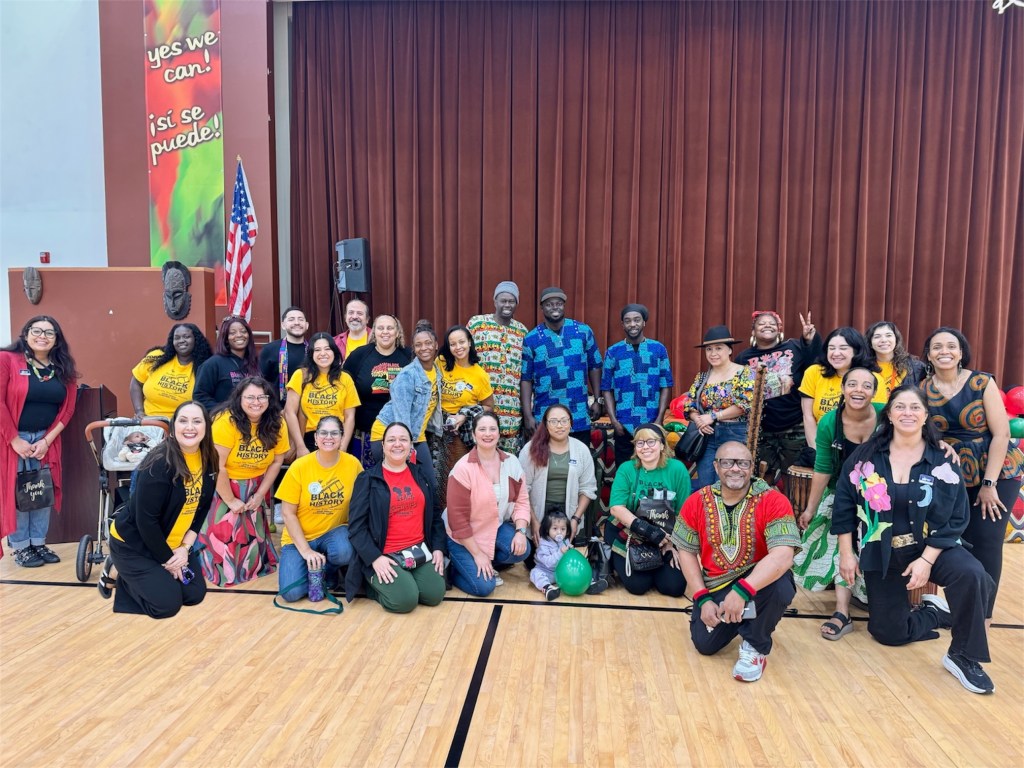
The celebration of Black History Month went out with a bang at Cesar Chavez Elementary School in downtown Long Beach last week.
Literally.
The powerful rhythmic beat of the West African djembe and dundun drums filled the air as students, parents, teachers and administrators gathered in the school gym for the finale of the school’s annual celebration.
More than 300 students clapped their hands in time to the pounding sounds of the Ame Kora music and dance group led by Amadou Fall, master of the kora, a 21-stringed harp/lute instrument used extensively in West Africa. Fall played the kora as part of the soundtrack for the Marvel Cinematic Universe’s popular 2018 film “Black Panther.”
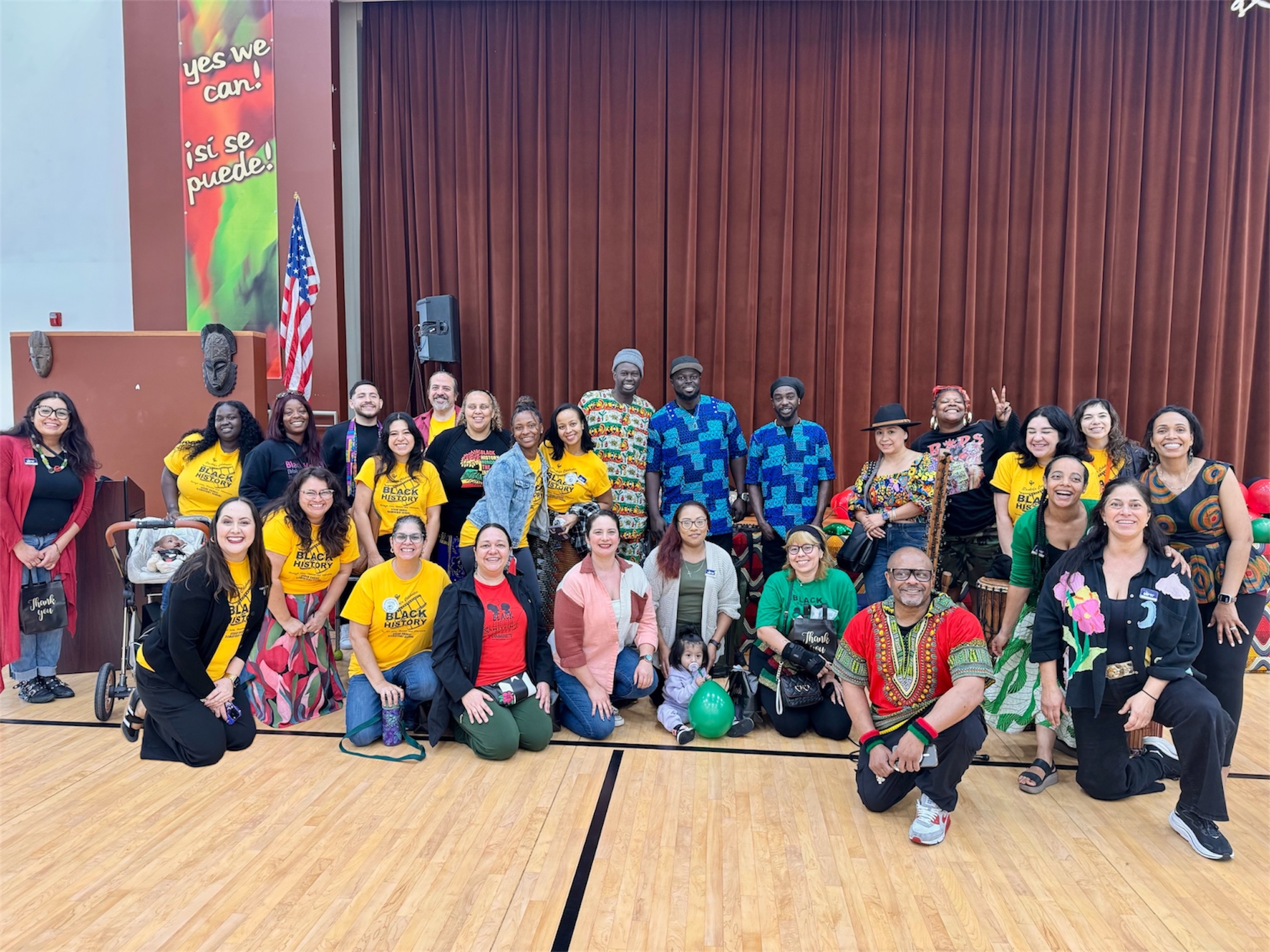
Ame Kora music group poses with school staff and members of the Sankofa Parent Village chapter of Chavez Elementary at the Black History Month assembly on February 26, 2026. (Photo courtesy of Rich Archbold)
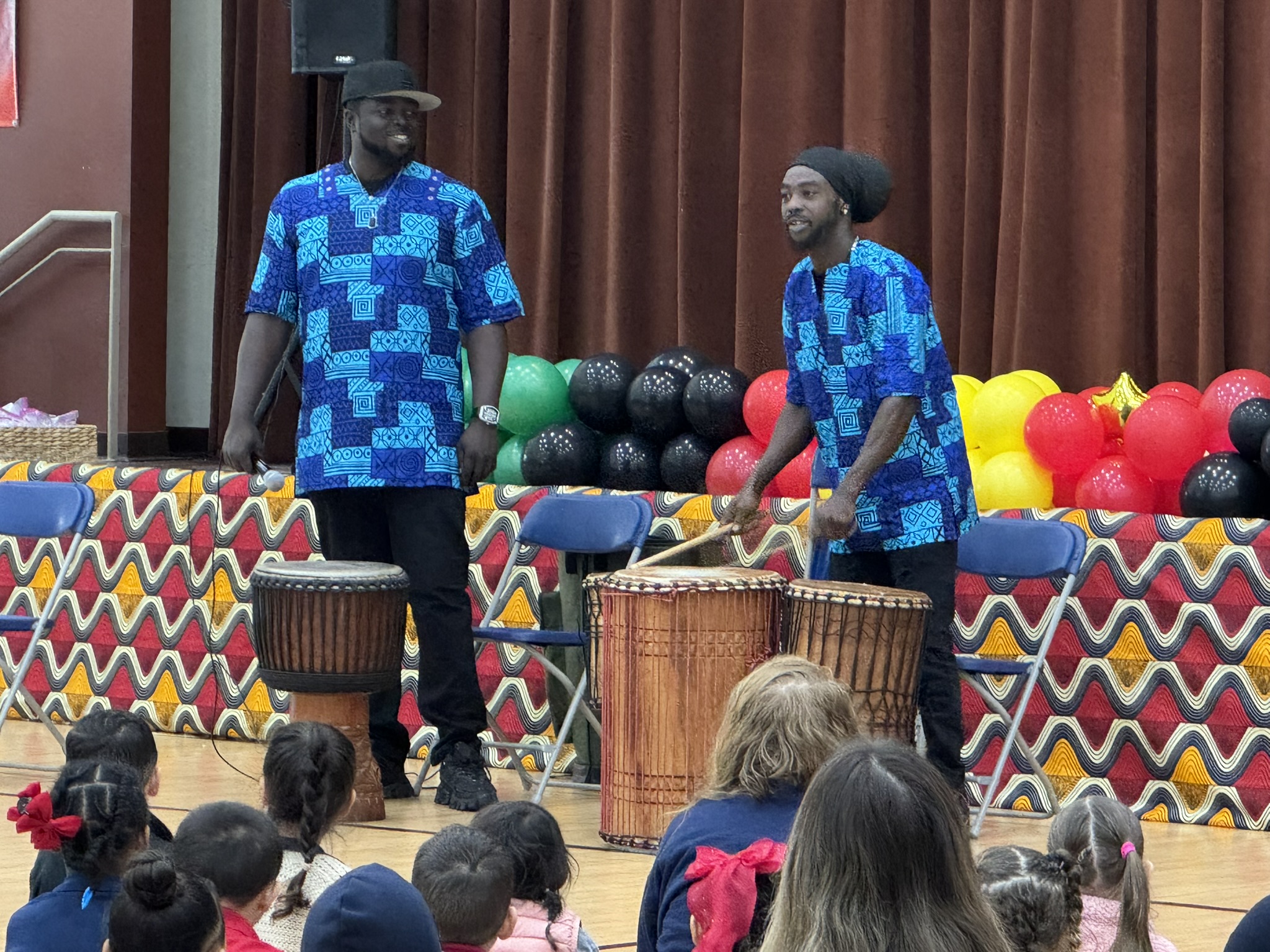
Musicians from the Ame Kora music group play the West African djembe (left) and dundun drums at the Black History Month assembly at Chavez Elementary on February 26, 2026. (Photo courtesy of Rich Archbold)
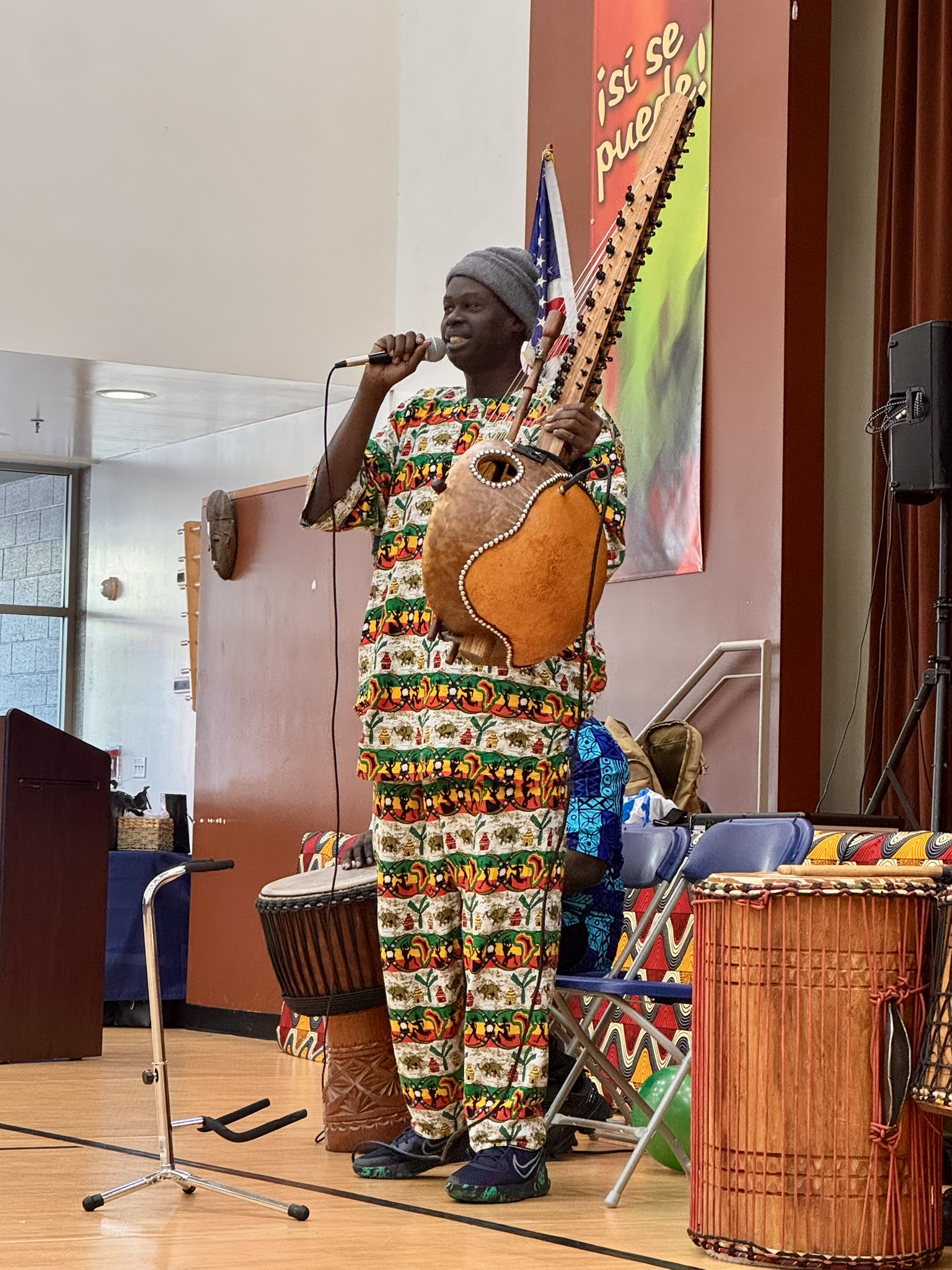
Amadou Falls demonstrates the West African kora, a 21-string harp/lute instrument at the Black History Month assembly at Chavez Elementary on February 26, 2026. (Photo courtesy of Rich Archbold)
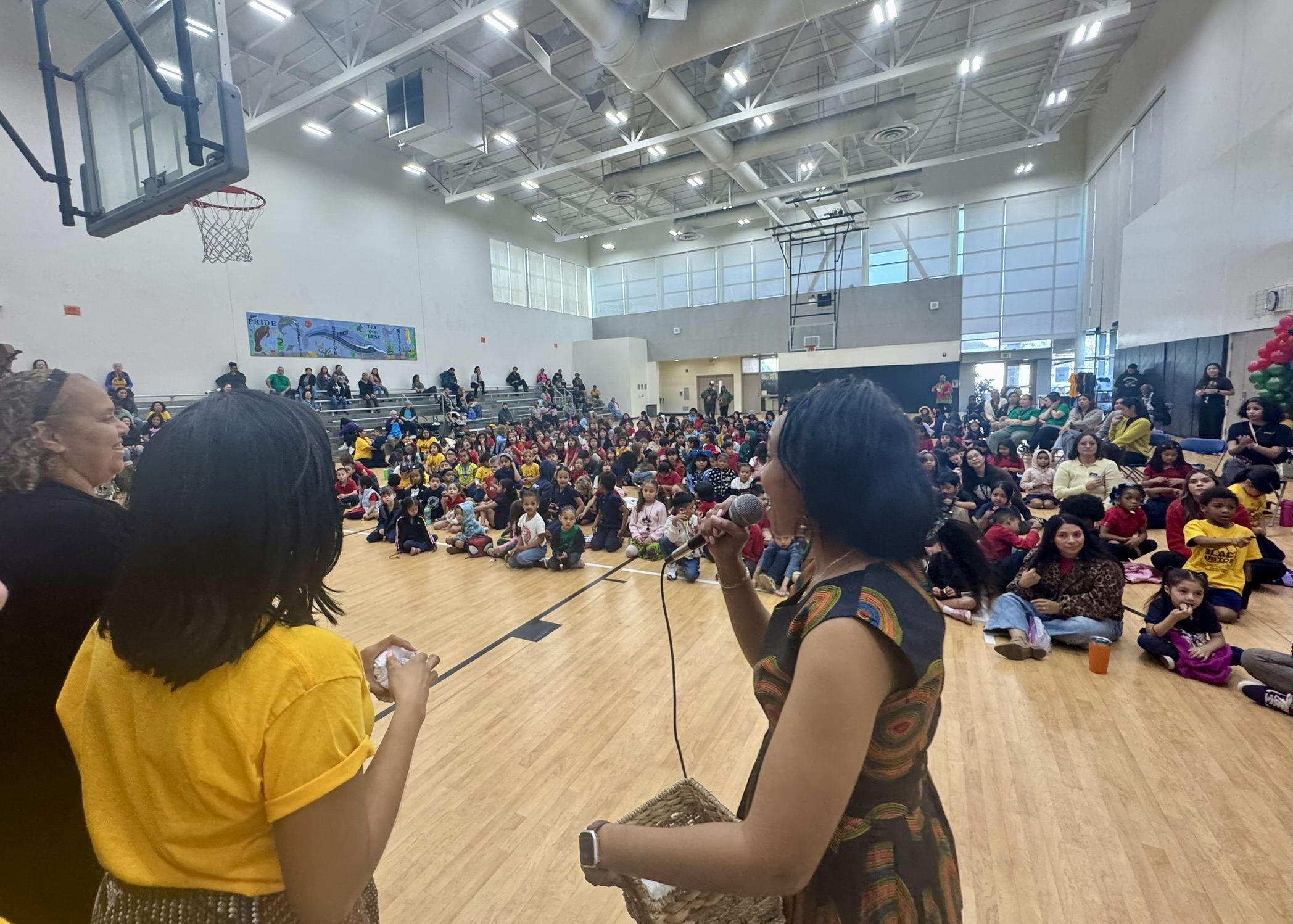
Students listen to Sankofa Parent Village speakers and West African music at the Black History Month assembly at Chavez Elementary on February 26, 2026. (Photo courtesy of Rich Archbold)
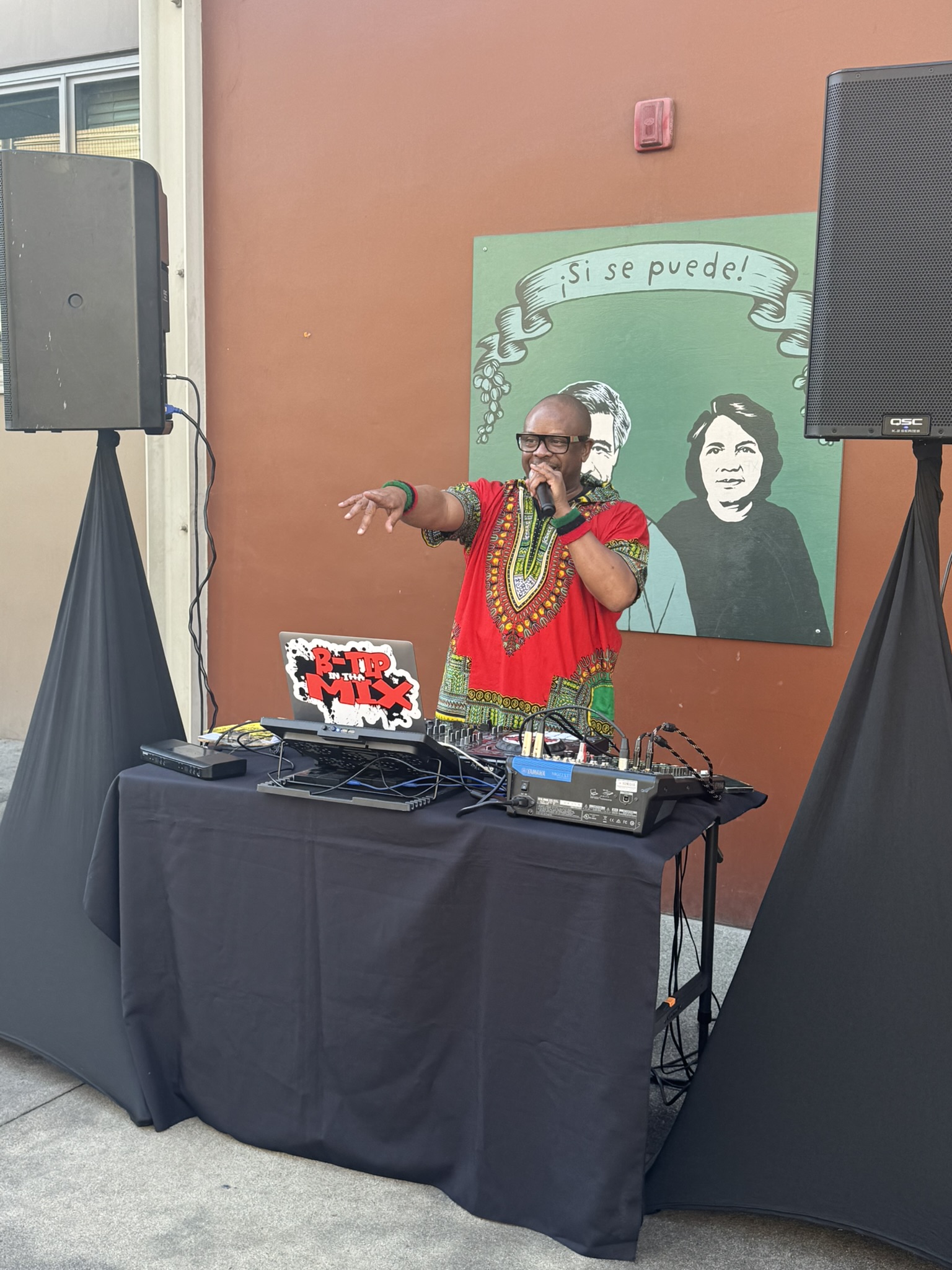
DJ James B-Tip Brown plays music to welcome students and families to the Black History Month celebration at Chavez Elementary on February 26, 2026. (Photo courtesy of Rich Archbold)
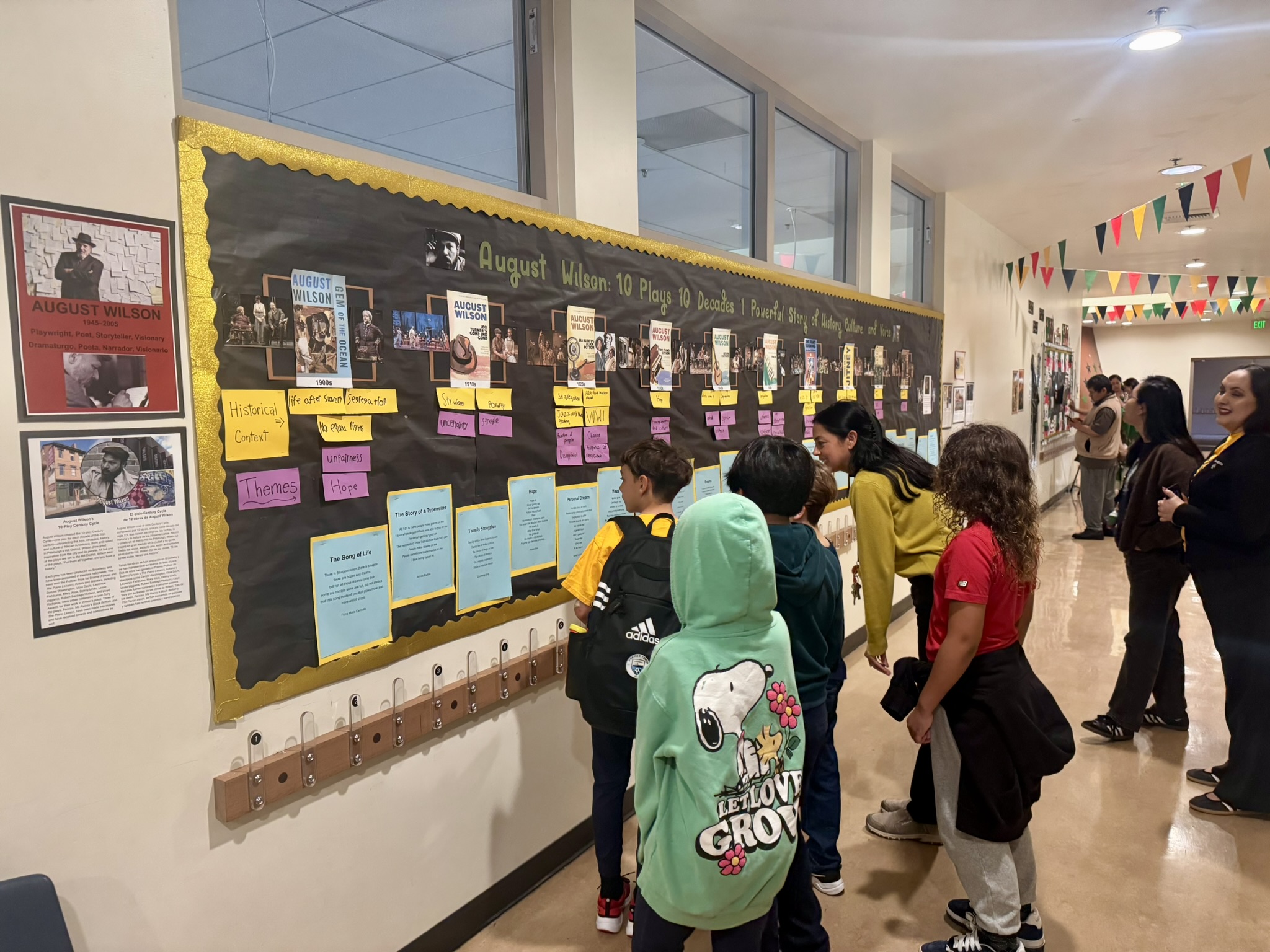
A bulletin board featuring playwright August Wilson along with students’ poetry inspired by Wilson is on display during Black History Month at Chavez Elementary. (Photo courtesy of Rich Archbold)
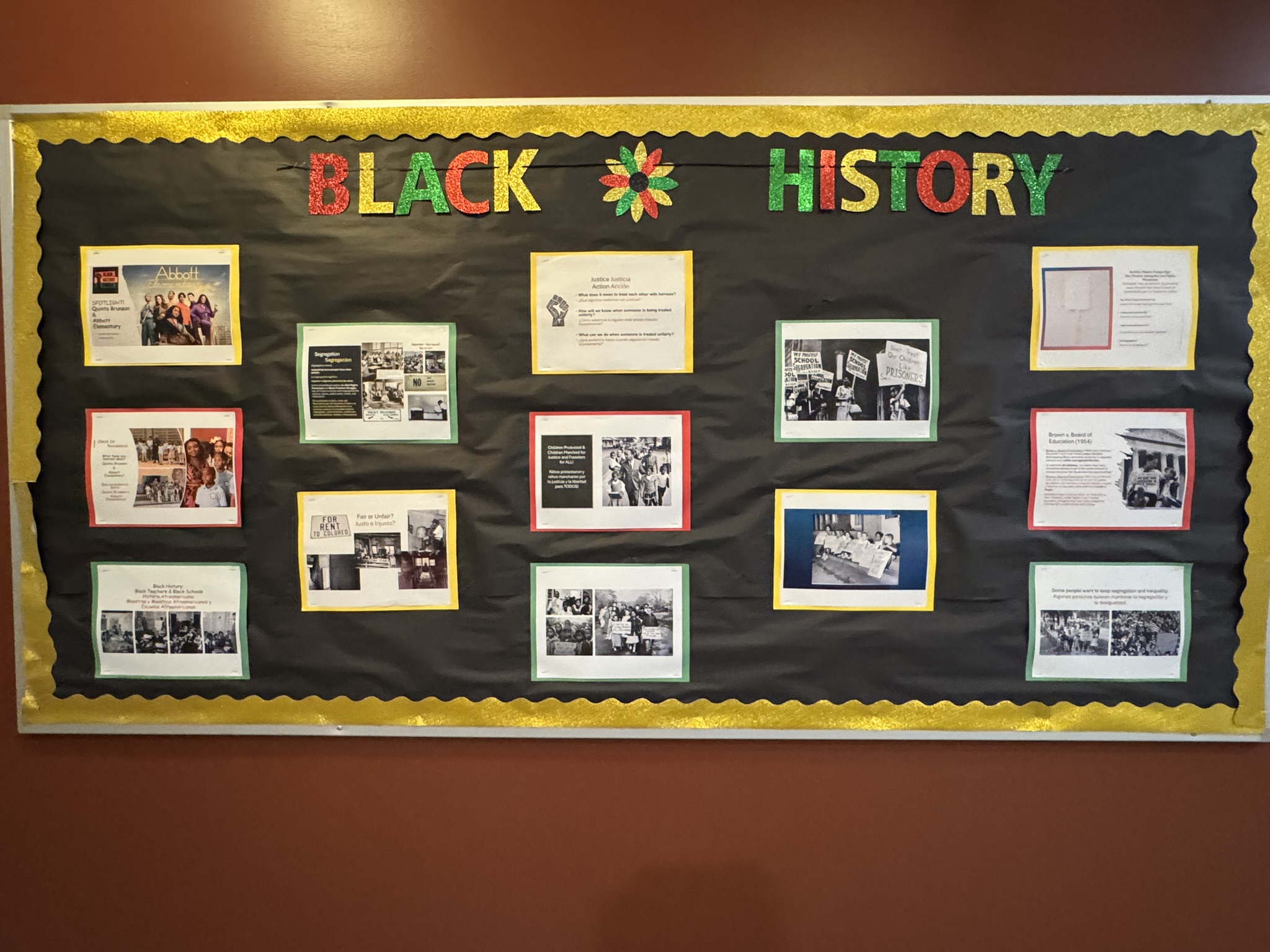
A bulletin board featuring Black history is on display at Chavez Elementary. (Photo courtesy of Rich Archbold)
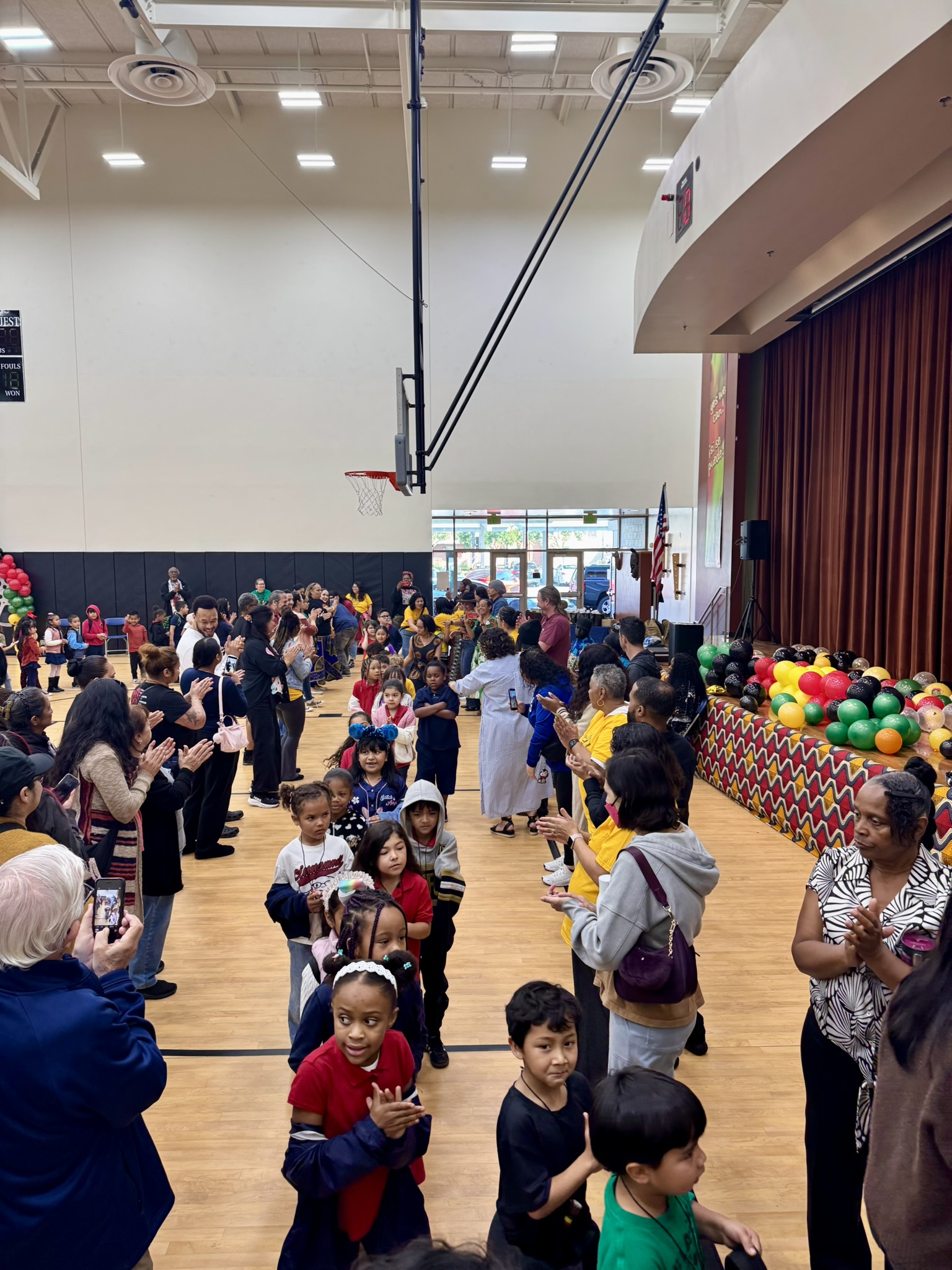
Students at Chavez Elementary depart their Black History Month assembly through a ‘Soul Train’ line of jubilant, clapping families on February 26, 2026. (Photo courtesy of Rich Archbold)
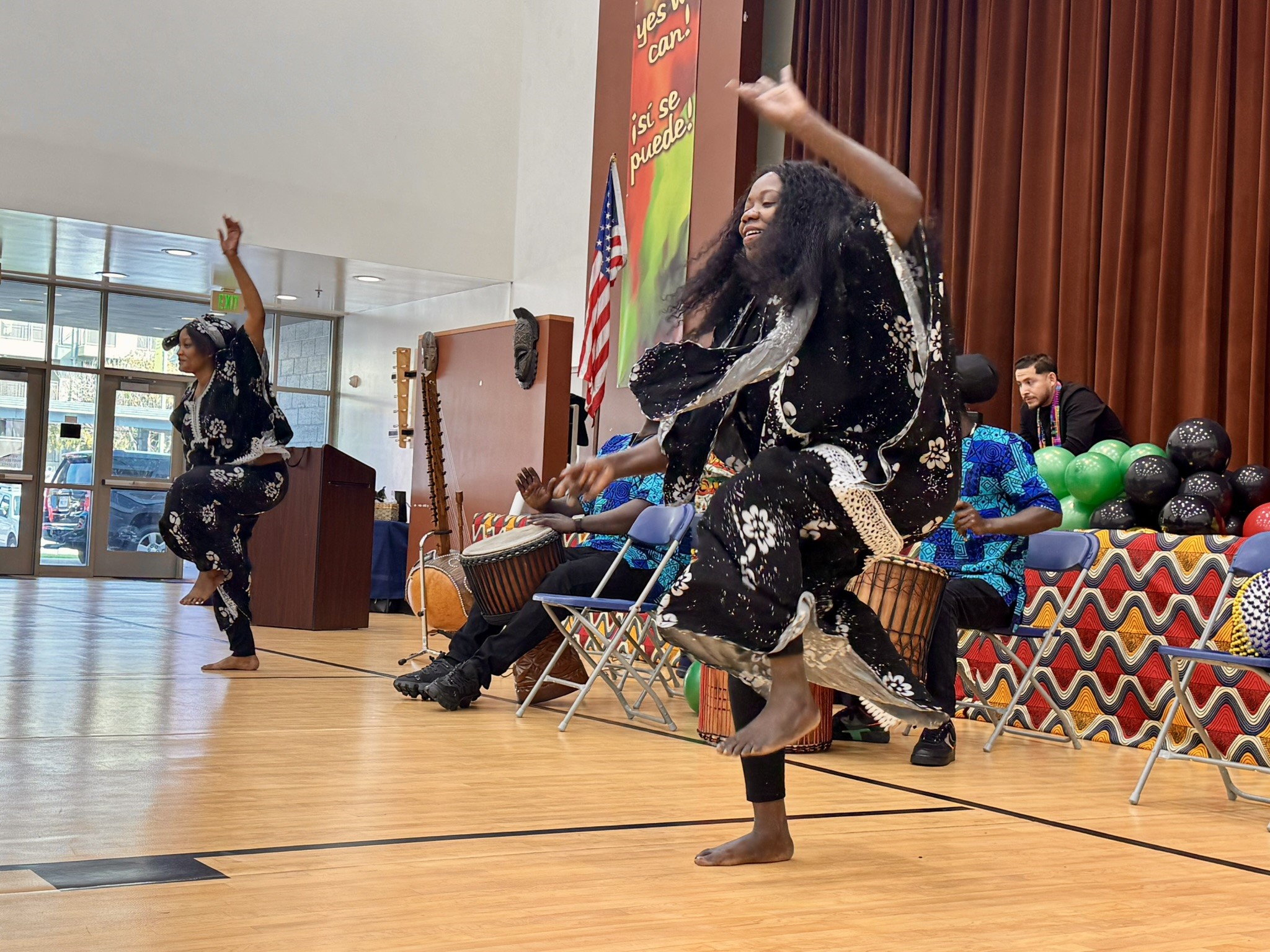
The Ame Kora music group share West African dance and music at the Black History Month assembly at Chavez Elementary on Thursday, Feb. 26. (Photo by Rich Archbold, Press-Telegram/SCNG)
Show Caption
1 of 9
Ame Kora music group poses with school staff and members of the Sankofa Parent Village chapter of Chavez Elementary at the Black History Month assembly on February 26, 2026. (Photo courtesy of Rich Archbold)
The joyful program started with everyone singing the Black national anthem, “Lift Every Voice and Sing.”
The school’s theme this year was celebrating Black excellence in television, film and theater, said Chavez Elementary Principal Brenda Ocampo.
“We wanted to honor the visionary artists, writers, directors and performers whose creative brilliance has shaped culture, challenged injustice and expanded how our stories are told,”Ocampo said. “By uplifting the creative minds behind the entertainment we enjoy, we inspire pride, possibility and social change within our students.”
Before the assembly in the gym, students and families enjoyed the music of Long Beach DJ James B-Tip Brown in the outdoor courtyard.
They also toured the hallways with large bulletin boards filled with stories, poems and artwork from students that reflected their learning and creativity. Many of the displays were in both English and Spanish, as Chavez Elementary is a dual-immersion campus, one of several in the Long Beach Unified School District. Students are taught and become proficient in the two languages.
The bulletin boards showed that students learned about poet Langston Hughes, playwright August Wilson, creator Quinta Brunson, filmmaker Ryan Coogler and actor Chadwick Boseman, among many other Black creators of the past and present.
During the assembly in the gym, members of the school’s Poetry Club were introduced by Sankofa Parent Village member Jacquese Jackson.
“When the idea for a poetry club was talked about,” she said, “I knew that I had to introduce the students to Langston Hughes.”
Hughes was a poet, novelist, playwright and social activist in a career spanning four decades, starting in the 1920s. He was known for pioneering jazz poetry and celebrating African American life by portraying the struggles and joys of Black communities.
“I first learned about his work as a second grader and was inspired not only to express myself through poetry but also to dream big,” Jackson said. “It was amazing to see that his legacy still has that same effect on aspiring poets.”
Poetry Club members read their own poems, written in the style of Hughes.
The celebration at Chavez was organized by the Sankofa Parent Village chapter at the school. Sankofa means “to retrieve” in the Akan language of Ghana and is often associated with the African proverb, “It is not wrong to go back for that which you have forgotten.”
The focus of Black History Month, in fact, is retrieving and celebrating the past while also understanding the present and building the future.
Parent Deborah Anna Brown, a professor of pan-African studies at Cal State Los Angeles and history at Riverside City College, introduced her speech at the assembly with rousing greetings in three African languages: “Akwaba! Sanibonani! and Jambo!”
This month marks the 100th anniversary of Black History Week and the 50th anniversary of Black History Month, she said. Black History Week was started by Dr. Carter G. Woodson in the second week of February in 1926, the professor added.
This week was chosen because it coincided with the birthday of President Abraham Lincoln on Feb. 12 and that of Frederick Douglass on Feb. 14. President Gerald Ford recognized Black History Month in 1976 during the celebration of the United States bicentennial.
“Dr. Woodson was born at a time when Black children were segregated and the material they were taught did not include them,” Brown said. “This month is a celebration of Black excellence — Black history, culture and tradition in the face of racism, violence and oppression.”
The month is also a reminder that Black history should not be just one short month of the year, she said.
“Black history is 365 days of the year and 366 in leap year,” she said as everyone applauded.
After the assembly, Brown told me that featuring the music and dance of West Africa was appropriate, as the majority of African Americans trace their genetic lineage to that part of the African continent.
Teacher Alma Alvarado-Zaldivar said her fourth grade class studied the work of Wilson, a Pulitzer Prize-winning playwright. He created a collection of 10 plays known as the “Century Cycle,” which chronicles African American life in each decade of the 20th century.
“From these historical contexts, we generated themes, such as identity, dreams, creativity, justice, family, resilience and hope,” Zaldivar said. “Our students wrote original poems inspired by Wilson’s body of work. Just as Wilson used poetry and storytelling to give voice to real people and lived experiences, students used their writing to reflect on their own communities and the themes we explored across time.”
One of her students wrote” “The world is a struggle. There’s hatred in the air. It’s starting to get better the more we hope. Soon in the future we will get full justice.”
You can see one of Wilson’s plays, “Gem of the Ocean,” at the Long Beach Playhouse, 5021 E. Anaheim St. The play is running on weekends through March 21. “Gem of the Ocean” is set in the 1900s, the first installment of Wilson’s 10-play, prize-winning work.
The celebration at Chavez Elementary ended fittingly, with the students exiting through a “Soul Train” line formed by proud families and friends — clapping in jubilation to the beat of West African drums.