
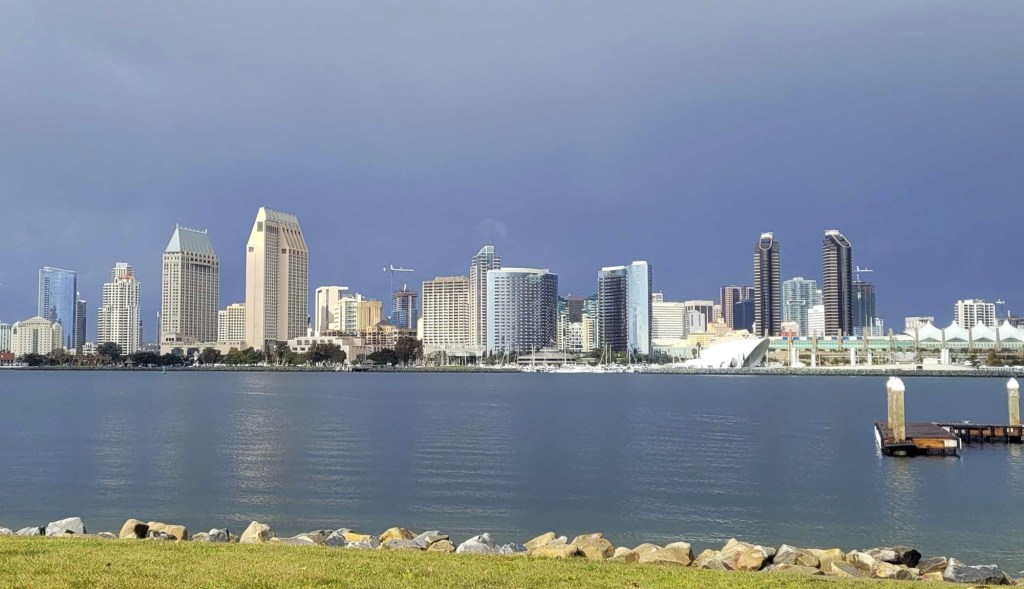
San Diego’s latest consideration of a tax on empty second homes has hardly generated the passion and rhetoric surrounding California’s Billionaire Tax Act initiative.
But the proposals share some of the same themes, goals and circumstances. They seek to have people with assets beyond the reach of many pay more to finance increasingly strained public services amid federal funding reductions — and tax cuts weighted toward the upper-income brackets.
Those and similar efforts also come at a time when the familiar notion of taxing the rich, especially the ultra-rich, has regained momentum nationwide.
An underlying context for some of this is the long-simmering agitation over the wealth gap, which has grown for decades.
A little-noticed coincidence on this front occurred on Wednesday. As the San Diego City Council’s Rules Committee advanced a levy on empty second homes to the full council, a virtual nationwide news conference was held on the “Real Affordability Agenda.” The leaders at the news event referenced what they said were 100 state bills across the country “to rein in runaway wealth-hording by the ultra-rich and runaway cost of living for the rest of the country.”
Sean Elo-Rivera, the San Diego council member and author of the second-homes proposal, has not used that kind of stark, class-warfare rhetoric. But he has insisted that various entities — be they wealthy individuals with unproductive properties, corporations or tourists — don’t pay what he says is their fair share for the burden they place on city services and housing.
This was his second attempt at the tax. His first one failed largely because it was paired with a new tax on short-term vacation rentals. That motivated Airbnb to threaten a big-spending campaign to defeat it, with a hint that the corporation might also contribute to an effort to overturn the first-time trash-collection fee on single-family homes, which would explode the city budget.
Further, rental owners who aren’t necessarily well-to-do protested, saying the fee would deprive them of income they count on. Influential city business leaders also came out in opposition, as did protesters reportedly bused in and paid for by Airbnb. The proposal didn’t get out of committee.
Beyond helping San Diego close a budget shortfall, Elo-Rivera maintained the taxes on second homes and short-term rentals would relieve pressure on the city’s housing shortage.
Regarding the empty second homes, supporters of the tax say such properties should be either used as rentals or put on the market so people can live in them. Otherwise, the belief is, if someone can afford to own a second home and leave it empty, they can contribute more to the city.
The revised proposal would charge $8,000 to leave a home empty, which would later increase to $10,000. The tax could be avoided if the owner or a relative lived in the house for at least 183 days a year, or rented it out. An added charge of several thousand dollars would be assessed on corporate-owned empty homes.
According to a city staff report, there are other jurisdictions with second-home taxes such as Berkeley, the state of Montana, Washington, D.C., and Summit County, Utah, which includes Park City.
Last year, Rhode Island passed the so-called “Taylor Swift Tax” on high-priced vacation properties, a surcharge for second homes valued at more than $1 million. The superstar entertainer’s house, assessed at around $28 million, became a poster child for the law.
Elo-Rivera’s office said there are 5,115 empty second homes in San Diego that could raise tens of millions of dollars annually, though the estimates vary greatly — from $12 million to up to $51 million in the first year, according to Lori Weisberg of The San Diego Union-Tribune.
The solo second-home proposal, targeted for the June ballot, gained more council support, and considerably less opposition. Still, some council members are leery of adding any new revenue-raising fees after the debacle of charging for parking at Balboa Park and the outcry from homeowners over the trash fees. All of this has come on top of several other fee increases.
Having the means to keep a house or condo empty except perhaps for occasional visits suggests at least a comfortable level of wealth. That doesn’t mean those who have an empty second home would necessarily be considered ultra-rich.
The Billionaire Tax Act makes no mistake about that. But taxing the rich, even those with considerable wealth, in the past has proved both attractive, at least at the outset, and complicated, at least politically. There have been regular proposals across the nation for decades, particularly in California, but success has been spotty.
Under the proposed November ballot measure, Californians and certain trusts with a net worth of $1 billion or more would see a one-time 5 percent tax. Proponents said this tax will apply to about 200 people.
The proposal has split the Democratic Party, as famously exemplified by Gov. Gavin Newsom, an outspoken opponent, and Vermont Sen. Bernie Sanders, who just came to California to stump for it.
Sanders and other supporters say too many people in the state are hurting and feeling the squeeze in services while billionaire “oligarchs” profit obscenely from doing business in California.
However, some big Democratic fundraisers aren’t enthused, and Silicon Valley titans are putting up lots of money to oppose it. Some billionaires said they already moved out of the state and others are threatening to do so, though the measure is retroactive to Jan. 1.
Even some unions are critical of parts of the measure, which directs most of the revenue to cover federal cuts to the Medi-Cal system for lower-income residents, according to Politico. The initiative is by SEIU-UHW (United Health Workers).
Newsom argues that because the California progressive tax system collects a big chunk of the state’s revenue from the rich, the initiative will blow a hole in the budget and put California on weaker competitive footing with other states.
A couple of decades ago, a Sacramento columnist reflected on the outsized impact wealthy residents have on state finances. His tongue-in-cheek suggestion to Californians: “Hug a millionaire today.”
So far, the trend to hug a billionaire has yet to emerge.
What they said
USA Today (@USATODAY) after the death of the drug kingpin known as El Mencho.
“Mexican officials said that about 80% of the recovered weapons in crime scenes were purchased in the United States and smuggled across the border.”