
Black History Month is dedicated to celebrating Black stories, culture and community, whilst acknowledging historical suppression. During this time, it’s common to see social media posts circulating with information and events hosted by members of the Black community, uplifting their voices.
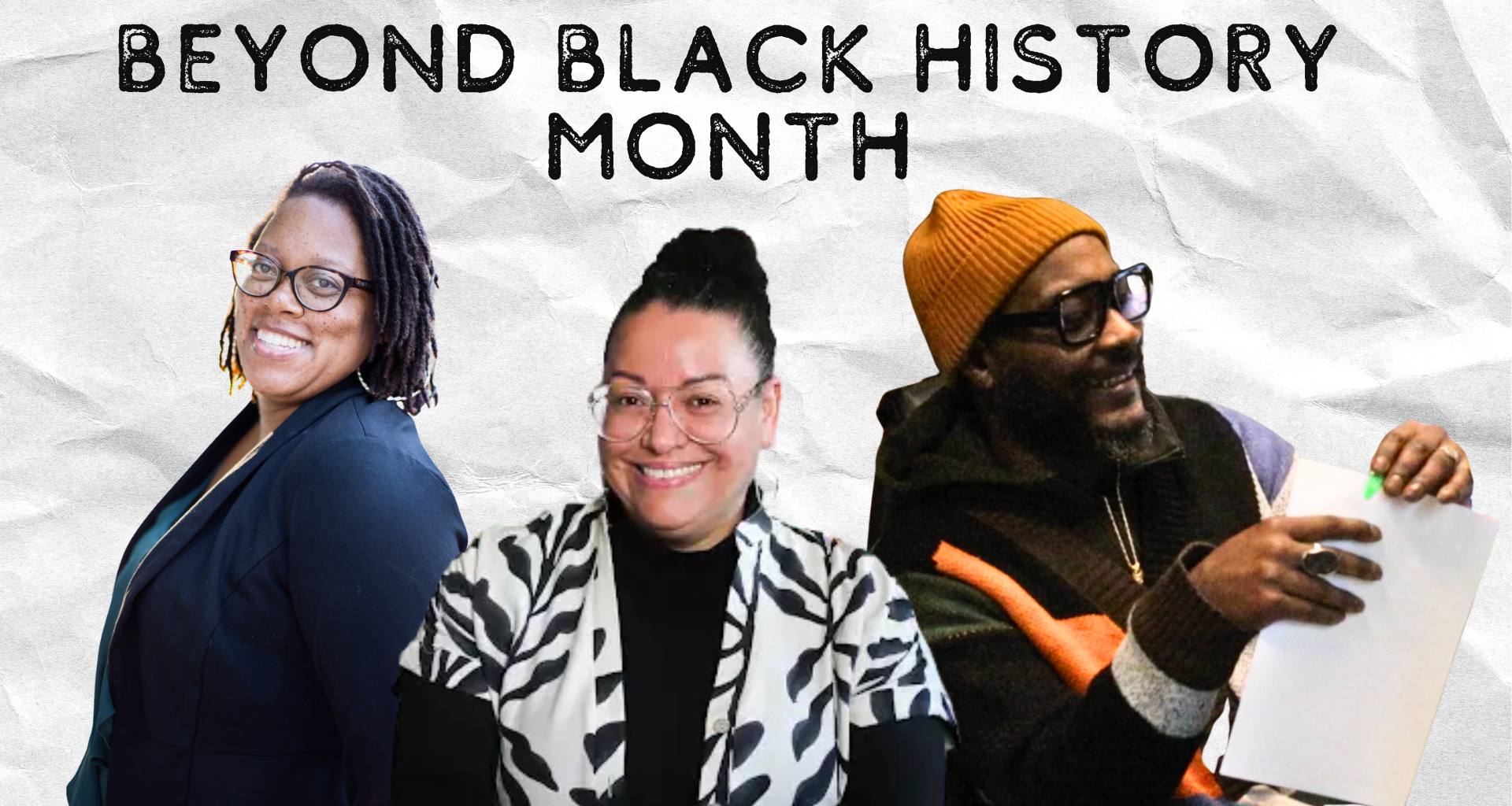
When coming across these stories during BHM, the question of how to continue to bring to light topics of Black history and culture beyond just the month of February might arise. Three Sacramento State professors share their insights about how people can begin to use the lessons learned from Black History Month to fight false narratives and elevate Black stories year-round.
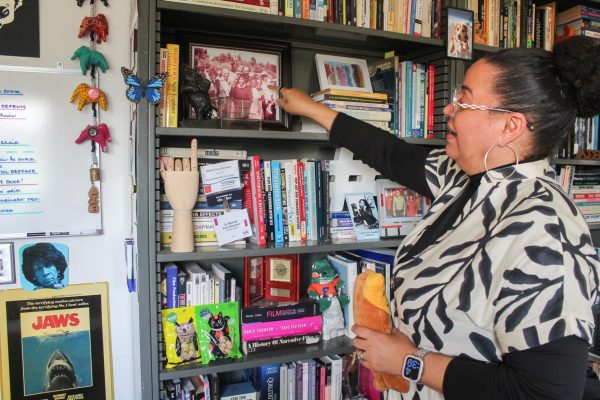 Professor and Executive Director for Presidential Communications Michele Foss-Snowden is posed pointing at an image of her family and reflects on her time in Sacramento while inside her office in Mendocino Hall Thursday, Feb. 26, 2026. Her office holds collectibles of her favorite movie franchise “Star Trek,” reflective of her discussions of the complex impact the movies have had on race and media. (Nykeriyah Brown)
Taking ownership of storytelling
Michele Foss-Snowden is a professor of rhetoric and media in the Department of Communication Studies and current executive director for presidential communications at Sac State. Her research focuses on television, movies and rhetorical criticism, specifically related to race and culture.
“The biggest challenge facing us right now is media literacy. But it’s the unique combination of media literacy plus hegemony,” Foss-Snowden said.
She explained how the suppression of Black history, culture and identity through media is intentional, but it is not always the fault of the audience.
“It’s almost like an IV drip of damaging content but doing so in a way that you don’t see it coming, and you consent essentially to your own oppression,” Foss-Snowden said.
Many Americans spend their free time consuming media such as movies and shows, with an average of 15.5 hours a day according to Scholars Strategy Network. Foss-Snowden said entertainment and media can also hold racial misconceptions and prejudices that begin to form and embed within society.
The Scholars Strategy Network also said that “racial images packaged as entertainment can skew the way all viewers understand and categorize people,” which has an impact on both Black and non-Black audiences.
Foss-Snowden emphasized how storytelling is crucial to understanding the human experience, including why it’s important to recognize how fictional and factual media can be damaging to marginalized communities.
“We, as humans, crave stories,” Foss-Snowden said. “We learn a lot of that very fundamental part of humanity through media storytelling. It doesn’t feel fair to blame the audience for accepting this food, even though it’s rotten, when we’re starving.”
She said that racism is unavoidable because of how deeply rooted it is in the foundations of our country’s history and media. However, she added that there are still ways for all people to begin to dismantle these structures with this in mind.
“I really think that the answer is taking more control of our storytelling,” Foss-Snowden said. “So the more that we can be a producer of our knowledge, instead of just a consumer of knowledge, the better off we’re going to be. And we are definitely seeing movement in that direction.”
Although Foss-Snowden said there is some overemphasis in mainstream media to push for representation, she hopes that communities begin to take ownership of their storytelling to make meaningful change within the world of media.
“My recommendation is that we absolutely flood all corners of the production landscape with our own storytellers,” Foss-Snowden said. “Not just being the ones who tell our stories but then also knowing what to do with those stories as individuals, once they’ve been produced.”
Lean into your curiosity
Clarence George III is an assistant professor in the Department of Ethnic Studies in the Pan-African Studies Program and director of the Cooper-Woodson College Enhancement Program. His desire to learn about his ancestry has driven his scholarly career, inspired by his experience as an undergraduate student at Sac State, graduating with a bachelor’s in communication studies in 2010.
“I think for me, Black History Month is something that should be celebrated outside of Black history because it’s talking about the foundations of human history,” George said. “Created by Carter G. Woodson, [the program]it laid the foundation for all the other heritage months that we celebrate and appreciate.”
He said that Black History Month is a moment to recognize all of American history, and how it displays the beauty and uniqueness of American multiculturalism.
RELATED: A legacy built on community and perseverance: Sac State professors reflect on Black History Month
“The American experience is such a rich and diverse one to where you can’t have the American experience without all these intricate ethnicities coming together to make it that. They all have a story to tell,” George said.
Readers and media consumers should dig deeper when they come across factual information and to trust their own ability to form conclusions, George said.
“We have to lean into our curiosity and realize that, unfortunately, sometimes information just ain’t gonna get to us,” George said. “So sometimes we have to be actively seeking information.”
George relates fact-checking to the principles of the court of law, and emphasizes how people should take the time to cross-reference evidence and find multiple sources while finding a rhythm that makes the research process easier.
“Education, research, conversation and genuine honesty are at the key of how we do better, and dare I say, a pinch of love,” George said.
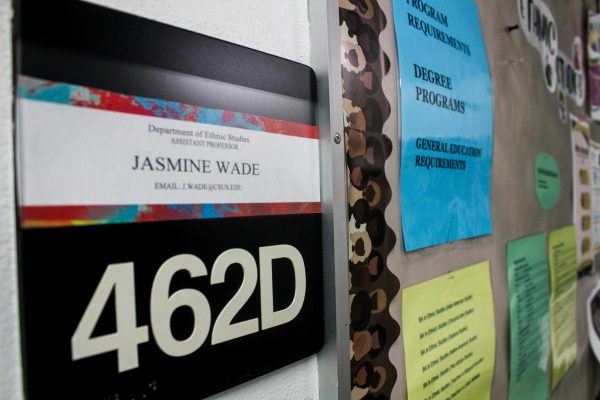 The outside of ethnic studies assistant professor Jasmine Wade’s office inside the Ethnic Studies Department in Amador Hall on Thursday, Feb. 26, 2026. She designed an Afrofuturism class for the department that she hopes to teach that focuses on how the Black community can thrive in the future. (Nykeriyah Brown)
Keep it simple: Find joy and stay grounded
Jasmine Wade is an assistant professor in the Ethnic Studies Department, specifically the Pan-African Studies program, where she teaches classes like ETHN 172, also known as “Black Women in America.”
The topics of Black history and modern-day struggles with racism and suppression can be overwhelming and complicated. Wade recommends people begin to shrink their information load and think more locally to make change more feasible.
“Given everything that’s happening, I’m not really thinking about this as being solvable on a global scale,” Wade said. “I’m thinking about what’s going on in my family, what’s going on on my block. What can I do within my community?”
Wade said she believes that when you break things down, tackling racist media and narratives can feel more tangible. One way she recommends people can stay informed without feeling overwhelmed is action through the things they enjoy.
“Popular culture is really good at capturing the mood of a time,” Wade said. “And I think that is another way to stay informed, stay present and in the moment, and understand what’s going on.”
Going to the movies, watching a trending show or listening to popular music is a way of participating in culture while embedding your presence in the media landscape.
“Being informed and leaning into joy and pleasure don’t have to be distinctly separate things. You can go to the movies and feel like you’re elevating your consciousness,” she said. “We’re doing the best that we can. And sometimes that’s going to look like me binge-watching ‘Paradise’ because that’s what feels good right now.”