
A rule mandating that new market-rate housing developments in Clovis include affordable units — which the city is required to implement as part of a 2024 lawsuit settlement — has cleared the city’s Planning Commission and is headed next to the City Council.
The commission voted 4-0 on Thursday evening to OK the “Mixed-Income Zoning Ordinance,” which would require developers of any new residential project that has 11 or more market-rate homes to set at least 5% of the units aside for lower-income residents. But developers will be allowed to pursue “alternatives for compliance,” the draft ordinance says, including paying fees.
Commissioners and city staff noted Thursday that there remain several unknowns in the ordinance: How long will it be in effect? How will developers navigate the rules? What happens to an affordable house if the primary owner dies?
“We’re the first city in the Central Valley that has this as a requirement,” Chad McCollum, the city’s economic development and housing communications director, said during the meeting. “We will have things that we just don’t know as we go through this process.”
He told The Fresno Bee in an email that the City Council is expected to consider the proposed ordinance in April.
Clovis doesn’t have much choice but to pass some form of the proposal. The city has to implement a mixed-income housing ordinance because of a lawsuit filed against the city in 2019 by Fresno-area housing activist Dez Martinez, who accused Clovis of violating state law by zoning land in a discriminatory manner and not planning for affordable housing.
When it settled the lawsuit in 2024, the city agreed to implement a mixed-income ordinance and create a local housing trust fund, among other housing and development-related concessions.
“The goal of this program is to build units,” McCollum said during the meeting. “Number two is to ensure that they’re dispersed throughout the city as widely and as fairly as possible.”
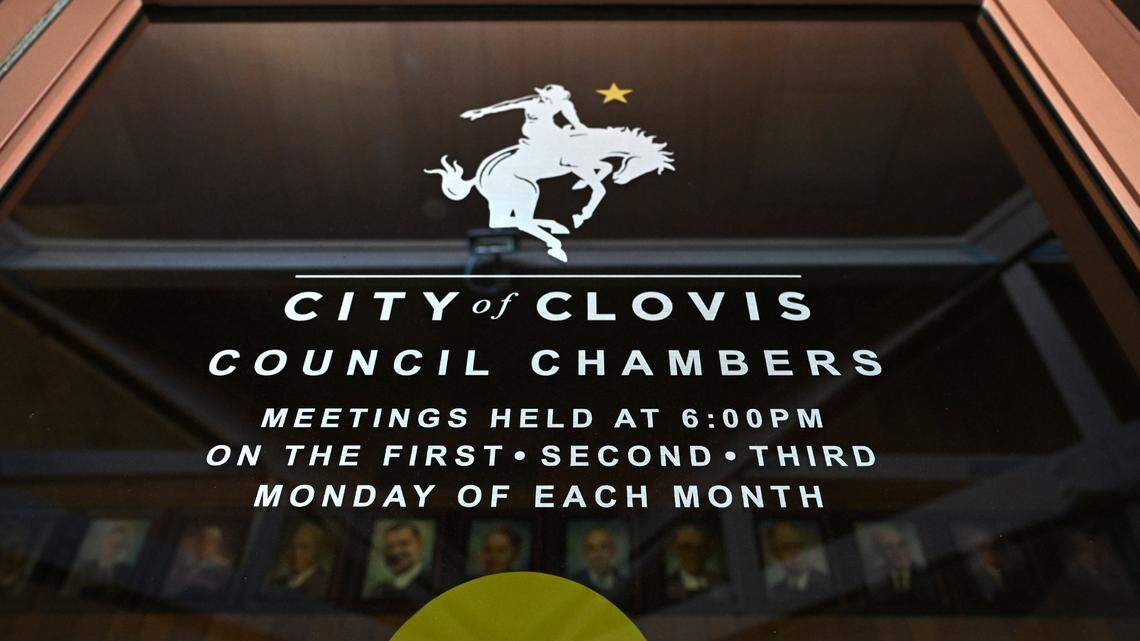
The entrance to the City of Clovis Council Chambers, photographed Friday, April 11, 2025 in Clovis. ERIC PAUL ZAMORA ezamora@fresnobee.com Proposed Clovis affordable housing rule aims for flexibility for developers
For rental residential developments, at least half of the required affordable units (5% of the total unit count) would have to be affordable to “very low-income” households, defined as ones with an income lower than 50% of the area median income. The rest would have to be available to “low-income households,” defined as ones making less than 80% of the area median income.
Residential developments offering homes for sale would have to make 100% of the required affordable units affordable to “low-income households.”
The affordable units and market-rate units in a project would have to be constructed concurrently. But developers would not have to build them in the same site if they have land elsewhere in the city that is ready for home construction. They could also choose to buy and rehabilitate existing market-rate homes elsewhere in the city and turn them into affordable homes, or dedicate land they own elsewhere in the city to affordable housing.
Developers could also pay $2.80 per square foot of residential floor area in each market-rate unit they build to get out of building affordable housing, though the city could adjust that fee. Or they could propose to the City Council some other idea for compliance.
McCollum said staff attempted to make the ordinance “as flexible for the developers as possible, within the confines of the judgment.”
He said in his email to The Bee that, once fully approved, the ordinance will not apply to projects in the pipeline that had already completed their applications with the city.
“Residential projects which have not yet submitted applications or have applications which are not ‘deemed complete,’ and have 11 or more units, will be subject to the ordinance,” McCollum said.
Fresno Bee reporter Leqi Zhong contributed to this story.
Related Stories from Fresno Bee

The Fresno Bee
Erik is a graduate of the Missouri School of Journalism, where he helped launch an effort to better meet the news needs of Spanish-speaking immigrants. Before that, he served as editor-in-chief of his community college student newspaper, Riverside City College Viewpoints, where he covered the impacts of the Salton Sea’s decline on its adjacent farm worker communities in the Southern California desert. Erik’s work is supported through the California Local News Fellowship program.