
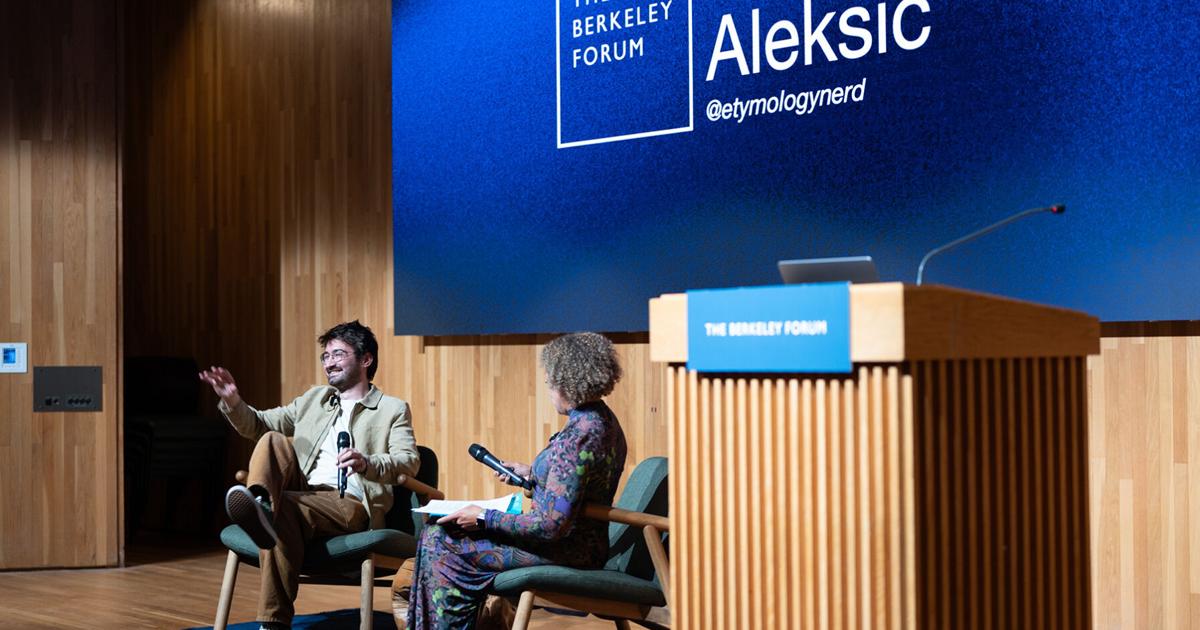
Adam Aleksic, a linguistics influencer more commonly known online as the “Etymology Nerd,” spoke at UC Berkeley about his recent book “Algospeak” and the implications of online language evolution.
The conversation was hosted Feb. 26 by The Berkeley Forum and co-sponsored by the Berkeley Center for New Media and UC Berkeley’s linguistics department. Linguistics professor Nicole Holliday moderated the conversation.
Much of Aleksic’s content focuses on how words enter into popular culture, including recent phrases tied to events or memes, such as “lowkirkenuinely” and “6-7.” At the event, he spoke about how language from incel subcultures has been adopted by mainstream online spaces as a result of algorithms that “reward extreme content.”
In his book, Aleksic also mentioned how he incorrectly thought that phrases such as “foid” would never breach mainstream spaces.
“I failed to predict the power of humor to normalize certain language,” Aleksic said in response to a student question. “I think the meaning of ‘foid’ is no longer that deeply harmful thing that it was and is now more absurd … people made the brainrot to subvert how incels talk.”
Students asked Aleksic about his opinion on the trend of subcultural language entering mainstream spaces, such as in the cases of “maxxing” and “gooning.”
In an interview with The Daily Californian before the event, Aleksic also described how internet virality creates a “different incentive structure” than in-person interaction. He said the anonymity offered on apps such as YikYak results in “a concerning misalignment with actual human objectives,” with users online making comments for the sole purpose of receiving both positive and negative engagement.
“There are these fascinating subcultures being built,” Aleksic said during the event. “The internet creates all these possibilities to surrender to the online, to dissolve yourself in a bliss of forgetting the real world.”
In the interview, Aleksic also emphasized the bias that social platforms hold when regulating speech, especially given the rise of hate speech and censorship on apps such as TikTok and Instagram.
“The problem is not with the platform at all, but really (with how it is) governing distribution,” Aleksic said. “(A social media platform is) an intermediary that intercepts our speech, and it has a financial incentive to push speech that makes (itself) money. I think it is our duty to interrogate that and be deeply aware of how the platform is really shaping more than we think.”
Cameron Irvine, a UC Berkeley engineering student who attended the event, said he believes it is critical for students across disciplines to explore all kinds of subjects, including linguistics.
“As (Aleksic) said, language is the tool that we use to communicate and every aspect of that is vitally important,” Irvine said.
Benjamin Wong, vice president of events at The Berkeley Forum, noted this was The Berkeley Forum’s first major event of the semester and that interest in the event exceeded expectations.
Aleksic emphasized how speaking on college campuses such as UC Berkeley gives him an opportunity to expound upon his ideas beyond a one-minute video.
“The medium is the message,” Aleksic said. “The way we consume media is so important and shapes profoundly how we understand information. I’m glad (there are) events like this, especially at colleges with so many inquisitive people asking incredible questions.”