
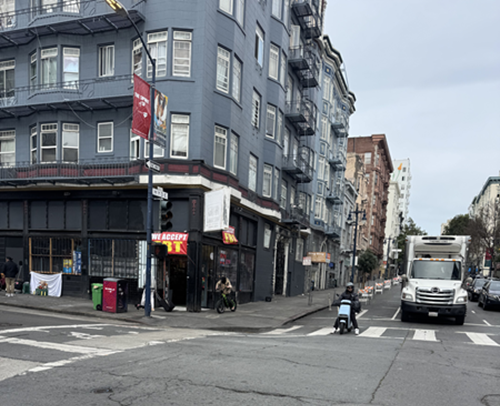
Parking barriers clear SFs oldest drug market
Parking Barriers Deter Drug Activities
Open-air drug markets still afflict multiple San Francisco neighborhoods. The police clearly need help. While the city supplements SFPD officers with ambassadors and Sheriff’s staff, an unlikely agency could potentially make a big difference: SFMTA.
How can a transit agency impact drug markets? Drug dealers like the protection of parked cars.
That’s become clear from the Tenderloin Station’s recently blocking parking on blocks with high drug activity. Leavenworth between Golden Gate and Ellis and the longstanding drug market at Hyde and Eddy have been repeatedly targeted.
When barriers to parking are in place in both areas, drug activities steeply decline and even disappear. This occurs without the presence of police.
Why aren’t barriers always in effect on these blocks? Two reasons.
Lost Parking Revenue
First, SFMTA must approve the removal of parking. And that raises fiscal issues. In 1988, when neighborhood after neighborhood was allowed to issue Residential Parking Permits for free parking 24/7, I asked Mayor Agnos’ parking chief why Tenderloin residents couldn’t get such permits as well.
After all, in 1985 the Tenderloin was completely rezoned into a residential district. Its zoning was no different from neighborhoods that got parking permits.
To his credit, the parking chief was honest. He said, “Randy, we make so much money from parking violations in the Tenderloin that we can’t give it up.”
The low-income Tenderloin has long had among the most expensive meter rates in the city. Basically, downtown parking rates. Despite the neighborhood’s almost entirely residential zoning–new non-residential uses are banned above the second floor— when it comes to parking the city still treats the Tenderloin as if new office towers filled the community.
So Tenderloin residents with cars either park at meters and take their chances or rent space in a garage. Most understandably choose the latter option.
This leaves many Tenderloin meters to the drug trade. Residents, patrons of neighborhood businesses and those visiting the neighborhood don’t feel safe parking on drug-filled blocks.
I understand SFMTA and the city face a budget crisis. But the city should not the need for parking revenue to jeopardize public safety.
Will Drug Markets Simply Relocate?
The second issue raised about barriers is that drug activities will simply move to streets that still allow parking. After all, temporarily closing Hyde and Eddy has coincided with expanded drug activities on Larkin Street.
But drug markets already operate on streets near those protected by barriers. Clearing Leavenworth and Hyde and Eddy of drug activities frees up police to focus on closing drug markets in Little Saigon.
The Tenderloin Business Coalition has constantly called for consistency of enforcement. Barriers provide that consistency. Overall, barriers reduce overall drug activities in the Tenderloin.
A Tenderloin Precedent
We’ve been down this road before.
In 2013 the Central City SRO Collaborative (CCSROC) ran a campaign to address drug dealer parking on the first block of Turk Street. As organizer Karin Drucker wrote,
“The first block of Turk Street boasts the Tenderloin’s highest crime and violence, with open drug dealing, drug use, and people crowding the sidewalk. If you are wondering why parking impacts public safety on this block, consider that the cars parked there provide a convenient and comfortable shelter for individuals to buy and sell drugs. The lack of attention from parking enforcement encourages more and more audacious behavior including serious drug use in a neighborhood where children walk to and from school and which is a mere three blocks from the posh Nordstrom’s shopping center.”
The CCSROC then focused on getting SFMTA to agree to a two-month pilot program barring all cars from lower Turk. As Drucker wrote in February 2014:
“This two-month pilot is designed to see how much a simple change in the landscape of the street will affect its activity, and to challenge the ‘containment’ assumption I mention above. Tenderloin police Captain Jason Cherniss waxes rhapsodic about the value of public safety through environmental design; not surprisingly, he championed this pilot to Director Reiskin. Supervisor Jane Kim and her aide Ivy Lee were ardent supporters as well.
But it was pressure from SRO tenants who live in the neighborhood that truly drove this effort.” (emphasis added)
As Drucker points out, shortly before the pilot parking ban began there was a double-shooting on lower Turk. Mayor Ed Lee responded by ordering Chief Suhr to have two officers, 24/7 at Turk and Taylor. The presence of those officers likely did more than the parking ban to close the largest drug market the Tenderloin up to that point had ever seen.
But the parking ban helped. And such bans are clearing longstanding drug markets in today’s Tenderloin.
SFMTA should authorize Tenderloin Station to install barricades where they have proven effective on at least a three month trial basis.
The city still faces a sidewalk drug use emergency. City Hall must implmenent all options to stop this.

Randy Shaw is the Editor of Beyond Chron and the Director of San Francisco’s Tenderloin Housing Clinic, which publishes Beyond Chron. Shaw’s new book is the revised and updated, The Tenderloin: Sex, Crime and Resistance in the Heart of San Francisco. His prior books include Generation Priced Out: Who Gets to Live in the New Urban America. The Activist’s Handbook: Winning Social Change in the 21st Century, and Beyond the Fields: Cesar Chavez, the UFW and the Struggle for Justice in the 21st Century.