

SPENCER ALDWORTH BROWN
If there’s a through line in Becca Prowda’s life, it’s service. As a 14-year-old girl growing up in Seattle in the ’90s, Prowda began volunteering at an AIDS hospice near her home — serving meals and comforting terminally ill patients in their hour of need.
That theme of service has followed Prowda into her career, maybe most notably at the poverty-fighting Robin Hood Foundation in New York City, where she worked after earning a political science degree at Barnard College. Robin Hood is also where she met her future husband, now mayor, Daniel Lurie. The two married in 2006 and have two children.
Settling in San Francisco in 2004, Prowda set her sights on working for then-Mayor Gavin Newsom, joining his administration as his assistant before moving to the Office of Protocol, followed by a nearly decade-long stint leading community affairs at Levi Strauss & Co. In 2019, Governor Newsom tapped Prowda as the state’s director of protocol, where she remains today.
In May 2024, Becca Prowda attended the Vatican Climate Summit in Vatican City, where she met Pope Francis.
Divisione Produzione Fotografica / Vatican Media
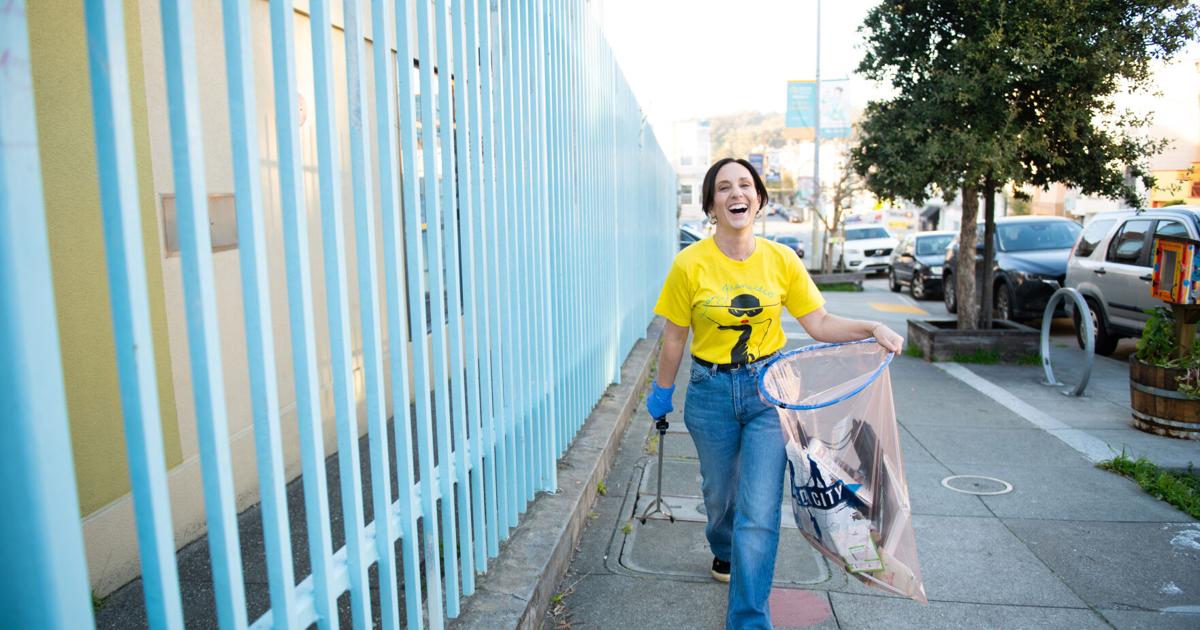
I had the opportunity to catch up with Prowda on a recent afternoon as she finished a neighborhood cleanup on Clement Street. It was late on a Friday, but the first lady of San Francisco beamed with pride and enthusiasm for the city she calls home. Our conversation ran the gamut from adapting to life as a public figure to her priorities as first lady to the power of soft diplomacy.
Well, let me begin by asking: How you are adapting to this new life as first lady? I think back to the election in November 2024 and standing on the stage that night. And I will admit there was a little bit of a wave of, “Oh, I can’t believe this is happening.” But if I actually dissect and peel back the layers of the onion, it does make a lot of sense. It makes sense that Daniel wanted to run for office, that he saw a problem, he identified the problem and he wanted to fix it.
Then for me to come along and be a part of that, it made a lot of sense too. Daniel and I met working at the Robin Hood Foundation in New York and we actually met five days before September 11. Robin Hood was, as an organization, very deeply impacted by everything that happened. Our offices were across the street from the World Trade Center.
What a horrific time … The city was in trauma, real trauma. And so that’s a little bit of the backdrop on how we met. And then in true Robin Hood spirit, and I think Daniel continued this spirit through a lot of what he’s done, it’s like it went from that feeling of hopelessness to action. Feeling like the world was falling apart to: We can do something about it, and we are going to do something about it.
Mayor Daniel Lurie with Prowda and their children at the Chinatown celebration on the January 2025 night of Inauguration.
Dave Gifford
Love that spirit. So it’s not totally surprising to me that we ended up where we are, and it’s not totally surprising to me that he wanted to take on the role of mayor. … San Francisco was in a challenging place as a city and as people, we were all trying to come out of a pandemic.
To bring the notion of, “Here we are in this situation and we’re going to do something about it,” I think it’s been very natural. … There’s this real call to action and I feel a part of that, like I bring a unique value to it, so that gives me energy. Hope, energy, joy, enthusiasm — that’s how I’m doing it.
As first lady, what unique contributions would you like to bring to the City? What I’m getting energy from right now as the first lady [is] something that’s really important to me. I’m focusing on service, which goes back to how I was raised. I grew up in Seattle and when I was young, there was a big inspiration point for me. When I was the age that my daughter is now, there was a medical facility being built adjacent to the neighborhood that I grew up in, and it was pretty controversial. There were a lot of people in the neighborhood who were for it; there were a lot of people in the neighborhood who were against it. It ended up becoming an AIDS hospice. This was in the time when there was a lot of stigma and a lot of discrimination, a lot of fear around HIV and AIDS. I had a curiosity around this, and I can remember I was in the car with my mom and we were driving by Bailey-Boushay [House], she said, “You’re asking a lot of questions. You’re curious. Do something about it.”
And so I did. I ended up volunteering there. I served meals there two days a week, Tuesdays and Thursdays, all throughout high school. And I really experienced a couple of things that are showing up in themes for me now, which is people were very scared, they were coming to the end of their life. Some of them were surrounded by love and by family. Others of them had been abandoned by their families and were alone and were feeling loneliness and isolation. I was able to play a role — holding people’s hand, I’d remember what their favorite meal was week to week and ask them if they wanted it, checking in with people, helping to meet needs that they had.
Prowda attended the November 2025 signing of a Memorandum of Understanding with the State of Pará, Brazil, where Governor Helder Barbalho of Pará and Governor Newsom signed the MOU to strengthen cooperation on wildfire prevention and response.
Office of Governor Gavin Newsom
That’s lovely. Fast forward to today, I’ve had this real theme of service that’s run through my life. … It’s where my career has gone, the mayor’s office and Levi’s and now the governor’s office. It has been a natural place for me to go as this first lady of San Francisco.
I can certainly see the theme. I’m proud of how we’ve been approaching it because I did work in City Hall. I have worked across all the city departments with a lot of people who are still serving our city, who are still public servants. It’s given me this opportunity to really reconnect with people, which is a wonderful gift, but also to bring together a lot of the touchpoints of my life.
At Levi’s, one of my responsibilities was to plan and run a global community day. And here I am now as the first lady, I know what that impact was. I know that we had employees from our distribution center to our retail stores, to our C-suite, who were showing up and feeling proud of our company and feeling invested in working there and who felt connected to their teammates. … And to think, all right, here I have this opportunity to bring some of that to San Francisco and increase the scope and increase the scale.
In any relationship there is a lot of exchanging of ideas. I’m wondering how you and Daniel think about being one another’s sounding boards? I think we’re really good sounding boards for each other and that is across his work, my work, our family life. That’s something that has been natural as long as we’ve known each other. I try to remind myself that my first role really is as a mom and as a wife, and I do try to approach being a sounding board through that perspective because there are a lot of people who are giving him their opinions and their advice and their counsel and their hopes and wishes and dreams, but I think my unique role can be someone who loves him unconditionally, thinks that he’s amazing and is really committed to his success and, by extension, the City’s success.
Prowda spoke with a San Francisco resident at a neighborhood cleanup in the Sunset last year.
So Yem
These very public roles are new to you and your husband. How are you two managing this new reality and is there anything that may surprise us about how you are navigating the journey? We eat dinner very late at night. … I do get asked the question a lot — how has our family life changed? There are definitely things that feel different being the mayor, no doubt, but our kids are pretty busy too. Our daughter started high school this year, and our son’s in middle school. Our daughter’s a ballerina, our son has a lot of sports going on in his life. As much as things have, in some ways, changed very dramatically, us coming together at the end of the day [has] actually been an organic transition. Because our kids are older, their things are going later into the evening. But I do find myself wondering sometimes: “How could it be 9:30 and we’re just eating dinner?”
Besides being first lady, you are also the director of protocol for the State of California. Give us some insight into that role. Well, first I would say, I think a lot of people don’t know what being the director of protocol is. On the governor’s behalf and on the State of California’s behalf, I am meant to be welcoming. I’m meant to be engaging. I am meant to help collaborate with international partners. We do that through hosting dignitaries coming to the State of California. … These days, there’s obviously a lot around AI and tech … also a lot related to trade, economic development, business.
We also facilitate the State of California’s representation, how we show up around the world. A lot of that work, yes, increasingly does focus on AI and technology, but for the last two decades, it’s really been focused on climate change. Under the Schwarzenegger administration, under the Brown administration, now under the Newsom administration. California has been, without question, [a] global leader in trying to figure out how to not only protect the planet, but how to do so in a way that is successful for businesses and is an economic driver.
LIGHTNING ROUND
The biggest risk I’ve ever taken is … moving to San Francisco.
My biggest regret is … I do my best not to live life with regrets.
If I had a magic wand, I would … get rid of all the trash in the city. I would green all the median strips, bring a little love to the medium strips.
I’m happiest when … I’m with my family.
That’s a very good point. I think it’s a tough time right now. It’s a tough time in our country. It’s a tough time around the world. There’s a lot of instability, a lot of fear bred out of that instability. A big part of my role, which I’m really proud of, is trying to highlight that the State of California and Governor Newsom are stable and reliable partners. We are going to work between administrations in the state to tackle tough issues and we’re going to be partners. We’re going to have technical exchange and cultural exchange and send our experts around the world so that we’re giving information and learning from international partners. I’m really proud of that during this time, because there is instability and California is not that. We’re the opposite of that.
Have you seen California use its soft diplomacy to advance economic, cultural and environmental initiatives? Absolutely, across the board. One of the cool things that I get to do is work on documents, memorandums of understanding. Pieces of paper, really, with a bunch of words on them, but behind those words, there are California state agencies, there are the leaders of those agencies, there’s the governor, there’s the governor’s staff. All of that work that happens, that is soft diplomacy. If you take an issue like electric vehicles, let’s say, or clean energy in general, we’re not just saying, “Let’s sign this document and great, we’ve done it.” It’s like, no, that’s day one for us. All of that work gets us there, and then it really is those diplomatic relationships: [for example,] the relationship between CalEPA and the Ministry of Environment in Germany and the technical exchanges that happen in between. And that is created out of diplomacy. That is created out of relationships. It’s created out of people. It’s created out of sitting across from one another and saying, “This is how we’re doing it. What can we work on together?”
What did Becca Prowda, growing up in Seattle, want to be when she was a little girl? I never knew what I wanted to be when I grew up. However, I have lucked into every job that I have had, and usually it has involved a written publication. So when I was in college — I went to college in New York City — between my junior and senior year in college, there was an article in the New York Times on the Robin Hood Foundation and I saw this article and I wrote a letter to the organization: “To whom it might concern.” And I got a call two days later from Laurie Fabiano, who went on to become my boss. She has been a mentor to this day. So that was one accidental dumb luck kind of thing that happened.
The other was when I moved to San Francisco, and I had read a New Yorker profile on Gavin Newsom and I read that profile and I wasn’t totally sure what I wanted to do when I moved out here. Did I want to continue in the public working in a nonprofit? Did I want to go into the private sector? It was a little bit of a career moment for me. I read this profile and a light bulb went off. I was like, “I have to figure out a way to work for this mayor.” And lo and behold, somehow he got a hold of my phone number and I got a call on a Friday. He said, “Becca, this is Gavin Newsom. Can you come in for an interview this afternoon? I need an assistant.” So I run home, I put a suit on. This is weeks into moving to San Francisco. I run down to City Hall. It was a Friday. I left the office starting with a job on Monday and here I am.
If you had one message to the world about San Francisco, what would it be? San Francisco is [one of] the most warm and diverse and inclusive places. It’s also one of the most beautiful. And I think it has an incredible streak of creativity and quirk. I think that that combination shows up in our small businesses. It shows up in the people who have made this their home and have built their lives here and their livelihoods. And I think it shows up in our art and our culture. I think it’s something that you can’t necessarily see on a computer screen or on your phone … it’s something you have to experience.
This interview has been edited for clarity and length.