
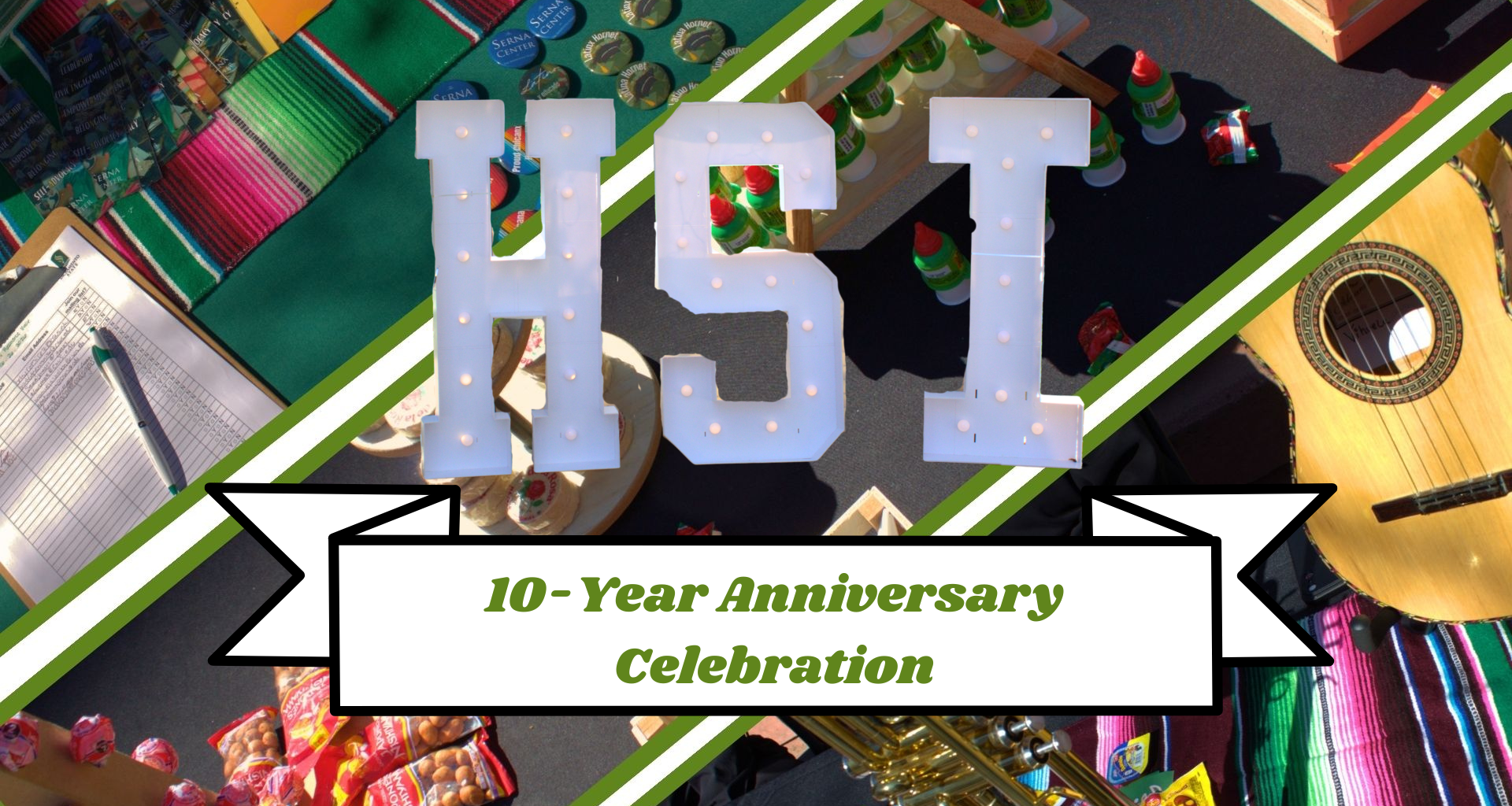
Sacramento State celebrated its 10-year anniversary as a Hispanic-Serving Institution with a celebration held on Thursday. The festivities were dedicated to honoring the culture and accomplishments of the Hispanic and Latine community.
Participants celebrated the anniversary with a day of traditional activities and a chance to learn more about the Latine community’s presence on campus through presentations and panels.
The campus officially became federally recognized as a HSI in 2015 after enrolling 7,904 Latine undergraduate students, representing 29% of the total undergraduate population. Since then, the enrollment of students who identify as Hispanic or Latine continued to grow to 39% as of this academic year. The celebration served as an acknowledgement of their growth at Sac State, as well as a space to learn ways to improve, according to some of the activities and panels taking place.
The festivities kicked off in Wileety Native College with a land acknowledgement and presentation led by HSI Director Lilia Contreras Ramirez and education professor Amber Gonzalez. They spoke about Sac State’s history as a HSI and the current Latine population present on campus.
Related: Sac State’s new HSI Director leads with service and dedication
“I think a lot of people actually don’t know what an HSI is and what it entails, not just on the student-facing thing, but the role that HSIs play in institutional work and building institutional infrastructure for universities,” Ramirez said.
They also highlighted the work that still needs to be done in order to create a support system that allows Latine students to thrive.
Following the presentation, the audience was invited to the library quad with the ‘SOMOS Fair and Activities.’ During this time, the Chicanx and Latinx Studies department hosted a ‘Cafe Con Pan Dulce Social Hour,’ decorated to commemorate the campus’s Latine communities.
Booths filled the library quad providing information about Latine-led clubs and artists sold and showcased their art. Mexican candies and snacks were also given out for free, bringing students a taste of cultural nostalgia.
The Movimiento Estudiantil Chicano de Aztlán club held a booth to educate participants about their activism, movements and the importance of Latine cultural space. Thalia Ansaldo, a psychology major and a board member of MEChA spoke about the isolation she felt in her first year before finding the club, and how important these events and spaces are for students finding their place.
“I feel like it’s really important especially for those first year and transfer students who want to be a part of something, and be a part of a community that they’re already familiar with,” Ansaldo said.
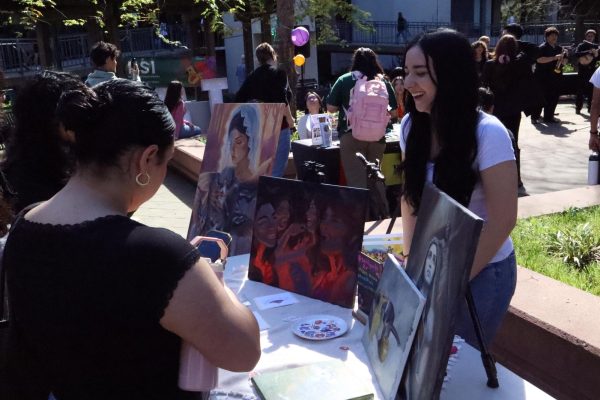 Sarah Guadagnolo, a liberal studies major and artist, sells and displays her work to attendees of the Hispanic-Serving Institute 10-year anniversary event on Thursday, Feb. 26. Guadagnolo said her art piece, “Eternal Bond,” reflects her heritage. (Gabriel Solis)
This sentiment was shared by artists like liberal studies major Sarah Guadagnolo, and Rosa Angelica Sarabia and her husband, alumnus Antonio Sarabia, who were all chosen to create a mural on campus. Guadagnolo said she creates art that showcases her heritage, with her art piece, “Eternal Bond,” symbolizing holding on to one’s grief and the generational trauma that is passed down through many Hispanic families. She emphasizes how impactful it is to display proper representation through artistic expression and the power it has to expand people’s perspectives of the community.
Sarabia emphasized the significance of artistic representation within the community, as she shared her experience growing up in a migrant neighborhood that lacked cultural exposure.
“It’s super important especially at the university level to have this kind of representation,” Sarabia said. “Especially for Latinos feeling like they not only belong here but are celebrated, that they are here and contributing in a positive way.”
Amongst the fair, the Mariachi Los Avispones, a dedicated mariachi club on campus, made their debut to the Sac State community. Jonathan Saya Gonzalez, a business major and founding member of Mariachi Los Avispones, described their initiative of providing a cultural outlet and how the HSI event supported them in achieving this community.
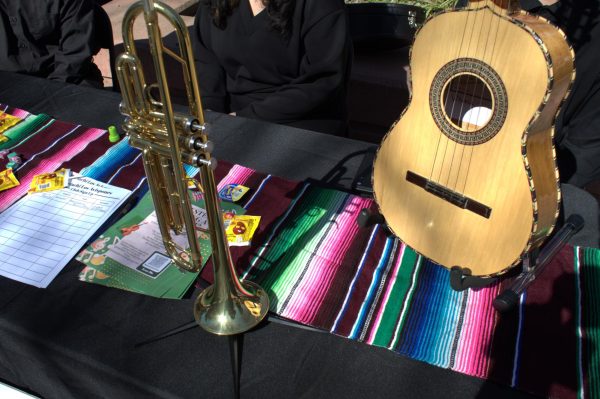 Mariachi Los Avispones made their debut in Sacramento State’s library quad on Thursday, Feb. 26, 2026. The mariachi opened their performance with ‘El Rey’ by Vincente Fernández. (Gabriel Solis)
President Luke Wood was also in attendance at the fair and gave a speech recognizing the accomplishments of HSI, highlighting the fact that Sac State just reached the highest graduation rate for Latine students in its 80 year history as a university.
“We actually have a mission focus at Sacramento State on serving Latine students,” Wood said. “That makes us one of only a handful of campuses in the entire country.”
The event concluded with the decade of servingness panel, where a conversation was led discussing HSI’s past, but more importantly how current priorities could be shifted to better serve those who’ve been traditionally underserved. The panel was made up of people who witnessed and contributed to the history of HSI at Sac State including Ramirez alongside Nancy Huante-Tzintzun, Andres Enriquez, Melisa Repa and Manuel Barajas.
The panel emphasized the need for a campus-wide conversation about frustrations with the institutions, the past of systematic exclusion and importance for more non-tokenized representation. Barajas pointed out that many of those in power are detached from the student life, specifically the Latine community, making it harder for them to understand the struggles they face and how to support them. Students were urged to learn more about these issues and become more vocal themselves about current needs and whether or not the academic institution meets them.
“It helps preserve our culture and roots, especially now during these difficult times,” Saya Gonzalez said. “It’s important to keep our pride and just overall be out there and push ourselves out there as a culture.”