
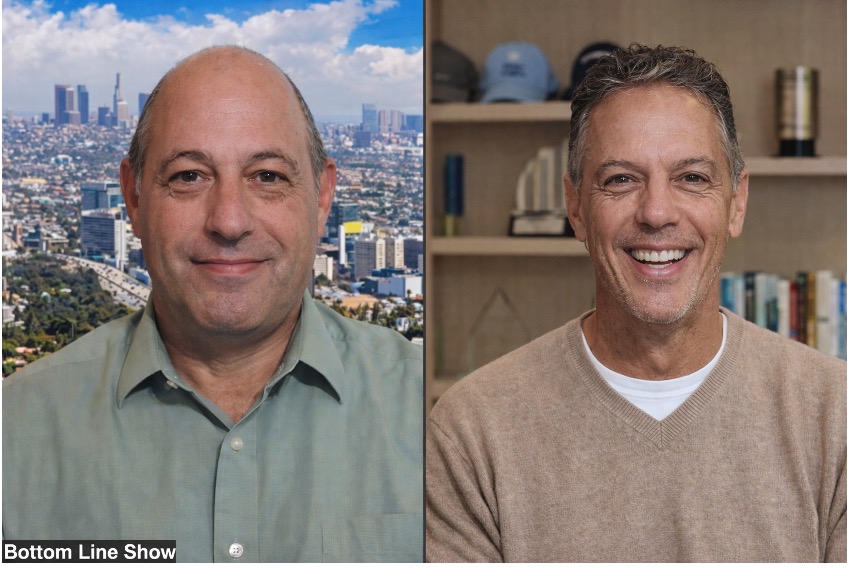
THE BOTTOM LINE – Los Angeles stands at a crossroads. Rising public safety concerns, persistent homelessness, deteriorating infrastructure, and mounting budget deficits have eroded public confidence in City Hall. As the 2026 election approaches, voters are no longer asking for promises they are demanding results.
In an interview on The Bottom Line Show, mayoral candidate Adam Miller outlined his approach to restoring accountability, improving efficiency, and rebuilding trust in a city many residents believe is no longer working for them.
Leadership Forged in Crisis
When asked about the toughest decision of his leadership career, Miller pointed to the early days of Cornerstone OnDemand, the education technology company he founded. Amid the dot-com collapse and the economic shock following September 11, he faced intense pressure to scale back and withdraw. He chose to pivot instead.
Rather than targeting individual consumers, the company shifted to enterprise software serving corporate workforces. The move required difficult financial decisions and disciplined resource management, but it proved transformative. Cornerstone grew into a global enterprise employing thousands across dozens of countries.
Miller says the lesson applies directly to governing Los Angeles: when resources are limited, leaders must optimize what they have, operate efficiently, and deliver results, not operate on hope.
A Record Built on Results
Miller argues that leadership credibility rests on measurable outcomes. He highlights initiatives he helped build or scale:
• Cornerstone OnDemand, now a multinational education technology leader
• Team Rubicon, a global disaster response organization mobilizing veterans
• A workforce initiative delivering over 2,000 internships for young adults in South and East Los Angeles
• The UCLA food allergy program and a leading global nonprofit advancing awareness
• Better Angels, focused on compassionate, results-driven homelessness outreach
Across these efforts, Miller emphasizes alignment, accountability, and measurable performance.
Operational competence not political rhetoric produces results.
Fiscal Reality Demands Discipline
Beyond leadership philosophy, the city’s fiscal reality presents one of the most urgent tests facing the next mayor.
Los Angeles faces structural deficits, rising pension obligations, and declining service delivery. Miller argues the city must adopt operational excellence rather than rely on new taxes.
He identifies key priorities:
• Eliminating duplication between city and county homelessness services
• Reducing the cost and timeline of affordable housing development
• Leveraging public-private partnerships to expand housing supply
• Modernizing city operations through automation and process improvements
He also sees opportunity in the 2028 Olympics. Poor management could deepen deficits, while effective planning could generate revenue and long-term economic benefit.
Efficiency is not optional; it is survival.
Public Safety: Compassion and Enforcement Must Work Together
Miller rejects the idea that enforcement and compassion are mutually exclusive.
Property crime remains elevated, response times lag, and staffing shortages strain law enforcement. His approach focuses on:
• Increasing patrol presence by reducing administrative burdens
• Deploying technology and smarter policing strategies
• Improving recruitment and retention across police, fire, and emergency services
• Conducting transparent after-action reviews following disasters
Safety and humanity are not opposing values they are complementary responsibilities.
Ethics Reform and Restoring Public Trust
Corruption scandals and federal investigations have damaged confidence in local government. Miller argues reform must extend beyond new regulations to cultural change.
Transparency and accountability, he says, must become standard practice not exceptions.
He expressed openness to banning developer contributions to elected officials if doing so would help restore public trust.
Public office must serve the public not private interests.
One City, Not Compounding Inequities
Miller rejects the notion of a divided Los Angeles defined by geography or privilege.
He emphasizes equitable access to opportunity, transit, economic development, and basic services across the Valley, South LA, the Westside, and the Harbor area. Persistent inequities such as food deserts and uneven investment, he argues, are unacceptable in a city of Los Angeles’s scale and resources.
Talent is evenly distributed. Opportunity must be too.
A City That Works for Its Residents
Miller acknowledges the frustration of residents who feel the city no longer delivers basic services.
Public safety, infrastructure, housing affordability, homelessness response, workforce development, and park maintenance all require improvement.
“We are paying some of the highest taxes in the country,” he said, “yet residents are not receiving the services they deserve.”
The Stakes for 2026
Miller’s closing message focused on restoring functionality and trust:
“We need a city that works better so all Angelenos can live better.”
The next mayor will inherit more than a budget deficit they will inherit a crisis of public trust.
Angelenos are not asking for perfection. They are asking for competence, transparency, and results.
Whether Los Angeles continues to drift or begins to deliver will depend on leadership defined by accountability, efficiency, and integrity.
For voters, the question is no longer whether change is needed.
The question is who can deliver it.
(Mihran Kalaydjian is a seasoned public affairs and government relations professional with more than twenty years of experience in legislative affairs, public policy, community relations, and strategic communications. A respected civic leader and education advocate, he has spearheaded numerous academic and community initiatives, shaping dialogue and driving reform in local and regional political forums. His career reflects a steadfast commitment to transparency, accountability, and public service across Los Angeles and beyond.)