

Last year, over 1,000 state employees doubled their salaries by working overtime, an analysis of California state employees’ payroll data found.
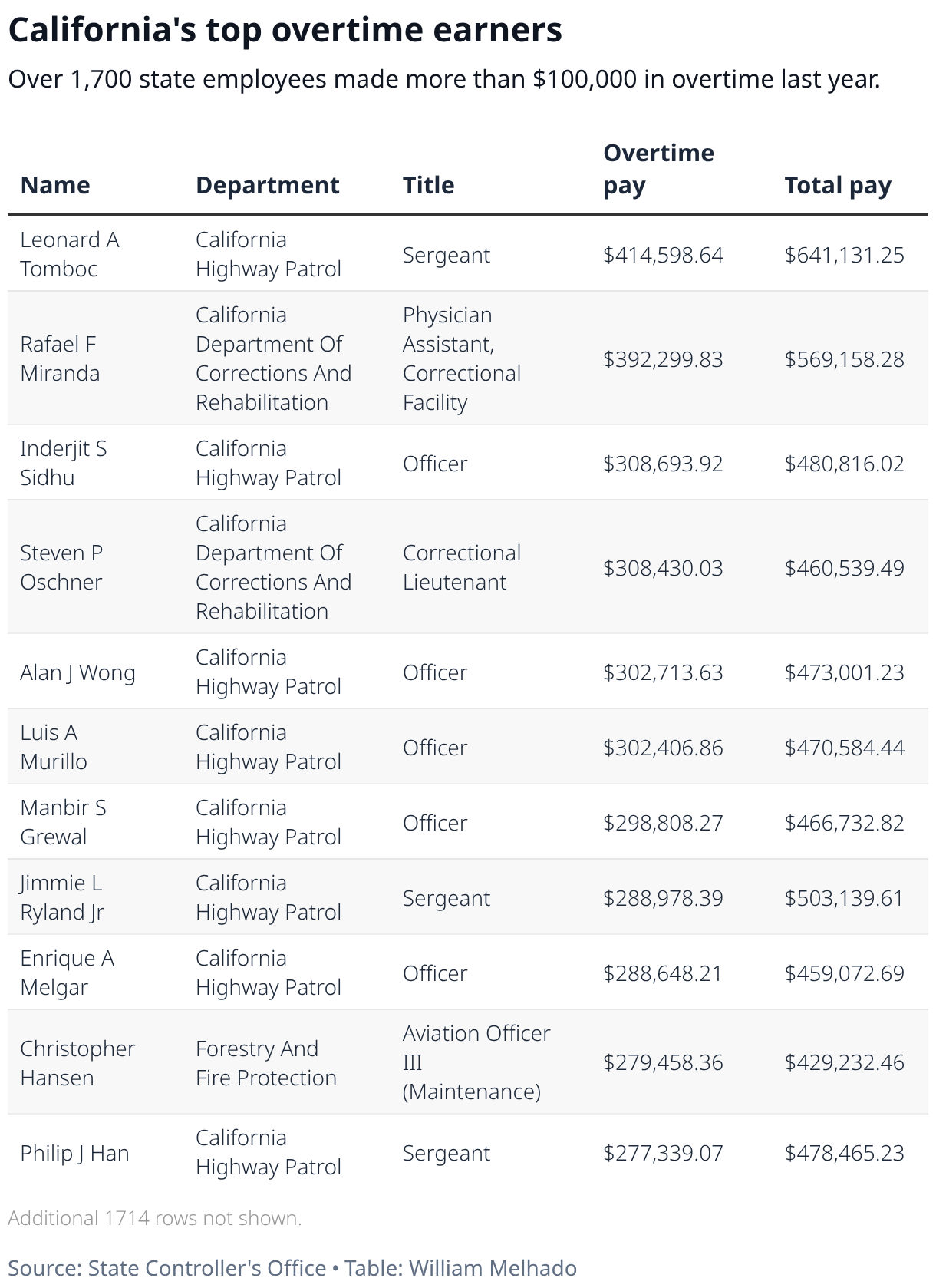
Those state employees, who predominantly work for law enforcement and public safety-related agencies, all made more than $100,000 in overtime in 2025 in addition to their regular salaries. In total, 1,725 state employees earned more than $100,000 in overtime last year, according to the latest data from the State Controller’s Office.
Of those employees, a quarter worked for the California Department of Corrections and Rehabilitation, a quarter worked for California Highway Patrol and another quarter for the California Department of Forestry and Fire Protection. The rest worked for a host of other agencies, including the Department of State Hospitals.
Last year’s top overtime earner, CHP Sergeant Leonard Tomboc, earned $414,599 in overtime, in addition to a salary of $223,438. Tomboc is based in San Francisco County and has worked for CHP for over 30 years, according to his LinkedIn profile. Rafael Miranda, a CDCR physician assistant, was paid $392,300 in overtime, more than double his $176,358 salary. Miranda has worked at High Desert State Prison in Lassen County for over 17 years, according to his LinkedIn profile. Neither Tomboc nor Miranda responded to requests for comment.
Overtime pay is not generally included when calculating state employees’ retirement benefits. For some members of the California Public Employees’ Retirement System who work in safety-related fields, overtime can be counted for pension benefits if their regular workweek is longer than normal federal labor standards.
 CHP officers’ salaries have outpaced that of other peace officers’
About 4% of CHP’s roughly 12,000 employees were among the highest overtime earners in the state, receiving over $100,000 for working beyond their scheduled hours.
“The California Highway Patrol’s overtime expenditures reflect the operational demands of a 24/7 statewide public safety mission,” Jaime Coffee, a CHP spokesperson, said in a statement.
In addition to CHP’s statewide highway patrols, officers are also called on to respond to emergencies, natural disasters and traffic collisions at all hours, Coffee said. CHP officers are required to make court appearances when subpoenaed and to provide protective details for dignitaries and high-ranking public officials, which contribute to the agency’s overtime expenses.
Coffee said a significant amount of the agency’s overtime costs come from officers performing reimbursable services, such as additional security for events or construction sites, which is billed to the contracting entity but paid through California’s payroll system. Overtime compensation is determined by the labor agreement with the CHP officers union.
Due to the bargaining unit’s unique salary formula, CHP officers’ pay has grown at a faster rate than that of other peace officers in California. Officers’ salaries are directly tied to the average compensation provided to peace officers in five local jurisdictions across California, many of which are the most expensive places to live in the state, such as San Francisco and Los Angeles.
The nonpartisan Legislative Analyst’s Office has previously recommended improving or repealing this salary formula for CHP officers as it has led to significant increases to state costs.
Overtime costs for state departments have grown in recent years
The amount state departments spend on overtime has increased significantly for some departments. Last year, CHP’s overtime costs came to $271 million. Seven years ago, the law enforcement agency spent $158 million on overtime.
Cal Fire has also increased how much of its compensation costs go toward overtime in recent years, which is due, in part, to the agency’s adoption of a new schedule for firefighters that is meant to improve work-life balance for these employees.
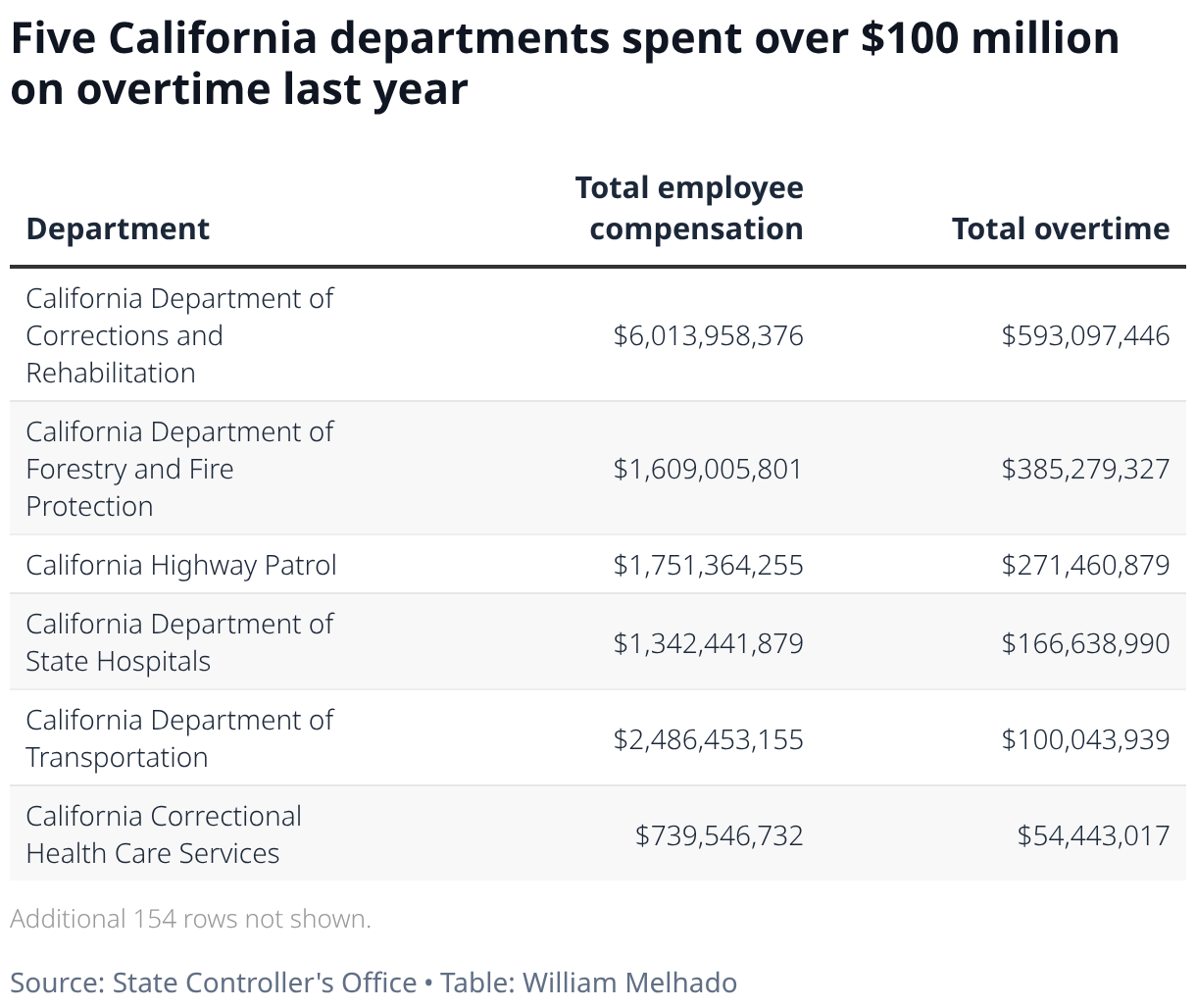
Alternatively, CDCR’s spending on overtime has decreased by $10 million between 2019 and 2025, although the department’s total payroll expenses have increased by $461 million over that period. Since 2021, CDCR has closed three prisons, and plans to shutter a Riverside County facility later this year, to cut down on how much California spends on incarceration. CDCR did not respond to a list of questions about the department’s overtime costs.
Unions have maintained that high overtime costs are a product of an ongoing need to recruit and retain staff.
“Time and a half is part of the negotiated contract, but the long-term solution is adequate staffing levels that reduce reliance on overtime pay while maintaining safety,” California Correctional Peace Officers Association President Neil Flood said in a statement.
Lance Christensen, the vice president of government affairs and education policy at the California Policy Center, disagreed. He said that unions have made efforts to maximize employees’ salaries by “manipulating the overtime system.”
“It’s not because a lot of these government entities don’t have enough personnel,” Christensen said.
This story was originally published March 2, 2026 at 5:00 AM.
Related Stories from Sacramento Bee

The Sacramento Bee
William Melhado is the State Worker reporter for The Sacramento Bee’s Capitol Bureau. Previously, he reported from Texas and New Mexico. Before that, he taught high school chemistry in New York and Tanzania.