
AI-generated summary reviewed by our newsroom.
Supreme Court pauses California rule, allowing schools to disclose students’ transitions.Majority cites parents’ due process and free-exercise (religious) rights to pause law.Dissent criticizes the court’s haste and says the decision conflicts with Dobbs reasoning.
Teachers in California will no longer be barred from telling parents that a child is experiencing gender dysphoria or is transitioning at school under a temporary ruling issued late Monday by the U.S. Supreme Court.
The ruling, among the few issued on the court’s so-called emergency docket to highlight the court’s reasoning in a case, said that California’s law barring such disclosures without the child’s permission harms parents’ rights to due process and religious liberty.
In siding with parents but not teachers who had sued to overturn California’s rule, the high court upheld part of an order by a San Diego federal judge in December, which said that parents had the right to be told if their children were transitioning or using names and clothing at school that were not consistent with the gender assigned to them at birth.
That ruling was challenged before a panel of the 9th U.S. Circuit Court of Appeals, which paused its implementation while the case played out.
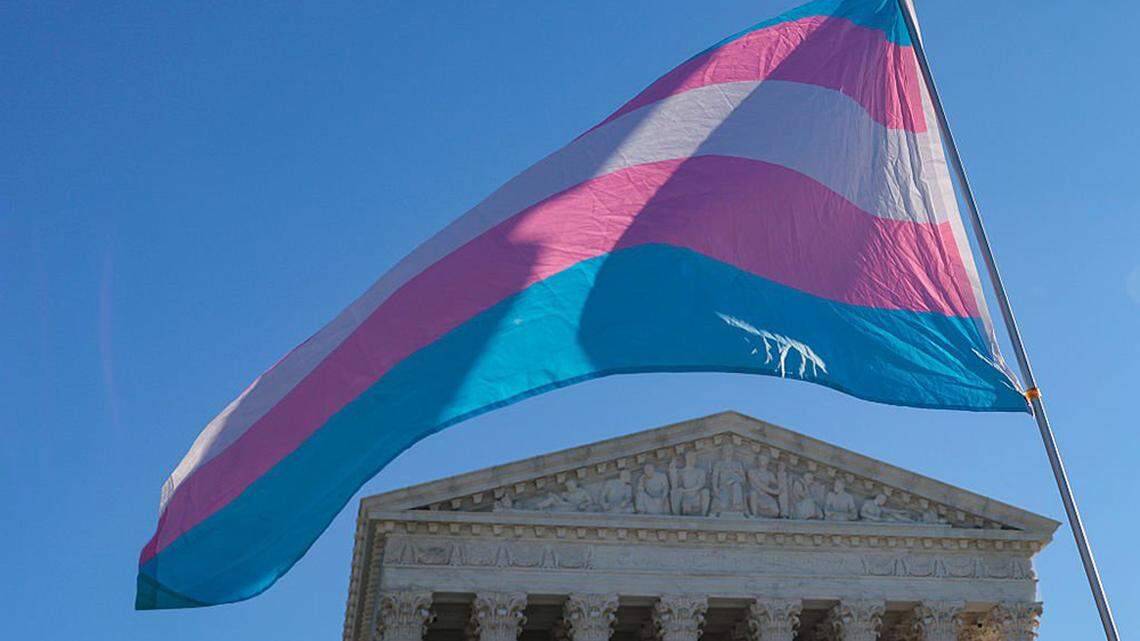
Protesters supporting transgender athletes competing in women’s sports wave a transgender pride flag outside the U.S. Supreme Court on Jan. 13 in Washington. On Monday, March 2, the court issued a temporary ruling allowing California parents to be informed if their children are transitioning at school. Heather Diehl Getty Images
But in its own ruling Monday, the high court’s conservative majority said it could take years for the case to be decided on appeal, potentially depriving parents of their rights for a long time.
“The parents who assert a free exercise (of religion) claim have sincere religious beliefs about sex and gender, and they feel a religious obligation to raise their children in accordance with those beliefs,” the majority wrote in an unsigned opinion.
The ruling drew immediate criticism from LGBTQ+ rights advocates. The office of California Gov. Gavin Newsom said it opened students to discrimination.
“Teachers should be focused on teaching — not forced to be gender cops,” Newsom spokesperson Marissa Saldivar said in a statement emailed to The Bee. “Today’s shadow docket ruling by the Supreme Court undermines student privacy and the ability to learn in a safe and supportive classroom, free from discrimination based on gender identity.”
The case began in 2023, when two teachers sued the Escondido Union School District. Elizabeth Mirabelli and Lori Ann West said their religious rights were violated by the policy.
They were soon joined by parents who said their civil and religious rights were violated by the policy and that it led to harm to their children.
That part of the case hinged on allegations by the parents of a middle schooler in Escondido who was born female but was using male pronouns and a male name at school. The parents, who were referred to anonymously in court documents, said they did not know their child was transitioning at school.
In meetings and parent-teacher discussions, the child was referred to as female, even though at school the child was using a male name and presenting as male. The parents were also not told that school officials believed the child was experiencing gender dysphoria.
Instead, they learned about it from a doctor — after their child attempted suicide.
“In parent-teacher meetings, no one told the (couple) about their daughter’s transitioning or referred to her using the male name and pronouns that were used at school.,” the Court noted. “At the beginning of their daughter’s eighth grade year, she attempted suicide and was hospitalized.”
In court documents and in the original case in San Diego, California Attorney General Rob Bonta argued that the law was meant to protect students from parents who might become abusive if they learned their child identified as transgender.
But the court said the state could remedy that, either by enforcing existing laws against child abuse or by writing exceptions into the law for cases in which abuse was suspected.
“The state’s interest in safety could be served by a policy that allows religious exemptions while precluding gender-identity disclosure to parents who would engage in abuse,” the court’s conservative majority wrote.
The ruling drew a rebuke from two of the court’s liberal justices, Elena Kagan and Ketanji Brown Jackson, who wrote in a dissent that the court had issued its temporary ruling as if it were permanent — yet had not taken the time it would normally take to research and consider such a case once it had made its way through the appeals process.
“The court is impatient: It already knows what it thinks, and insists on getting everything over quickly,” Kagan wrote in the dissent joined by Jackson.
The dissent did not address the merits of the case, but focused on the process. Kagan pointed out that the 9th Circuit had already been asked to reconsider its earlier ruling and said the high court should have waited for the appeals court to act before stepping in.
Kagan also said the ruling conflicted with the court’s decision in the case that overturned Roe v. Wade, ending the right to an abortion. In that case, the conservative majority said there was no right to an abortion enshrined in the Constitution and no basis for deriving such a right from its language and intent.
But in this case, she wrote, the justices recognized such a right on the part of parents to have control over their child’s religious and educational upbringing and medical care.
The court, she wrote, was “recognizing a parent’s right to make important decisions about her child’s health … (while) repudiating a woman’s right to make important decisions about her own health.”
“Today’s decision cannot but induce a strong sense of whiplash,” she wrote.
A concurring opinion written by conservative Justice Amy Coney Barrett and signed by Chief Justice John Roberts and Justice Brett Kavanaugh defended the ruling, saying it was not the same as the decision in Dobbs v. Jackson Women’s Health Organization, which overturned the right to an abortion.
“The doctrine of substantive due process has long embraced a parent’s right to raise her child, which includes the right to participate in significant decisions about her child’s mental health,” Barrett wrote.
With Roberts, Kavanaugh and Barrett signing on to the concurrence, and Justices Clarence Thomas and Samuel Alito saying they would have upheld the entire lower court order — including its enumeration of the religious rights of teachers — it was clear that at least five of the court’s conservative justices backed the unsigned opinion.
Justice Sonia Sotomayor said she would have denied the request in its entirety, meaning she, along with Jackson and Kagan, would not have supported it. Justice Neil Gorsuch did not state his views in the case.
Related Stories from Sacramento Bee
The Sacramento Bee
Sharon Bernstein is a senior reporter at The Sacramento Bee. She has reported and edited for news organizations across California, including the Los Angeles Times, Reuters and Cityside Journalism Initiative. She grew up in Dallas and earned her master’s degree in journalism from UC Berkeley.