
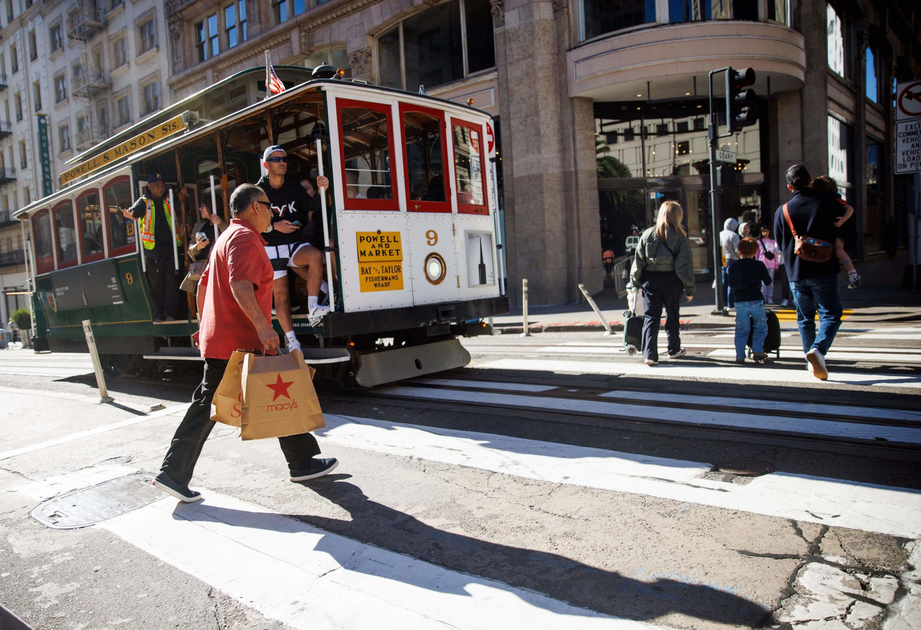
When Karin Flood walks down Powell Street, she sees Union Square’s past, present, and uncertain future. She’s the fifth-generation owner of the 122-year-old Flood Building (opens in new tab), built with her family’s 19th-century silver mining fortune directly across from the cable car turnaround.
The Floods have been a steward of the shopping district at its bustling zenith and through its ghost-town pandemic lows. Choosing businesses to fill her ground-floor spaces feels less like a real estate deal and more like a referendum on what the square should be. “You want it to be a fit, not only for us as a building, but for the city,” she said. “There’s a lot of heart involved. It makes it even more challenging when you’re trying to find that right tenant.”
Union Square is on a rebound. Safety and cleanlinesshave improved, new businesses are activating storefronts (opens in new tab), and several buildings have changed hands at prices that could reset rents.
But beneath that progress is a central tension: Will it rise again as a high-end shopping district catering mainly to well-heeled out-of-towners, or will it be more affordable, diverse, and local?
A civic improvement nonprofit, SF New Deal, has released a study meant to chart the shopping district’s next era. Instead of relying on metrics like rent costs and vacancies, the organization, which provides funding and support for small businesses, focused on measures of success like “dwell time” and “relevance of offerings.”
The pre-pandemic version of Union Square “was very successful in the sense that it was making a lot of money,” said Simon Bertrang, executive director of SF New Deal. “But looking back, it was a real monoculture, and perhaps it was a bit more vulnerable to disruption.”
Drawn from months of surveys, observational studies, and sales data collected last year, the nonprofit’s Vibrancy Index (opens in new tab) found that tourists, residents, and workers want more food and beverage options, longer operating hours, and a greater diversity of shopping price points (read: not just high-end designers like Louis Vuitton and Hermes).
Some recent leases fit that egalitarian mindset, including Pop Mart, Nintendo, and the impending Super Duper burger kiosk. Luxury tenants (opens in new tab) have also returned, including watchmakers, jewelers, and high-end fashion brands.
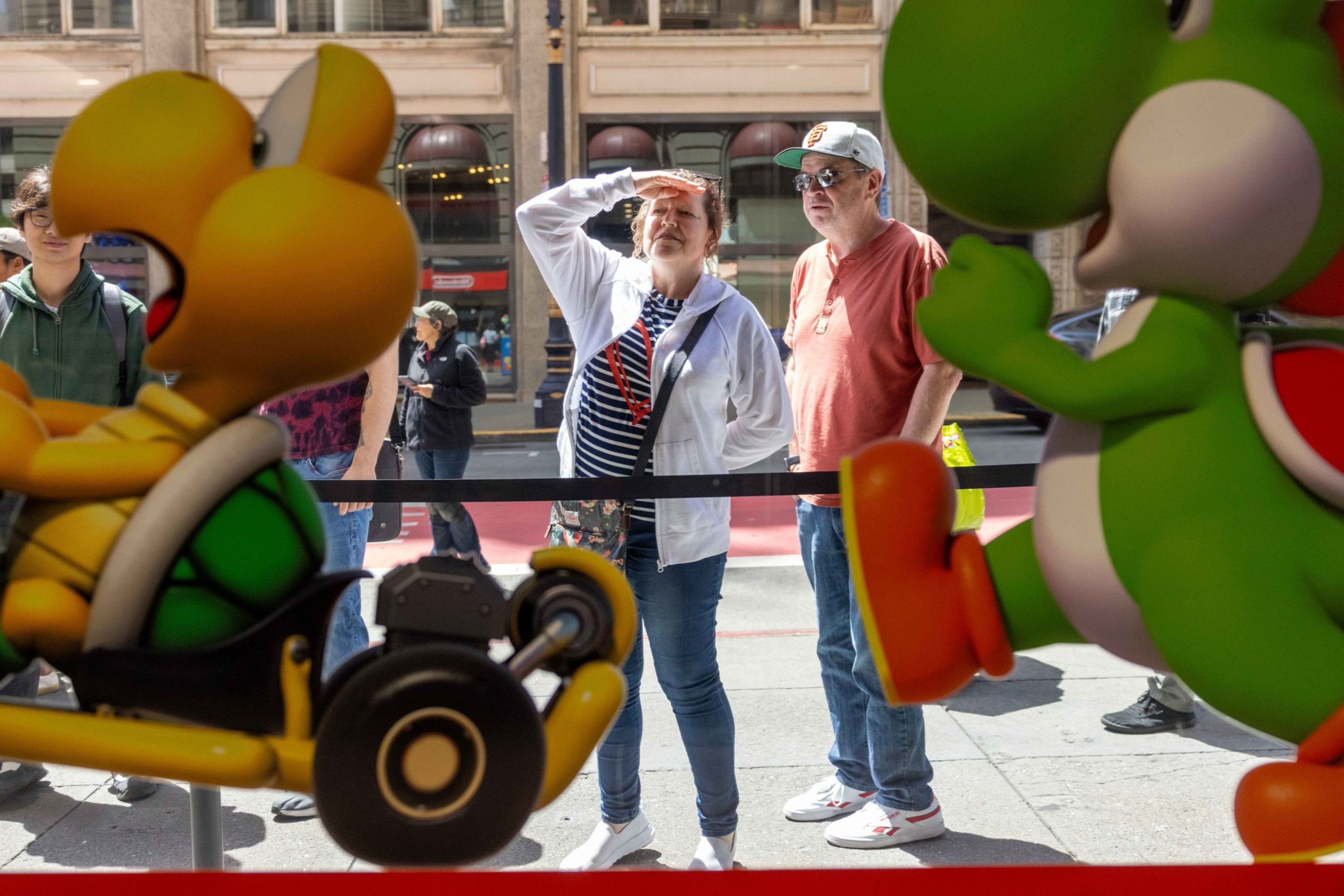 The Union Square Nintendo store is only the second U.S. outpost from the brand. | Source: Amanda Andrade-Rhoades/The Standard
“What the Vibrancy Index shows is that there’s a mismatch right now between what Union Square is offering and what people say they want,” said Joshua Callahan, managing director of The Roxborough Group, which owns the Union Square building that’s home to the Barnes Hotel, (opens in new tab) Starbucks, and Ugg.
The real estate slump has allowed local small businesses to score short-term leases that weren’t possible pre-pandemic, according to Callahan, who has viewed the Vibrancy Index and worked with SF New Deal to lease to Mexican restaurant Al Pastor Papi (opens in new tab) through the Vacant to Vibrant program. But those opportunities could wither as big brands move back in.
Stakeholders broadly agree that the district should feel distinctly San Francisco. Delivering that vision is harder.
Union Square Alliance CEO Marisa Rodriguez says that the square’s “core won’t change,” but concedes that it must undergo an “evolution” to be “more reflective of where the city is headed.” In addition to retail, the area will need a residential component, more “food experiences” — she suggests known draws like the Taiwanese noodle emporium Din Tai Fun — and art and culture. (The Giants’ purchase of the Curran Theater could inject energy into the historic playhouse.)
Flood, meanwhile, feels pulled in different directions. She has talked to small businesses, large international brands, and entertainment companies in her quest to find tenants that would make sense both financially and philosophically.
“We’re the first thing people see when they come up the escalator at Powell, so we need to have something that wows you and that says ‘Welcome to San Francisco.’ It should be the best we have to offer.”
Making messy math work
The trouble with Union Square is that it isn’t a monolith: Each landlord in the area has their own priorities and financial interests.
“It’s not like there’s a grand plan, where you can have a loss leader in one place, and then have a well-capitalized brand store in another place,” Flood said. There’s no Union Square czar who can drive competitors toward a cohesive vision for the future.
While some brokers and landlords may want to champion local or independent businesses, the challenge is making the economics work in the long term.
“Landlords that bought buildings at a certain price expect a certain return,” said Jennifer Hibbits, a broker at Lockehouse. “Can those sweet mom-and-pop retailers afford the rent that landlords need, want, and expect in Union Square? Probably not.”
 Since pandemic lows, safety and cleanliness have improved at Union Square. | Source: Jason Henry for The Standard
On a recent afternoon, two German women, who were in town for a conference, were looking for a local experience. They smiled along to an acoustic guitarist on a Union Square stage but were less than impressed with the retail options.
“We were looking for a shopping street of smaller places that felt more San Francisco,” said Laura Crewe, who works in the pharmaceuticals industry. “We didn’t find it.”
Numan Koksal, taking a break from his job as a parking lot attendant, said he thinks it would be “fantastic” to have more options for cheap food and casual shopping in the square. He said that when tourists ask for recommendations, he often sends them to restaurants or boutiques out of the neighborhood. “They’re already spending a ton of money to be here,” he said. “They’re not buying luxury handbags.”
City leaders have consistently promoted the idea of transforming downtown San Francisco into a “24/7 neighborhood” where people “live, work, and play,” and plan to invest more than $20 million into revamping Powell Street (opens in new tab) to encourage lingering. There are early conversations about building housing in the area at Macy’s (opens in new tab) or the former San Francisco Centre mall. (opens in new tab)
For Union Square to be a neighborhood, not just a tourist destination, it will need retailers locals want and can afford, said Blaine Merker, partner at urban strategy firm Gehl, which worked with SF New Deal to design the Vibrancy Index. (opens in new tab) That means places where people want to hang out. “‘Vibes actually become really important,” he said.
The square is still very much in a moment of transition and momentum, he and others note. New leases and strategies will debut regularly in the coming months, brokers say, including some unexpected ones. For example, Chanel has decided not to move forward with opening a flagship store (opens in new tab) at 340 Post St., the building it purchased for $63 million (opens in new tab) in 2021, sources say. While Chanel plans to remain in the market — it has a store on Geary Street — it’s looking for a different tenant for the space that until December hosted Williams-Sonoma.
From big brands to local flavors
If you’d visited the corner of Powell and O’Farrell streets several years ago, you’d have found national mall brand Lids hawking flatbrims and trucker hats. Today, in the same spot, Dandelion Chocolate sells truffles and toffee that give shoppers a taste of San Francisco.
“Before the pandemic, Union Square felt like a place for people who lived outside the city to come to interact with really big brands,” Dandelion owner Todd Masonis said. “It’s nice that in this new generation — in this time of transformation — there could be more of a mix of local and big businesses. I think that just makes for a better experience for everyone.”
Dandelion got its pop-up space on Powell through Vacant to Vibrant and is in the process of signing a long-term lease, Masonis said, with plans to expand to selling fresh hot chocolate and pastries.
Jon Handlery, who owns several buildings on Powell and Geary Streets that have been in his family for generations, said that when he imagines the future of Union Square, it looks like the Maiden Lane of decades past; in other words, “a busy little block of intriguing shops (opens in new tab).”
“If you can create something that has a different feel, that you can’t find anywhere else, then the growth and the triumphant return will happen,” Handlery said. “I truly believe it.”
Union Square has an “incredible opportunity” to refresh its retail mix, said Colliers’ Laci Ravina, who says pairing big and small businesses creates a more dynamic district.
Sarah Lacy, who opened The Best Bookstore in Union Square in November with her partner, Paul Carr, is hoping the combination works in their favor. The couple signed an initial lease through Vacant to Vibrant and have signalled to their landlord that they’re interested in staying for the long haul if sales continue to be strong.
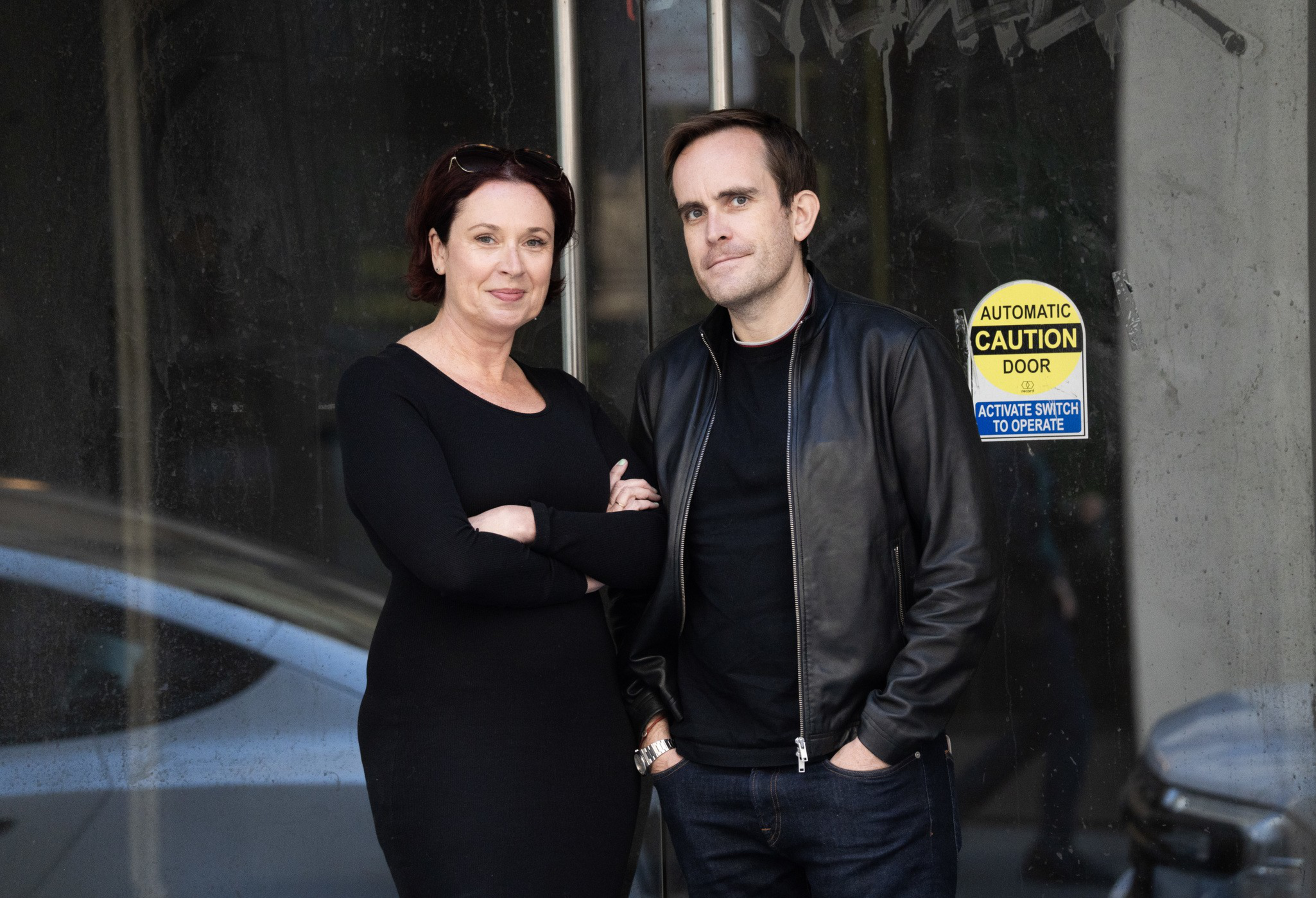 Sarah Lacy and Paul Carr opened their bookstore late last year. | Source: Minh Connors for The Standard
“What happens if suddenly foot traffic roars back to pre-pandemic levels? Well, then our rent is probably going to be tripled,” she said. “Do our sales go up quicker than or on pace with our rent, or does the rent go up before that’s reflected in our sales? That’s the dangerous game for retailers like us.”
Lacy believes that if the district fails to embrace a more diverse future, it will be a huge disservice to San Francisco.
“There’s this opportunity for a reset and to consciously craft the identity of Union Square,” she said. “If we just go back to the way it was before, that will just be so depressing.”