
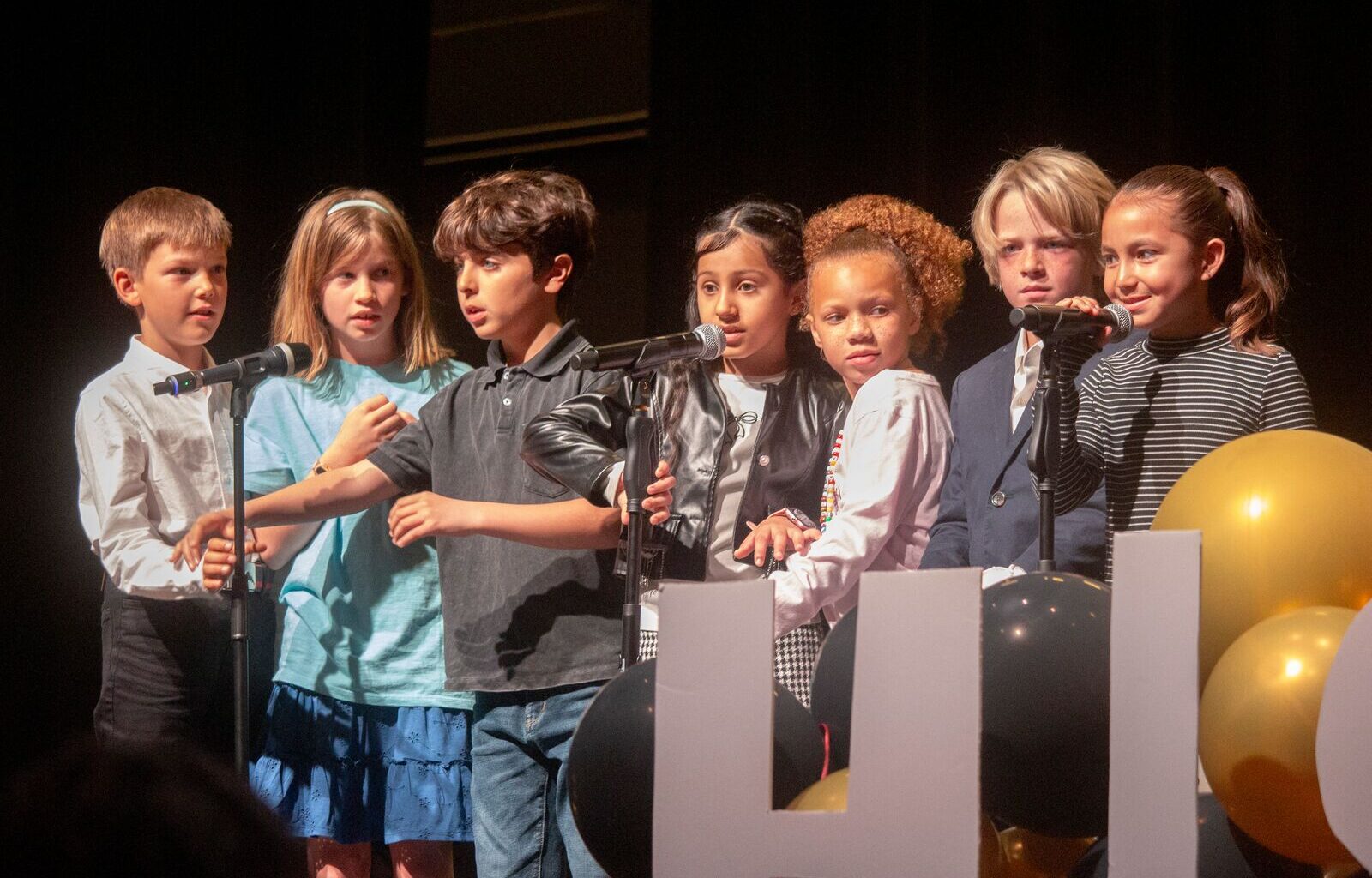
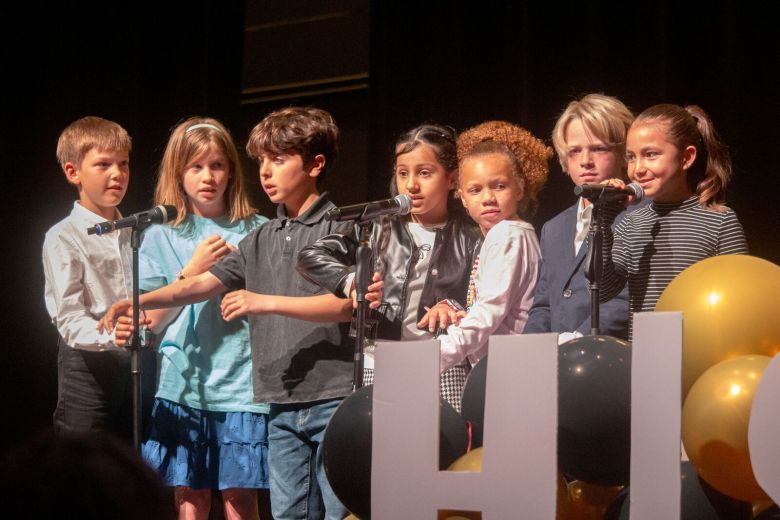
 Students from Thousand Oaks Elementary School performed at the Berkeley Unified School District’s 7th Annual Black History Oratorical Fest on March 26, 2025. Credit: Myron Caringal/Berkeleyside
Every year since 2018, Berkeley elementary, middle and high school students have honed their public speaking skills by performing on stage in a tournament-style competition celebrating Black history.
But this year, there will be no district-wide Black History Oratorical Fest, no grand finale, with the Berkeley Unified School District citing staffing concerns as a reason for canceling the festival.
Individual school sites will continue to host their Black history oratorical events.
“While the districtwide finale was meaningful, it ultimately elevated a small number of students,” Superintendent Enikia Ford Morthel wrote in an email shared with Berkeleyside, estimating that 37 students participated in the culminating Black History Oratorical Fest last year.
While a grant from the Berkeley Public Schools fund was awarded for this year’s festival, Ford Morthel wrote in the email that hosting the event would have required “significant cross-departmental staff capacity.”
In previous years, the oratorical festival was structured as a tournament‑style event, where students in grades 3 to 12 performed published and original speeches and poems tied to a yearly theme. Top performers from each school advanced to the district-wide final to compete for prizes.
Some Berkeley teachers and parents said they were disappointed that a visible celebration of Black culture was ending in the city as diversity efforts and programs are being scaled back across the country under the Trump administration.
Amanda Cardno, a special education teacher at BTA, said there aren’t many opportunities for the district to come together, especially in celebration of Black joy. She said having each school host their own oratorical event this year felt like “it missed that note.”
“It’s sad to feel like we’re losing all things that are Black excellence, and we’re really fighting for those spaces, so it can be frustrating,” she told Berkeleyside. “It constantly reminds us that we have to do it on our own.”
Some educators attributed the event’s staffing shortage to budget cuts last year that affected the Office of Family Engagement and Equity (OFEE), which helped organize the oratorical festival. There are eight staff (plus a supervisor and assistant) listed on the website, down from 12 specialists last March when layoff notices were issued for each position in 2025.
BUSD did not respond to questions about whether cuts to OFEE were related to the event’s cancellation.
Ford Morthel announced the “site-led oratorical model” during last week’s school board meeting. In an email to Berkeleyside last week, BUSD said schools will host classroom showcases, characterizing the showcases as a “district‑supported” pilot program and an opportunity to “expand participation across campuses.”
But Berkeley Technology Academy (BTA) teacher Caety Klingman, who spoke during public comment about the oratorical fest last week, said it’s inaccurate to describe what BUSD plans for this year as a pilot program.
“We already had the site-based model,” she told Berkeleyside. “It’s not like this is a new thing. As far as I can tell, all they’ve done is take away the district-wide festival.” She said teachers were emailing district leaders since December to ask for more information, including the year’s theme and classroom materials.
Ford Morthel told Klingman that district funding is available for site-based competitions. BUSD will collect community feedback as they plan for next year. Kamar O’Guinn, the event organizer and manager of the African American Success Framework, declined to comment.
Cardno’s daughter, a fifth grader at Emerson Elementary, said she was excited to compete and see if she could make it to the district finals during her last year of elementary school.
“I felt a little sad because it’s really fun to talk about Black history and it feels like such a big deal to go to the district,” she said. “Once I found out that there was no district oratorical fest … I felt like I had nothing to really look forward to.”
Emerson is planning to host its oratorical festival in April.
“An oratorical fest is still a great opportunity, it’s still going to be fun. It just might feel a little different,” she added.
Berkeley’s Black History Oratorical Fest exposed kids to cultures and public speaking
Oratorical festivals have a long history in the East Bay, celebrating and uplifting Black art, culture and community. One of the original events, Oakland’s MLK Jr. Oratorical Fest, was founded in 1978. Since then, thousands of students have participated in the program, which has launched similar events in nearby school districts and served as a launching pad for young people into the performing arts.
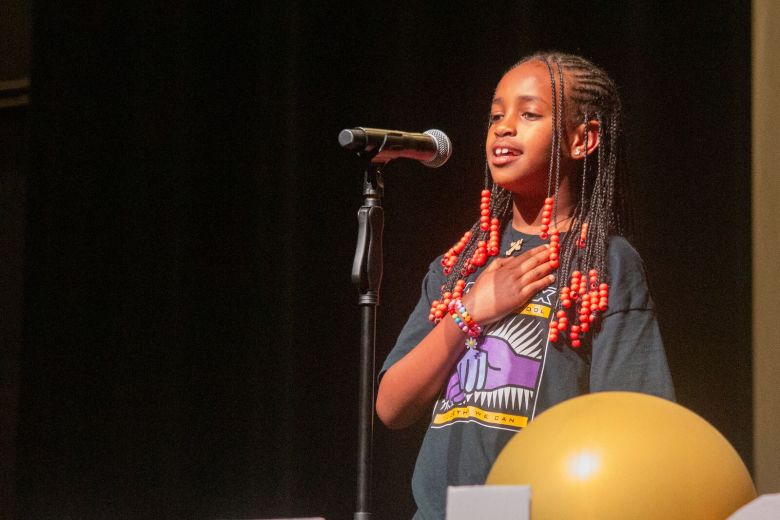 Rahwa Kiflemaryam, a student at Malcolm X Elementary School, won second place in the youth division at Berkeley’s 2025 district-wide festival. Credit: Myron Caringal/Berkeleyside
At last year’s oratorical festival, Berkeley children as young as 7 and college-bound high school seniors came together on the Oxford Auditorium stage to pay tribute to Black leaders and culture under the theme “New Negro Movement,” commonly known as the Harlem Renaissance. Klingman said students benefited from the public speaking opportunity, with some writing about the experience in college essays and others giving speeches at graduation.
The superintendent said, in addition to site-based oratorical festivals, BUSD has planned other events to celebrate the 100th anniversary of Black History Month, including assemblies, guest speakers, and film screenings. The district website also has grade-level reading lists, family guides, and teaching resources.
On Saturday, Rosa Parks Elementary School hosted Black Legacy Month, a community-wide celebration with music, art and food.
Earlier this month, BUSD hosted a screening of the documentary “The Epicenter: The Struggle to Bring Black Studies to Higher Education in the Bay Area,” a new film by a Berkeley High alumnus Doug Harris. BUSD was the first school district in the country to offer African American studies in high school.
Malcolm X Elementary recently hosted School Yard Rap, a live educational performance group that “uses hip hop to teach Black history and highlight Black excellence in science, technology, engineering, arts, and mathematics.”
“*” indicates required fields