
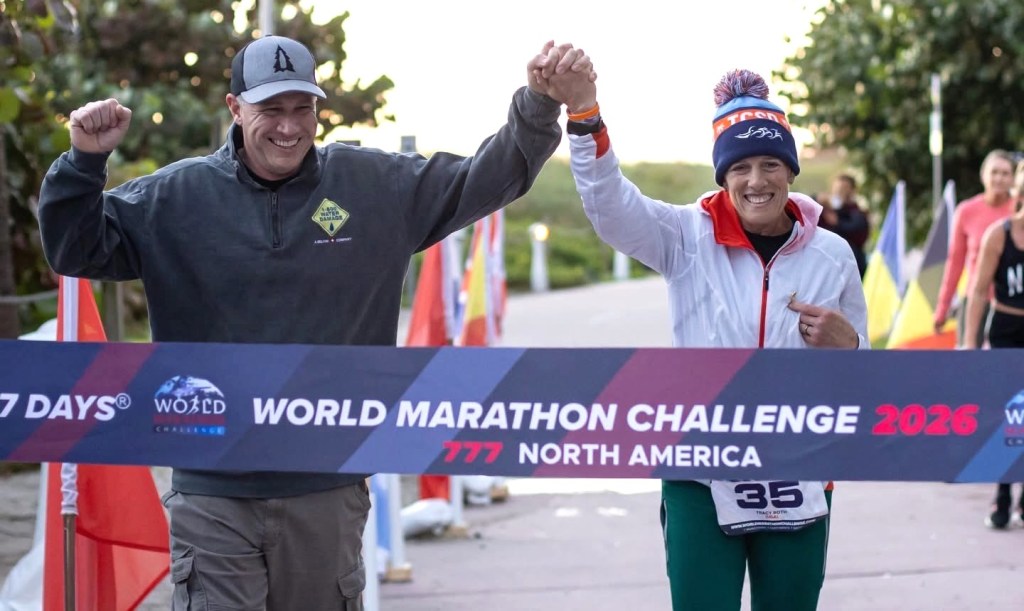
“What an absolutely amazing adventure of a lifetime.”
That is how Poway resident Tracy Roth described completing seven marathons in seven days on seven continents.
Roth was among the 57 people from around the world in the 2026 World Marathon Challenge held Jan. 31 to Feb. 6.
“I am just soaking up what I’ve done and want to enjoy it for a while,” Roth said.
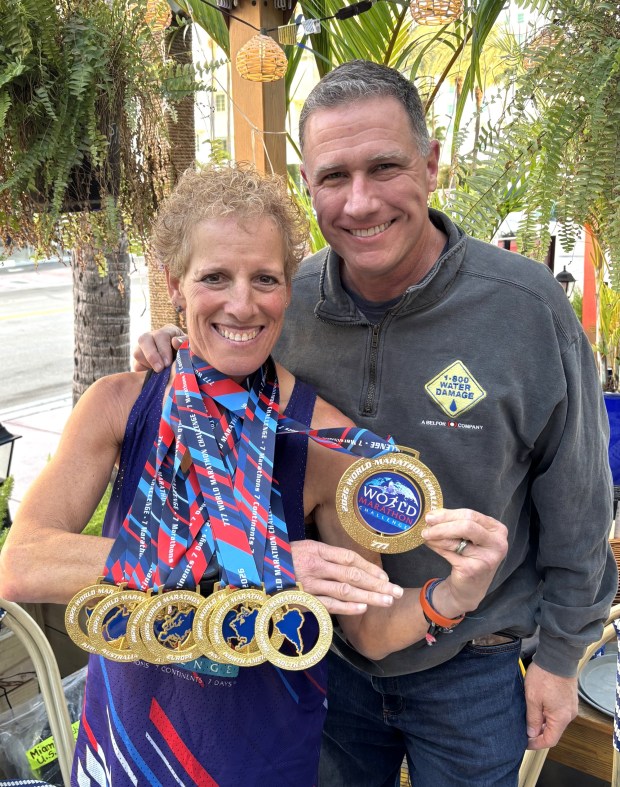 Tracy Roth and her husband, Brad, at the celebration lunch in Miami on Feb. 6 wearing all seven of her finisher medals and 2026 World Marathon Challenge medal. (Courtesy of Tracy Roth)
At age 62, Roth said she was the third oldest of the entrants. The oldest were a woman from Portugal and a man from China who were both 74.
“Even though their bodies were older than the others, their minds were sharp and they had the best attitudes,” Roth said. “They were very inspiring.”
Roth said while runners in their 30s and 40s were focused on being the fastest due to many of them raising money for charities, Roth just wanted to complete each race within the eight hours allotted per marathon, which she did.
“I was impressed by how well we were able to run in a 2.6-mile circle,” Roth said of their first marathon on Jan. 31, which was held in Antarctica and required 10 laps to complete.
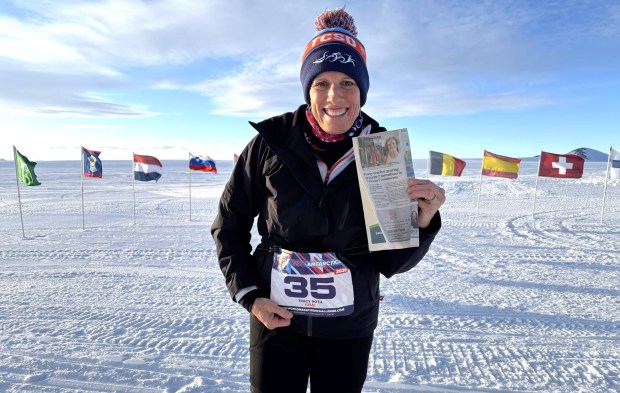 Tracy Roth in Antarctica on Jan. 31 holding a copy of the Oct. 30, 2025 Poway News Chieftain with the article about her fundraising for the 2026 World Marathon Challenge. Behind her are the flags of all 20 countries represented by the runners. (Courtesy of Tracy Roth)
Even though it was summer in Antarctica, the runners had to bundle up for the below freezing temperatures and snow. For that reason, Roth said they had to wear special athletic clothing, shoes with cleats, protective eyewear and 100 SPF sunscreen because of the sun’s reflection off the Antarctic snow.
Due to the freezing temperature, she said the runners took breaks in a tent to eat snacks and drink, though the time clock kept ticking the entire time.
“You had to take everything off from the neck up in order to eat and drink,” she said.
Roth said while her clothing was sufficient for the freezing temperatures, she did not have warm enough gloves, so her hands were very cold.
“That was my fault,” she said.
Roth finished the Antarctica portion in 6 hours 25 minutes. Because of a storm coming in, the runners had to depart at around seven hours in, about an hour before the time allotted for the marathon. If they did not fly out then, the group would have been stranded for days. Consequently, six runners had to complete their remaining miles upon landing in South Africa while Roth and the other runners rested, she said.
“It was all daylight in Antarctica,” she said. “I saw no glaciers or penguins, just flat land. … It was like a desert, but with snow that was dry and powdery. It was beautiful … calm, serene and no noise. It was very peaceful. All I could hear was the wind.”
In contrast, their hottest marathon took place on Feb. 2 in Perth, Australia where at one point it was 107 degrees during their third race, she said.
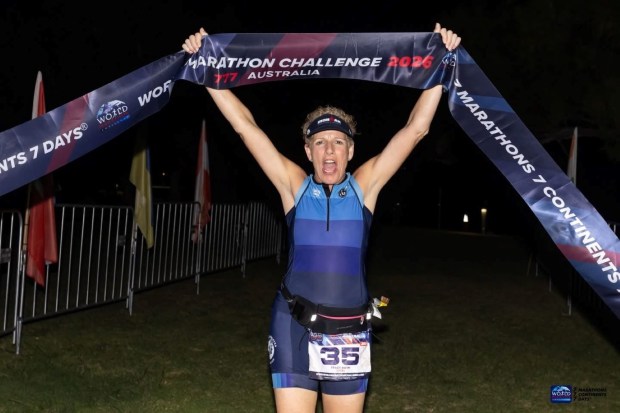 Tracy Roth holding the finisher ribbon late at night in Perth, Australia. (World Marathon Challenge / Runbuk)
“It was really hot and difficult. I run a lot in hot weather (in Poway) so I am used to the dry heat. But my new friend from England had never run in dry hot weather, so I introduced him to salt to take during the run and electrolytes, which I shared with him.”
Once it became nighttime, Roth said the temperature in Perth dropped to the 90s while they ran along the water.
The challenge began with the runners gathering in Cape Town, South Africa on Jan. 28. After getting acquainted and doing some sightseeing, they loaded onto a plane to fly to Ultima Base, Antarctica.
The clock for the 168-hour event, which included travel time, started when the runners took off for the first race in Antarctica.
After completing that marathon, they returned to Cape Town for the second race on Feb. 1 to check Africa off the list. Then they flew to Australia for the third race. The Asia marathon was held on Feb. 3 in Dubai, United Arab Emirates.
Roth said running through Dubai reminded her architecturally of the University Town Center mall in San Diego.
“There were orange cones and it was like a maze with fancy 40-story buildings, surreal music playing and it was beautiful at night with the lights,” she said.
After Dubai, they flew to Madrid, Spain so the Europe marathon could be completed on Feb. 4. It was raining and they ran on an old Grand Prix racetrack.
The South America marathon was held in Fortaleza, Brazil on Feb. 5.
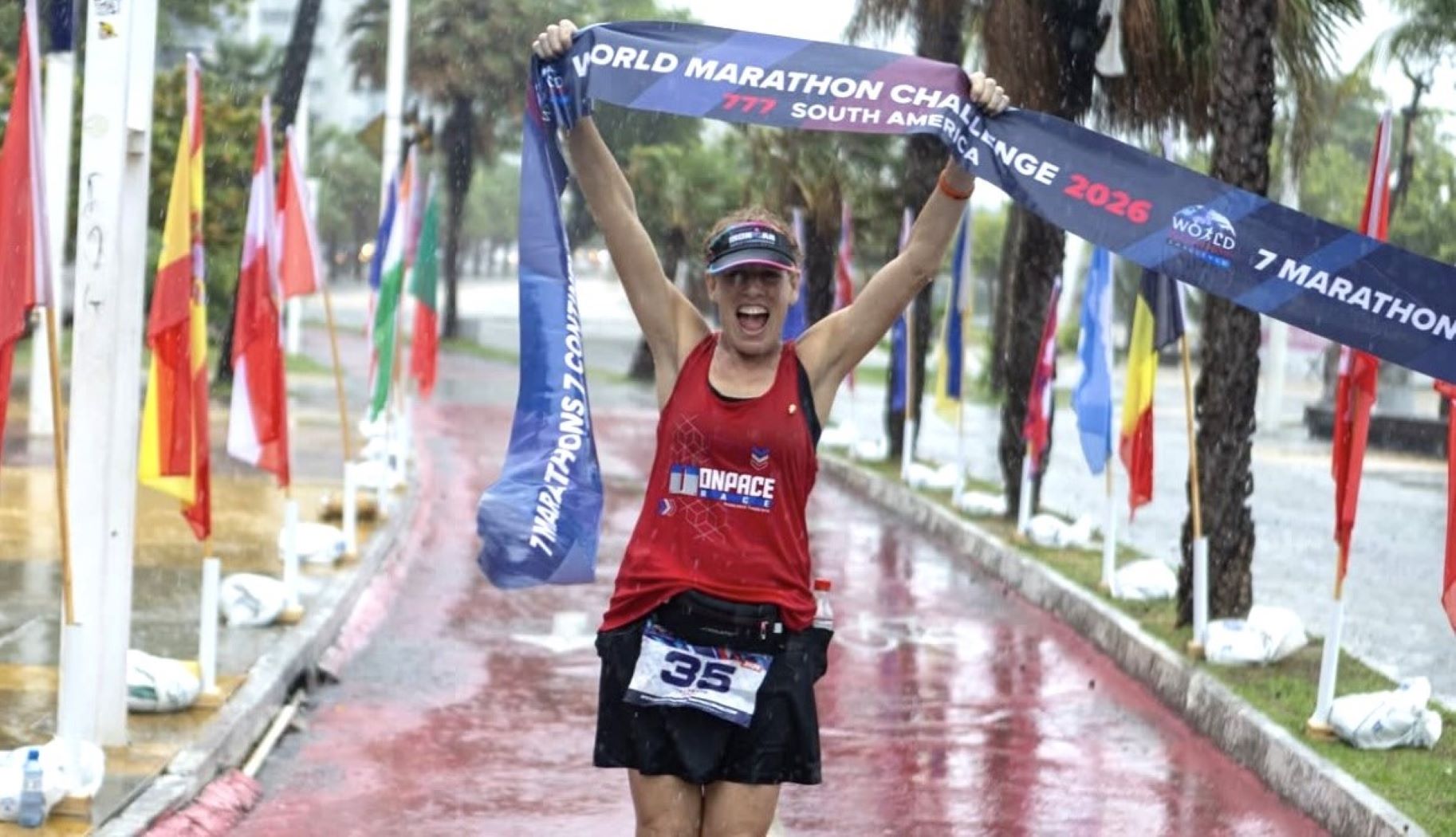
Tracy Roth holding the finisher ribbon in Fortaleza, Brazil on Feb. 5 in the pouring rain. (World Marathon Challenge / Runbuk)
Show Caption
1 of 1
Tracy Roth holding the finisher ribbon in Fortaleza, Brazil on Feb. 5 in the pouring rain. (World Marathon Challenge / Runbuk)
“It rained harder there than anything I had seen in my life,” Roth said. “During the last eight miles I had so many blisters and it got so hot and humid. I had sloshy wet shoes … and my feet were swelling.”
Their last flight as a group was to the final marathon, held in Miami on Feb. 6 for the North America race.
“We landed at 7 p.m. and started running at 11 p.m.,” Roth said. “It was 40 degrees so I put on all my Antarctica clothing.”
Her shoes did not have time to dry after getting soaked in Brazil, so Roth said she put back on the waterproof shoes she wore in Antarctica.
In all, challenge participants ran 183.4 miles over the seven-day period and spent about 68 hours in the air.
Roth said everyone completed all of the challenge’s races, so each was recognized by the Intercontinental Marathon Club, which maintains the list.
Of all the places, Roth said her favorite was South Africa, where she got to sightsee before the challenge began.
“There is such a diverse people from all over the world there,” she said. “They were so nice and friendly. I can’t wait to go back there.”
Roth has not always been a runner. She took up the sport at age 39 after losing her mother to breast cancer. Running was her path to healing, she said, as it was a way to naturally lift her spirits with the rush of adrenaline and endorphins.
She ran her first marathon at age 40 as a way to have something to work towards while training with early morning runs before heading into her classroom at Tierra Bonita Elementary in Poway to teach fifth grade.
Over the past two decades, Roth has run in local races and a marathon in each of the 50 states, which earned her a trophy from an organization that honors runners who have achieved that. She has qualified for over 25 Boston Marathons, but only competed in five due to the expensive entry fee. She also completed five ultra-marathons (100 miles each) along with 19 full Ironman triathlon races, which consist of a 2.4-mile swim followed by a 112-mile bike ride and then a 26.2-mile marathon.
Roth has shared her journeys with her students. For example, when giving state reports she lets students wear the medal she earned in a marathon in that state.
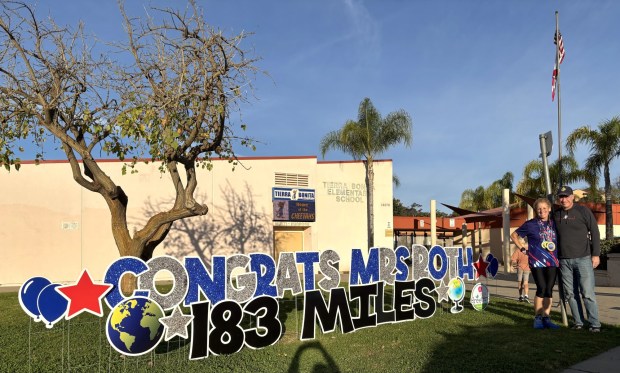 Tracy and Brad Roth outside Tierra Bonita Elementary in Poway, where a congratulatory sign welcomed her return on Feb. 9. (Courtesy of Tracy Roth)
This time was no different. Tierra Bonita held a celebratory send off for her and students tracked her travels on a map. She returned to a decorated classroom honoring her accomplishment.
Roth said she also brought back treats to the students she teaches, such as nuts from Brazil, chocolate from Dubai and water from Antarctica.
The challenge’s entry fee was $49,500. Of that, Roth fundraised $40,000 from family, friends and the community. She said without the financial support of friends and strangers she could have never entered.
Strangers who supported her included Erika Fellars, a Rancho Bernardo resident, who last year read in the Rancho Bernardo News Journal about Roth and her plan to complete the seven marathons. In response, Fellars gave a generous donation towards Roth’s entry fee. Fellars declined to state publicly the amount.
“I felt this tug on my heart,” Fellars said. “My husband (the late Todd Fellars) would have been tickled … as he used to run marathons and do Ironman (races).”
Fellars’ husband, a Navy doctor, died in 2023 due to brain cancer at age 52.
Upon receiving the donation, Roth reached out to Fellars to thank her. After learning about Todd Fellars, she offered to wear something of his during each of the marathons.
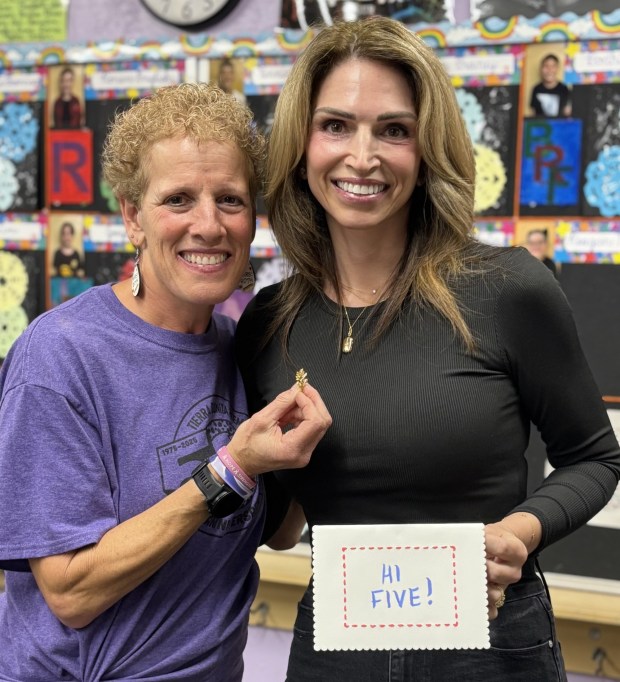 Tracy Roth with Rancho Bernardo resident Erika Fellars, who donated to Roth’s fundraiser in memory of her late husband, Todd Fellars. Roth is holding his Navy insignia, which she wore during all seven marathons in the challenge. (Courtesy of Tracy Roth)
“It was a beautiful offer,” his widow said, who lent Roth one of her husband’s military insignia pins for his rank of commander. It included a leaf design to represent the medical corps.
Roth made sure to take a photo on each continent with the pin visible and sent them to Fellars. The pin and thinking about Todd Fellars served as inspiration to complete the Miami marathon when she was so exhausted and feet so painful, she said.
“Coming toward the finish line … my body had it and for the last two miles my body was starting to shut down,” Roth said. “My husband (Brad Roth) had flown out to meet me and all I could think about was pointing to that pin for the video (when crossing the finish line).”
Receiving those photos meant a lot to the Fellars family.
“That was special to me and my girls,” Fellars said.
“Tracy is pretty incredible,” Fellars said, adding they met twice before Roth’s trip. “Once we went on a hike and another time I visited her school. … She’s an amazing, inspiring person with a good heart.”
It is the new friendships Roth made through the challenge, with people such as Fellars and her fellow runners, that she cherishes.
“Most of (the runners) spoke English or Chinese,” Roth said, adding those who were multilingual helped translate for those who were not. “Everybody was so nice and it was fun communicating by signs (if we could not speak a language). We found a way to communicate.”
While many would want an extended rest after such an exhausting experience, that is not the case for Roth. She went on her first swim just two weeks later, on Feb. 22, completed a yoga workout and returned to running on Feb. 23. Roth said she has to get back into peak condition since she plans to compete in the Ironman 70.3 in Oceanside on March 28.
Roth said the key to doing these athletic feats is not just physical training, but mental.
“It is because I believed I could,” she said. “You have to have the mindset believing you can achieve.”
She added, “if you really want it bad enough, you can make it happen.”