
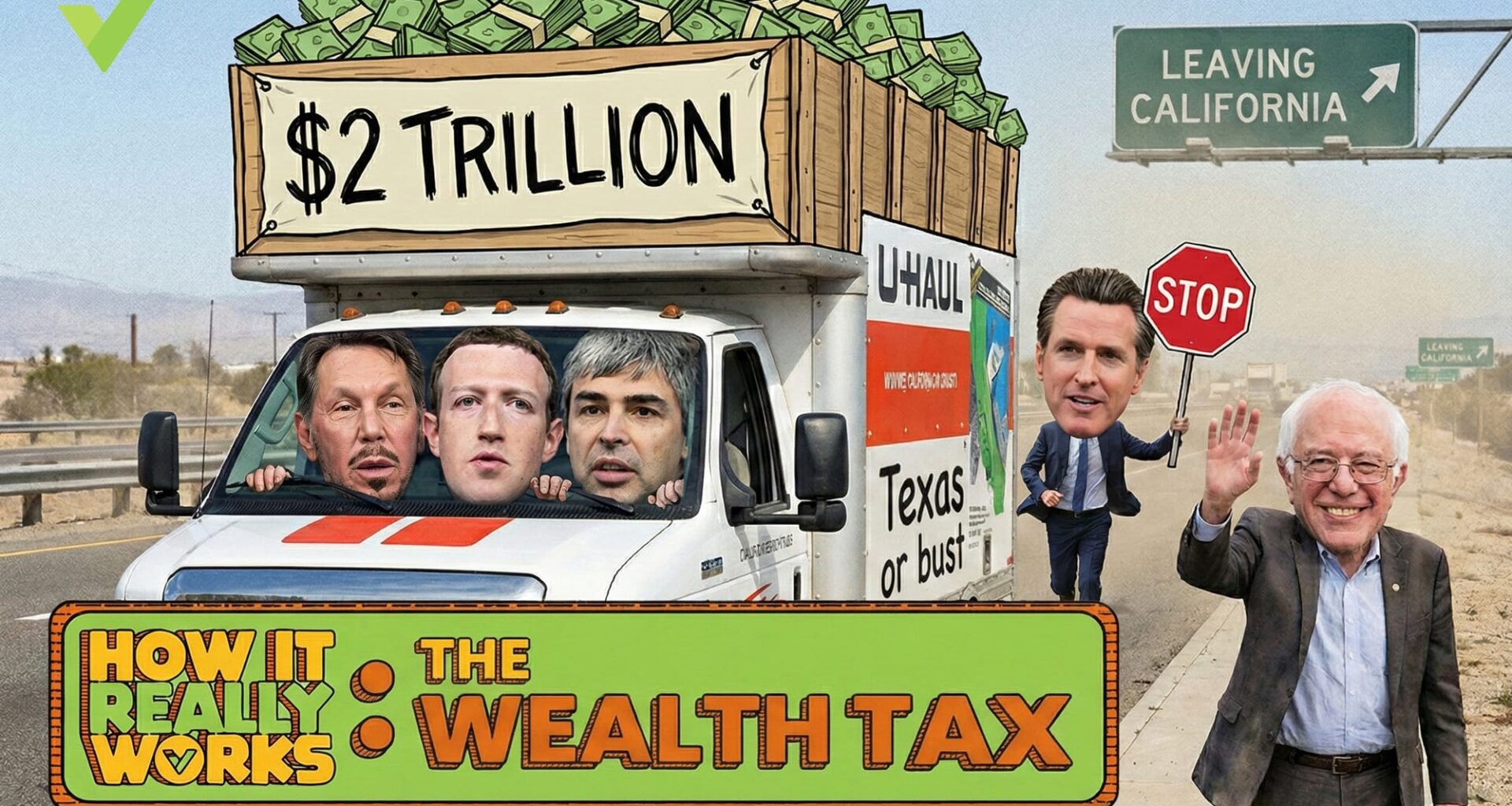
California’s proposed billionaire wealth tax has become one of the most consequential policy debates in the nation.
The labor unions say it is a response to income inequality, lack of affordable housing, federal health care cuts for the poor, food insecurity, and the social impact of automation.
Opponents warn it could accelerate capital flight, erode the tax base, and reshape California’s economy and entrepreneurial culture long before any revenue is collected.
More than one-third of California’s tax revenue comes from the top 1% of earners.
What a Wealth Tax Is
A wealth tax is a tax on what a person owns.
It is based on a taxpayer’s net worth, meaning the total value of assets minus debts. Assets can include real estate, stocks, businesses, artwork, and other investments.
This is different from an income tax, which applies to wages and other earnings, or a capital gains tax, which applies when assets are sold for a profit. It is also different from estate taxes, which apply when wealth is transferred at death.
A wealth tax applies even if assets are not sold, and no cash is received by the taxpayer. That distinction is central to its controversy.
Wealth Taxes in the United States
The United States has never had a permanent federal wealth tax. The Constitution places limits on direct taxes, and American tax policy has instead focused on income taxes, capital gains taxes, and estate taxes.

From time to time, lawmakers and academics have proposed wealth taxes at the federal level. These proposals have sparked debate but have not become law. Concerns have included constitutionality, enforcement, valuation, and the potential impact on investment and entrepreneurship.
At the state level, wealth taxes have also been rare. Most state tax systems rely on income and sales taxes, with property taxes limited largely to real estate.
The California Ballot Initiative
California voters may soon face a proposal known as the 2026 Billionaire Tax Act.
On December 26, 2025, the California Secretary of State approved a ballot initiative titled “Imposes One-Time Tax on Certain Individuals and Trusts” for circulation.
The measure is both a statute and a constitutional amendment and is backed by the Service Employees International Union–United Healthcare Workers West (SEIU–UHW).
To qualify for the November 2026 ballot, supporters must collect 874,641 valid signatures by June 24, 2026.
If approved, the initiative would impose a one-time 5 percent tax on the net worth of individuals and certain trusts valued above $1 billion.
Liability would be based on California residency during the 2026 tax year, using January 1, 2026, as the valuation date.

Assets would be taxed whether or not they had been sold or converted to cash, meaning unrealized gains would be included.
The tax would apply retroactively to anyone who was a California resident as of January 1, 2026.
What makes this proposal unusual is that it would apply to the wealth people already had, before the law was passed. This tax would reach back in time as a form of retroactive taxation. Retroactive taxes are legal in some circumstances but are relatively rare and often controversial.
Wealth Taxes Around the World
Wealth taxes are not new. Many European countries adopted them in the twentieth century, especially after major wars, when governments needed revenue to rebuild and reduce debt. These taxes were usually aimed at the wealthiest households. Over time, most countries abandoned annual wealth taxes.
Nine European countries have repealed wealth taxes since the 1990s. Many governments found that the taxes raised less revenue than expected. They were expensive to administer and difficult to enforce. Valuing complex assets each year proved challenging, and wealthy individuals often moved assets or changed residency to reduce their tax exposure.
France repealed their wealth taxes after concluding that the economic costs outweighed the benefits. In many cases, wealth taxes produced a small share of total government revenue. France lost 10,000 millionaires worth about $41 billion dollars between 1982 and 2017. Economist Eric Pichet estimated the tax raised $4.1 billion dollars annually, while capital flight cost roughly $8 billion dollars per year.
Norway implemented a 1 percent wealth tax in 2022. More than 30 billionaires and mega-millionaires left that year. The policy was expected to raise $146 million, but an estimated $54 billion in capital exited, producing a net fiscal loss of nearly $450 million.
Commentary followed. The account Wall Street Mav wrote on X that Norway implemented a wealth tax, expecting higher revenue but instead saw wealthy residents move to cheaper jurisdictions. Tech entrepreneur Antonio García Martínez wrote that “every successful tech entrepreneur bailed to Switzerland,” adding that net revenue fell.

Today, only a small number of countries still impose broad wealth taxes. Switzerland, Norway, and Spain maintain versions of them, though the rules and rates vary widely.
In the U.S., the Census Bureau reports 7.5 million people moved between states in 2023. Research on domestic migration consistently shows people tend to relocate toward lower-tax environments with stronger entrepreneurial ecosystems.
Who Would Be Affected
California’s nonpartisan Legislative Analyst’s Office (LAO) estimates that 200 to 250 billionaires could be affected if California’s billionaire tax passes.
Under optimistic assumptions, the LAO projects the tax could raise approximately $100 billion in one-time revenue.
But the LAO also warned that outcomes depend heavily on stock market performance and taxpayer behavior, stating:
“The reduction in state revenues from these kinds of responses could be hundreds of millions of dollars or more per year. This would mean less money for the state’s general budget that supports education, health care, prisons, and other services.”
According to Forbes data compiled by Americans for Tax Fairness and reported by Business Insider, between 214 and 241 billionaires lived in California as of January 2026, more than any other U.S. state, with combined wealth estimated at roughly $2 trillion.
Where the Money Would Go
According to Reason, no revenue from the wealth tax would flow into California’s general fund.
Instead:
90 percent would go into a Billionaire Tax Health Account to “protect or enhance Medi-Cal,” California’s Medicaid program.10 percent would go into a Billionaire Tax Education and Food Assistance Account, funding K–12 education, two years of community college, and programs including CalFresh, CalFAP, CalFood, and California’s Universal Meals Program.
Reason also noted that the Biden administration previously found Medi-Cal improperly claimed nearly $53 million in federal funding for ineligible noncitizens between October 2018 and June 2019.
Who Are the Proponents?
Supporters of the Billionaire Tax argue the tax is necessary to address widening income inequality, looming budget shortfalls, and anticipated reductions to healthcare for the poor due to Republican Medicaid funding cuts.
The political message will be that the wealthy should pay their “fair share” for health care and food.
Labor unions cite research showing that the effective tax rate paid by America’s richest 0.0002 percent fell after the 2017 GOP tax overhaul, arguing that recent federal policy disproportionately benefited the ultra-wealthy.
SEIU–UHW, representing roughly 120,000 workers, argues that California’s concentration of wealth makes the state, in its words, “uniquely positioned to address both the well-documented crisis of wealth inequality in the United States and the emerging and interrelated crises the state faces.”
Suzanne Jimenez, the union’s chief of staff, told the Marin Independent Journal:
“We looked at how could we generate the revenue to fix this kind of hole and this group of folks just made sense.”
Jimenez added that California billionaires are the “most fortunate people in this state.”
Supporters argue that under the current system, massive fortunes can grow through unrealized gains while generating relatively modest taxable income, and that a one-time wealth tax reaches gains that might otherwise never be taxed.
Progressive leaders, including Sen. Bernie Sanders and Rep. Ro Khanna, have endorsed the wealth tax.
After investor Peter Thiel warned he would leave California over a wealth tax, Khanna wrote on X, as reported by Kiplinger’s:
“Peter Thiel is leaving California if we pass a 1% tax on billionaires for five years to pay for healthcare for the working class facing steep Medicaid cuts. I echo what [Franklin D. Roosevelt] said with sarcasm of economic royalists when they threatened to leave, ‘I will miss them very much.’”Teamsters Enter the Fight
In January 2026, Teamsters California, one of the most powerful unions with approximately 250,000 members, formally endorsed California’s proposed billionaire wealth tax, according to Fox Business.
They are framing the initiative as a defense of working-class Californians facing rising living costs, job displacement, and automation.
In a joint statement, Teamsters California co-chairs Peter Finn and Victor Mineros said:
“The fight to pass the California Billionaire Tax is a fight to protect workers’ ability to afford living in California; it’s a fight Teamsters California will continue to lead.”
They accused technology executives of exploiting the tax system, adding:
“The same Big Tech billionaires shedding crocodile tears over the idea of paying their fair share of taxes while amassing sky-high piles of cash are exploiting a rigged system that makes delivery workers and bus drivers pay higher rates than the AI executives trying to wipe away our jobs.”
The union said the tax would hold billionaires “accountable for destroying our jobs and robbing families of our healthcare,” arguing that automation, artificial intelligence, and autonomous vehicles threaten union jobs, public safety, and family-supporting wages.
Teamsters leaders said the proposal is part of a broader effort to ensure that California’s economic growth benefits workers rather than only corporate executives and shareholders, especially as federal health-care funding faces potential cuts.
Democrats Newsom, Mahan Oppose Wealth Tax
Opposition to the tax includes several prominent Democratic Party leaders:
Gov. Gavin Newsom has said wealth tax proposals are “going nowhere in California” and that the state “can’t isolate [itself] from 49 other states.”
Speaking at The New York Times DealBook conference in December 2025, Newsom said a wealth tax was not pragmatic. He later added:
“I want to be a big tent party.”
The New York Times reported that Newsom is raising money for a committee opposing the measure, which received a $100,000 donation from venture capitalist Ron Conway in November 2025.
A Newsom spokesperson told the Marin Independent Journal that he opposes “state-level wealth taxes” because they encourage relocation.
“The evidence is in. The impacts are very real — not just substantive economic impacts in terms of the revenue, but start-ups, the indirect impacts of … people questioning long-term commitments, medium-term commitments,” he said. “That’s not what we need right now, at a time of so much uncertainty. Quite the contrary.”
Newsom also said the measure is “badly drafted.”
“It does not support our public educators,” the governor said. “Does not support our teachers and counselors, our librarians. It doesn’t support our first responders and firefighters. Doesn’t support the general fund and parks.”
Newsom said the Legislative Analyst’s Office shows the proposed wealth tax would bring a “one-time” windfall, then “over the years, you would see a significant reduction in taxes because taxpayers will move. And that is what I fear at a state level.”
“There’s impact as it relates to the flow of capital, the impacts on the market, which are not inconsequential,” the governor said.
“You’ve got to democratize our economy if you’re gonna save democracy, absolutely. But this proposal by one local [SEIU–United Healthcare Workers West], I do not believe, is the answer.”
San Jose Mayor Matt Mahan, a Democrat running for Governor, wrote on X:
“Driving billionaires out of state might feel good in the short run but working people (as is almost always the case) will pick up the tab.”
Mahan notes that roughly 40 to 50 percent of California’s income tax revenue comes from the top one percent of earners.
Campaign Money and Organized Opposition
The New York Times reported on January 11, 2026, that Peter Thiel donated $3 million to a committee affiliated with the California Business Roundtable to oppose the tax. It was the first publicly disclosed seven-figure donation against the initiative. Opponents estimate more than $75 million could be spent to defeat the measure.
The New York Times reported that Thiel made his fortune through early investments in Facebook and Palantir, supported the anti-tax group Club for Growth, and placed early tech investments inside a Roth IRA, allowing them to grow tax-free. Public records cited by the Times show he has established residence in Florida, registered to vote there, obtained New Zealand citizenship, and explored citizenship in Malta.
Rob Lapsley, president of the Business Roundtable, told the Times:
“I can tell you, unequivocally, we are casting a broad net to donors all over the state — he’s one of hundreds we have.”
The Times also reported that Sergey Brin has participated in strategy discussions to defeat the tax.
The Wall Street Journal reported that Brin has contributed $20 million to a group fighting the tax.
Former Google chief executive Eric Schmidt has contributed $2 million and venture capitalist Michael Moritz also gave $2 million.
More Billionaires Will Leave California
Even before qualifying for the ballot, behavior has changed.
The New York Times reported that Larry Page moved assets out of California ahead of January 1, 2026. The Telegraph later reported that Page moved his family office and flying-car ventures. Brin also moved business entities.
The San Francisco Chronicle reported that crypto firm BitGo moved its headquarters to Sioux Falls, South Dakota. CEO Mike Belshe wrote:
“Who in their right mind would found a new business in California if California does this?”
Andy Fang, cofounder of DoorDash, wrote:
“I love California. Born and raised there. But stupid wealth tax proposals like this make it irresponsible for me not to plan [on] leaving the state.”
The Marin Independent Journal reported that tax adviser David Lesperance said:
“Because of the potential ballot measure, almost all of my clients are taking steps as quickly as possible both to sever California residence and to move assets outside of the state.”“The Money Doesn’t Actually Exist”
The proposal taxes unrealized gains, a major departure from existing tax practice.
Under current federal rules, capital gains are generally taxed only when assets are sold. Under the proposal, assets would be taxed regardless of liquidity.
Many voters view taxing paper gains as unfair or impractical, particularly when taxpayers lack cash to pay bills based on assets they have not sold.
The California Chamber of Commerce warned that including unrealized gains would be unprecedented and would hurt the state’s technology and innovation sectors.
Matt Fleming, writing for Southern California News Group, said:
“The fundamental flaw with a wealth tax is that it goes after unrealized gains based on stock valuations. Not only are these valuations highly volatile (stocks are up one day and down the next), but unrealized gains means the money doesn’t actually exist. In order to pay the tax bill, billionaires would likely have to sell assets, like stock. For entrepreneurs growing businesses, this would be a big problem.”Founder Risk and Corporate Control
Garry Tan, CEO of Y Combinator, warned that the proposal conflates voting control with equity ownership.
He said Larry Page and Sergey Brin, who control about 30 percent of Google’s voting power but own roughly 3 percent of its equity, could face $60 billion tax bills, forcing liquidation of about half their shares.
Palmer Luckey, founder of Anduril, told Newsweek the tax would force founders to:
“sell huge chunks” “immediately pivot into profit [obsession] over mission or long-term sustainability.”
Luckey added that the proposal “makes founder-led companies practically illegal.”
Reid Hoffman, LinkedIn cofounder, said the proposal’s treatment of illiquid assets could destabilize businesses. On X, he wrote:
“While I am against the proposed tax, I’m always open to dialogue with our elected leaders.”
He added that it is:
“[B]adly designed in so many ways that a simple social post cannot cover all of the massive flaws.”
And then he said:
“Poorly designed taxes incentivize avoidance, capital flight and distortions that ultimately raise less revenue.”Why Isn’t Jensen Huang of Nvidia Going Anywhere?
Not all tech leaders oppose the tax.
Nvidia CEO Jensen Huang, whose estimated net worth of $155–$162 billion could trigger an $8 billion tax bill, told Bloomberg Television:
“We chose to live in Silicon Valley, and whatever taxes they would like to apply, so be it. I’ve got to tell you, I have not even thought about it once.”
Huang emphasized that Nvidia’s success is inseparable from California’s dense network of universities, suppliers, startups, and engineers.
Capitalism vs. Socialism
At its core, the wealth tax debate is an ideological one.
The wealth tax reflects a democratic socialist worldview that sees extreme wealth as incompatible with democracy.
In New York City, voters recently elected Zohran Mamdani, backed by the Democratic Socialists of America and the Working Families Party. Mamdani has famously said:
“Billionaires should not exist.”
On the other side of the ideological spectrum…
Bill Ackman, the hedge-fund manager, said the California union’s proposal is “an expropriation of private property” in a post on X.
Speaking at the World Economic Forum in Davos, billionaire investor and Trump administration technology adviser David Sacks said:
“This is not a tax — this is asset seizure. It’s not a one time, it’s a first time.”
(Sacks moved from California to Texas.)
Crypto and Property Rights
Arjun Sethi, co-CEO of Kraken, wrote on X that he would rather hold wealth in Bitcoin, Dogecoin, and Ethereum than allow California to confiscate his property:
“We’ll decide what’s fair. We’ll decide what you get to keep.”
Sethi added that he would rather “invest money and hold it in Bitcoin, Dogecoin, and Ethereum and borrow and lend on apps like Tydro without having to worry about California seizing my property.”
Does This Poll Well When Voters Pay Attention?
Polling on the billionaire wealth tax is still thin, but the early signal is clear.
According to reporting by the New York Post, initial polling showed majority support when voters were asked a generic question about taxing billionaires to fund health care and education. Once voters heard arguments from both sides, including capital flight, retroactive taxation, and enforcement problems, support dropped to about 41 percent.
That drop matters. Ballot initiatives built on soft, surface-level support often collapse once voters confront tradeoffs. This proposal is complex, and complexity rarely helps at the ballot box.
This Is Not Really About Revenue
The wealth tax debate is framed as a fight over fairness, but it is really about power and predictability.
The central question is whether California can tax accumulated wealth without driving it out of the state, and whether taxation should be used to steer economic behavior rather than simply fund public services.
Retroactive taxation cuts against one of the core expectations of a functioning tax system. People plan, invest, and take risks based on known rules. Changing those rules after the fact undermines trust well beyond the small group being targeted.
The Law Is Messy by Design
The proposal raises unresolved legal and administrative problems.
Critics warn that targeting a narrow class of individuals invites constitutional challenges. Others question how the state would fairly and consistently value private companies, illiquid assets, and complex financial holdings on a single date.
Even supporters concede that actual revenue would depend on market conditions, legal outcomes, and how quickly taxpayers adjust their behavior before any money is collected.
The Tax Is Already Working, Just Not as Advertised
The measure is not on the ballot yet, but its effects are already visible.
Founders are relocating. Assets are moving. Advisors are helping clients exit California residency. These are not hypothetical responses. They are happening now, in anticipation of the tax.
Supporters project tens of billions in revenue. Critics warn of long-term damage to California’s tax base, investment climate, and startup ecosystem. Both sides are making estimates. Only one side is already changing behavior.
The Choice Voters Will Face
This proposal forces a broader question.
Does California want to remain a magnet for risk-taking, entrepreneurship, and long-term investment, or is it willing to trade predictability for a one-time redistribution of wealth?
Rising inequality and budget pressure are real. So are the risks of poorly constructed tax policy. The billionaire wealth tax may never make it onto the ballot, but it has already exposed how far California is willing to go, and what it may be willing to lose in the process.