
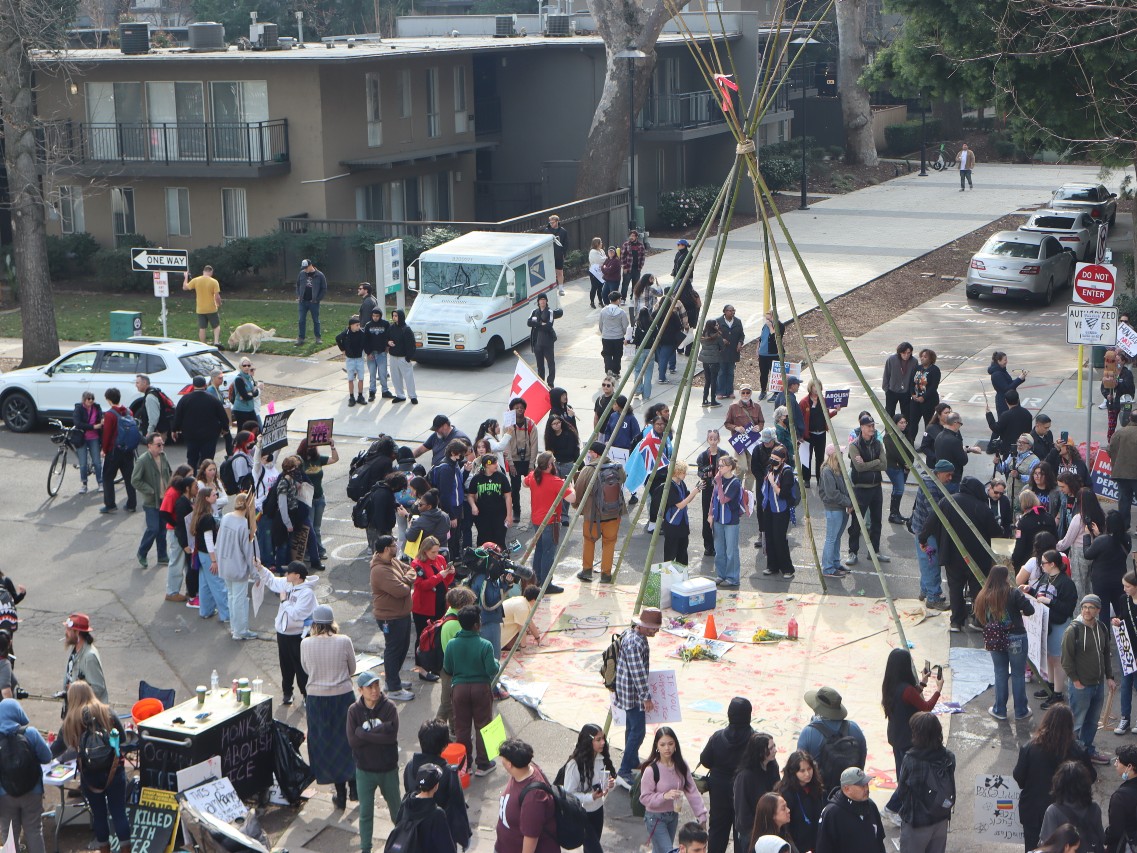
When Sisseton-Wahpeton Oyate tribe member Sierra Rose Feay drove down from Trinidad to Sacramento to perform a fire ceremony in honor of Renee Good, she expected to stay for a few days.
“What we normally do when we have issues, we take it straight to the Capitol,” Feay said. “When someone passes away, you host a sacred fire and you have to keep that fire going for four days and four nights.”
Key to performing the ceremony was Feay’s place of worship – her tipi. She brought it with her and put it up outside of the John Moss Federal Building in downtown Sacramento in what she called an unused driveway, which also extended into two lanes of N Street.
Federal agencies including the Department of Homeland Security and immigration authorities are housed at the building, which has become a well known place of protest against ICE.
On the second day of the ceremony, Feay said officers from the Sacramento Police Department broke up the gathering. After that, they charged her fiance, who was leading the morning sunrise song and prayers, with two misdemeanors – unlawful camping and obstructing the street.
The same day, police seized the tipi and labeled it as a tarp and bamboo sticks, according to the agency’s Feb. 5 booking receipt reviewed by CapRadio.
“I’m hurt, I feel disrespected. My treaty rights were violated,” Feay said. “They took my church. Where am I going to go pray?”
Feay has now been in Sacramento staying in AirBnbs for over a month waiting on the release of her tipi. Feay told CapRadio she is not leaving Sacramento until she gets the tipi back, which might not happen until May.
“That’s our sacred lodge,” she said. “They called it a homelessness encampment.”
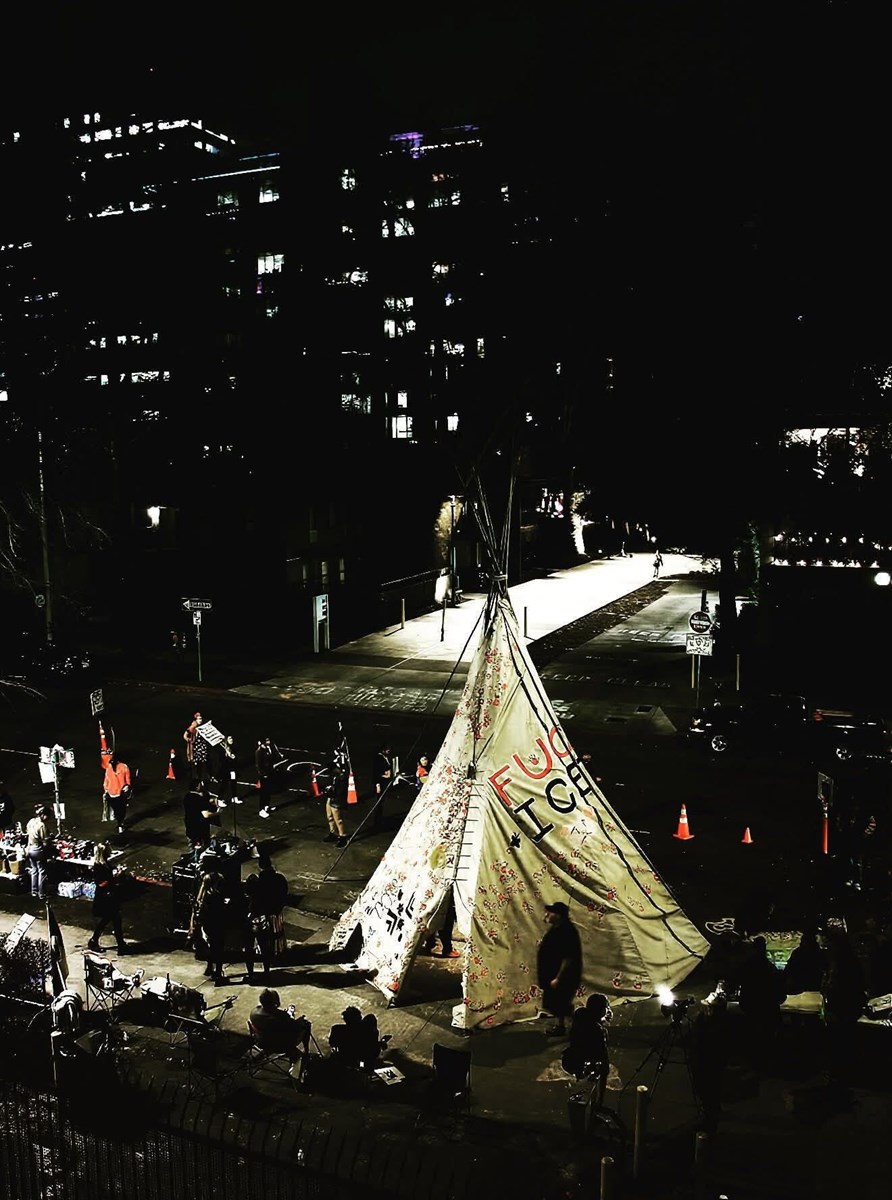 Sierra Rose Feay’s tipi was taken down on Feb. 5, day two into the native fire ceremony to honor Renee Good. Sacramento PD say the tipi was removed due to safety hazards for pedestrian and vehicle traffic.Courtesy of Sierra Rose Feay
Sacramento PD told CapRadio in an email March 3 that the structure and items were removed based on safety concerns.
“The Sacramento Police Department remains committed to respecting individuals’ constitutional rights while also ensuring the safety and accessibility of public spaces for everyone,” an agency statement said. “The structure was removed because it was creating a safety hazard for both pedestrian and vehicle traffic.”
Still, Feay said she’s left wondering why she is unable to get her tipi back. She said she may have to wait until her fiance’s misdemeanor citation hearing on May 6, but police have not provided a clear answer as to why.
“ I’ve been down to the Sacramento police department. I’ve been down to records. I’ve been down to the DA, I’ve been down to the evidence locker. I went everywhere. I even went down to the city council last Tuesday,” she said.
Councilmember Phil Pluckebaum represents downtown and was made aware of the situation last month.
“The city has a process of releasing evidence when there’s property seized and they’re working through that process,” Plukebaum said. “I’ve asked wherever possible for that to be expedited. It is taking longer than I think any of us expected at this point.”
Legal questions on Native American religious freedom raised
Feay told CapRadio that the seizure of the tipi is in violation of the Native American Religious Freedom Act of 1978 (AIRFA) because they were conducting a religious ceremony with a sacred object.
The act states that “it shall be the policy of the United States to protect and preserve for American Indians their inherent right of freedom to believe, express, and exercise the traditional religions of the American Indian, Eskimo, Aleut, and Native Hawaiians, including but not limited to access to sites, use and possession of sacred objects, and the freedom to worship through ceremonials and traditional rites.”
Mia Perez-Arroyo is a Sacramento based civil rights attorney and a tribal court judge for the Texas-based ‘Yorimea’ Band of Yaqui Indians. She said the answer is nuanced.
“The American Indian Religious Freedom Act recognizes Native religious practices, but it does not itself create a direct legal claim,” she said in a written statement. “The real legal question is whether law enforcement substantially burdened a religious ceremony under the First Amendment or the Religious Freedom Restoration Act.”
Perez-Arroyo added that governments are usually allowed to enforce time, place and manner regulations in public spaces.
Outside of the reason for seizure, the length of time the tipi is in custody could raise further questions.
“The more complex legal question arises when ceremonial property used in a religious gathering is seized and held for an extended period, because courts may examine whether that continued retention is actually necessary to enforce the citation,” she said.
When asked about native religious freedoms, Pluckebaum said the city is evaluating the merits of the claim.
“The city’s goal is to be in compliance with all laws and trying to figure out if there was an error on the city’s part or if there is still one about the returning of religious property,” he said. “That’s definitely an open question.”
Follow us for more stories like this
CapRadio provides a trusted source of news because of you. As a nonprofit organization, donations from people like you sustain the journalism that allows us to discover stories that are important to our audience. If you believe in what we do and support our mission, please donate today.