
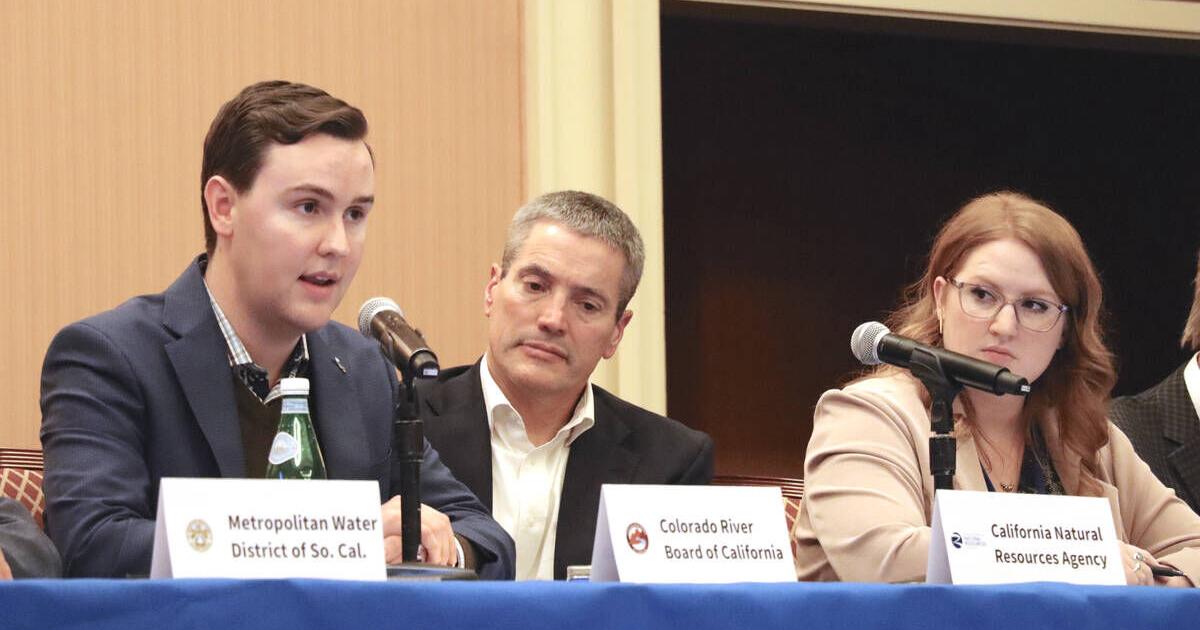
SACRAMENTO — California water officials issued a formal warning to the federal government Monday, asserting that current draft plans for managing the Colorado River after 2026 lack a sound legal basis and unfairly shift the burden of drought onto Lower Basin states.
In a detailed comment letter submitted to the U.S. Bureau of Reclamation, JB Hamby, California’s Colorado River Commissioner, argued that the government’s Draft Environmental Impact Statement (DEIS) fails to analyze whether its proposed “shortage” scenarios actually comply with the 1922 Colorado River Compact—the foundational “Law of the River.”
A call for legal accountability
The dispute centers on how water cuts will be distributed once the current operating guidelines expire in 2026. According to California officials, the federal government’s current models allow Upper Basin states (Colorado, Wyoming, Utah, and New Mexico) to increase their water use while forcing “robust and regular” cuts on the Lower Basin (California, Arizona, and Nevada) to protect falling reservoir levels at Lake Mead and Lake Powell.
“The preferred alternative should be one that works for the entire system,” Hamby said in a statement. “Reductions in the use of Colorado River water… must be regular and robust to balance supply and demand and avoid unnecessary, protracted, and destabilizing litigation.”
The “infrastructure floor” controversy
A major point of contention in California’s filing is the Bureau of Reclamation’s treatment of Glen Canyon Dam. The federal government has treated the dam’s minimum operating level (3,490 feet) as a “hard floor,” choosing to cut downstream water deliveries to California and Arizona rather than investing in infrastructure repairs to the dam’s aging outlet works.
California argues that NEPA (National Environmental Policy Act) law requires the government to evaluate upgrading the dam’s infrastructure instead of simply shutting off the tap to downstream users.
Economic and environmental stakes
The Board’s letter highlights several “blind spots” in the federal review that could have devastating local consequences:
Urban Economies: The report fails to account for the socioeconomic impact on Southern California’s 19 million residents and its massive regional economy.The Salton Sea: California criticized the Bureau for excluding the Salton Sea from its geographic scope. Officials warned that reduced water flows to the Imperial and Coachella valleys will shrink the sea further, exposing toxic dust and endangering federally protected species.Agricultural Security: While California has already invested $8 billion in water resilience and reduced its usage significantly, the state argues it cannot be the sole shock absorber for a drying river.The path forward
Despite the sharp tone regarding legal compliance, California officials emphasized their desire for a “negotiated, long-term framework” rather than a court battle. The state recently committed to saving an additional 1.6 million acre-feet of water through 2026 to stabilize the system.
“California remains a collaborative partner,” Hamby said. “But the Post-2026 Guidelines must reflect a key principle: all Basin states that benefit from the Colorado River share responsibility for adapting to hydrologic realities.”
The Bureau of Reclamation is expected to review the comments from all seven basin states before issuing a final environmental impact statement later this year.