
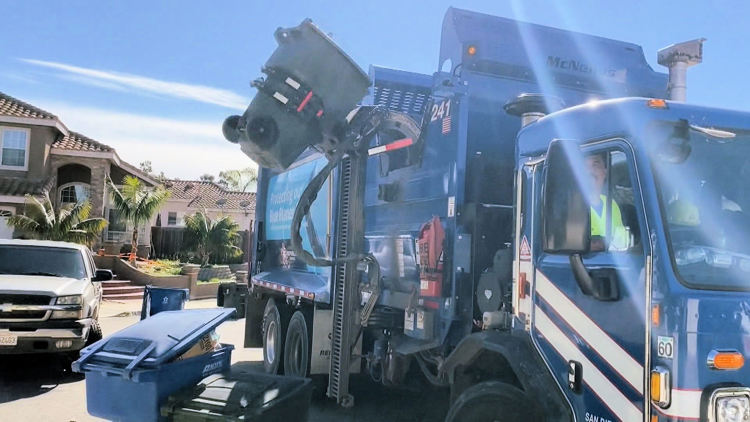
The Lincoln Club Business League on Tuesday announced it was collecting signatures for a ballot measure to repeal a controversial trash tax for San Diego homeowners.
In June 2025, the San Diego City Council passed a solid-waste fee, breaking a 106-year-old precedent of the city not charging single-family homeowners a fee for trash pickup.
“This is about honesty, accountability and affordability,” said Kevin Faulconer, president and CEO of the Lincoln Club Business League and former mayor of San Diego. “San Diegans were misled, and the trash tax is now costing them far more than promised. The Lincoln Club Business League is leading a coalition to repeal the trash tax and stop City Hall’s reckless habit of piling on new fees to cover its own fiscal mismanagement.”
Then-Council President Sean Elo-Rivera and Councilman Joe LaCava proposed Measure B in 2022 to allow the city to collect a fee for solid waste collection, transport, disposal and recycling, including the cost of bins and force short-term vacation rentals, accessory dwelling units and “mini-dorms” currently receiving city trash pickup to pay for the services.
When Measure B passed by a narrow margin, it was with the estimate of a fee ranging from $23-$29 to amend the “People’s Ordinance,” passed in 1919. However, this was with the assumption that the city served 285,000 households. But faced with the prospect of a new fee, the Environmental Services Department counted the number of households the city served following the election and came up with 226,495 — a nearly 60,000-household difference.
As a result, when a cost study came back in April 2025, the fee jumped to $36.72 per month on the low end and $47.59 on the high. That received almost universally negative feedback from the public, so a revised fee schedule then went to a range of $31.98-$42.76 in the first year by delaying certain services such as bulky item pickup and an electric vehicle pilot program.
If Faulconer and the Lincoln Club qualify the ballot measure for the November ballot and voters approve it, the repeal would take effect in 2027, becoming law 30 days after certification of the election results. The measure would “eliminate two years’ worth of trash fees, with the repeal applying to the second half of 2027, all of 2028, and the first half of 2029,” a statement from the business league read.
“This is not a new cost, this is a cost that has been borne by those who do not receive city services,” Elo-Rivera said last year.
Single-family refuse pickup is funded by the city’s general fund, which all residents pay into through property tax — whether they rent or own a single-family home, a condo or an apartment. The city takes away 300,000 tons of trash and 150,000 tons of recycling, compostable and yard waste annually.
“I believe the final product is not what the majority of the city voted for,” said Councilman Raul Campillo, who voted no on the fee. “It was my fear that approving this fee would lead the public to not trust this council. The messages from my constituents have proven this fear.”
The “People’s Ordinance” had been criticized for years by activists for being inequitable because although every household pays property tax either directly or through rent, only single-family households received trash pickup at no additional charge. In 2009, a San Diego County grand jury concluded that the ordinance had “outlived its usefulness in a 21st-century society.”
According to city documents released with the ballot measure in 2022, the price of keeping the service as it existed without adding a fee was expected to cost at least $234.7 million between fiscal year 2023 and 2027.
According to the ESD, around 32% of the city’s waste is diverted from landfills, far short of its goals of 80%. City staff said weekly recycling pickup could increase that percentage. Trash diversion is on the minds of city leaders as the Miramar Landfill is projected to be full in 2031.