

The two most populous states, California and Texas, offer an interesting dataset in examining the state of legal education and the market of law schools, including the market for new attorneys. There’s much to examine in the last decade. (I’ll speak about “ten years ago” and “today,” and relevant data will be 2014 to 2024 or 2015 to 2025, the last available data sets.) And perhaps there is no one particular “tale” as much as a number of observations.
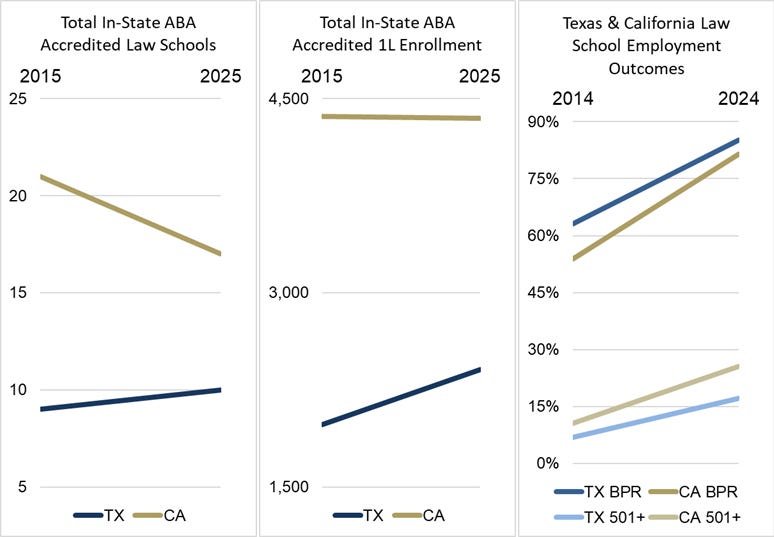
Ten years ago, California boasted 21 ABA-accredited (or provisionally accredited) law schools and Texas just nine. Today, California has lost four and is down to 17. Texas has gained one and is up to 10.
Despite the closure of four ABA schools, total 1L enrollment remains mostly flat in California. It was 4363 1Ls enrolled a decade ago compared to 4347 today. But in Texas, 1L enrollment has grown significantly, from 1982 a decade ago to 2407 today.
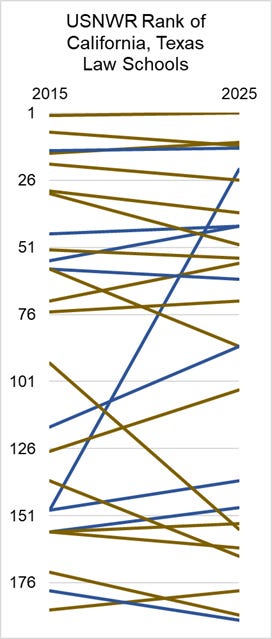
A different telling data point is overall USNWR rank. Yes, one can question the methodology, and the methodology has changed. But it illustrates a fairly stark picture of how the law school “hierarchy,” if you will, has changed.
On the whole, California schools have declined in rank, whereas Texas schools have improved. There are, of course, important and subtle differences in individual schools, but here I’m simply focusing on the aggregate.
In 2015, there were four California schools in the “top 25” of the USNWR rankings and just one from Texas.
By 2025, there were just three California schools in the “top 25” and now two from Texas.
In 2015, there were six California schools in the “top 50” and just two from Texas.
By 2025, there were five from California and four from Texas.
In 2015, there were 11 California schools in the “top 100” and four from Texas.
By 2025, there were 10 from California and six from Texas.
In short, California schools have, on the whole, declined in their relative position to the overall law school picture, and Texas schools have improved. And that’s despite an additional school and a 25% increase in 1L volume in Texas, which has not adversely affected admissions standards or employment outcomes. (And of course, not all of the improvement in these metrics stems from Texas A&M’s meteoric rise—but it certainly doesn’t hurt.)
One more metric to observe: total cost of attendance. (Data drawn from ABA data, but some schools reported “$0” in some categories, and I went to verify data on websites before backfilling figures. I used full-time enrollment figures. South Texas’s cost of living in the ABA appears to be in error as it exceeds Stanford’s cost, so I updated that, too.)
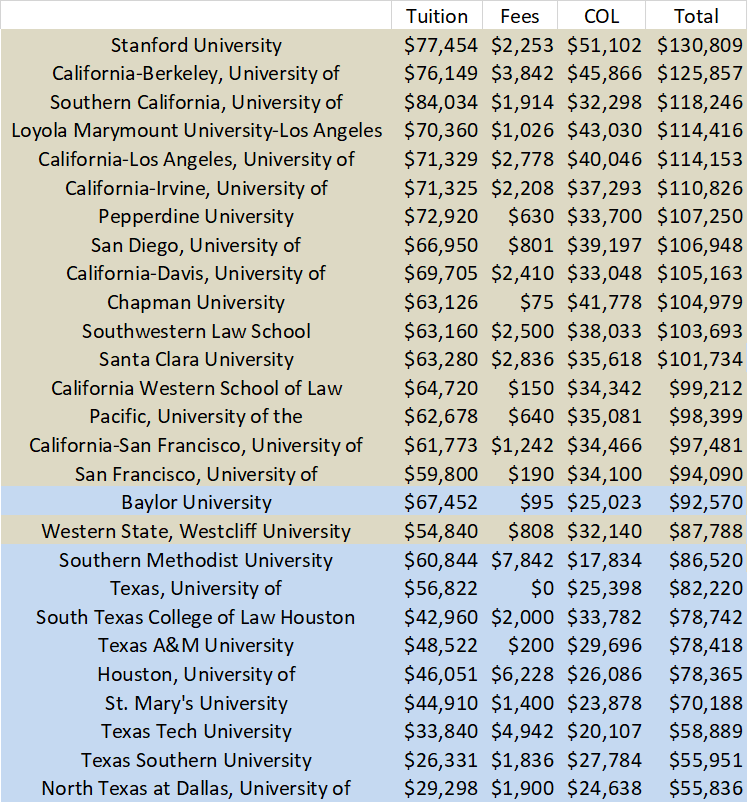
Using out-of-state tuition prices, the cost of attendance shows a pretty stark divide across states. Yes, tuition can be supplemented with scholarship dollars. But virtually every California school is more expensive than virtually every Texas school. This is both for tuition and for cost of living, even if pulled out as separate categories.
As I opened this post, this perhaps isn’t so much a “tale” as much as a series of observations about the legal markets. In one noteworthy category, placement into law firms of 501+ attorneys, California law schools outperform Texas schools, and materially so. But on a range of other factors—USNWR rankings, cost, overall bar passage-required employment, total law schools, total 1L enrollment—Texas schools appear to be improving, and California schools appear to be worsening. This is all relative, of course, and California still enrolls far more students than Texas, has far more law schools, and, in the aggregate, still shows higher demand. But the trends are interesting ones to observe over the last decade, and perhaps portend what the next decade may look like.