
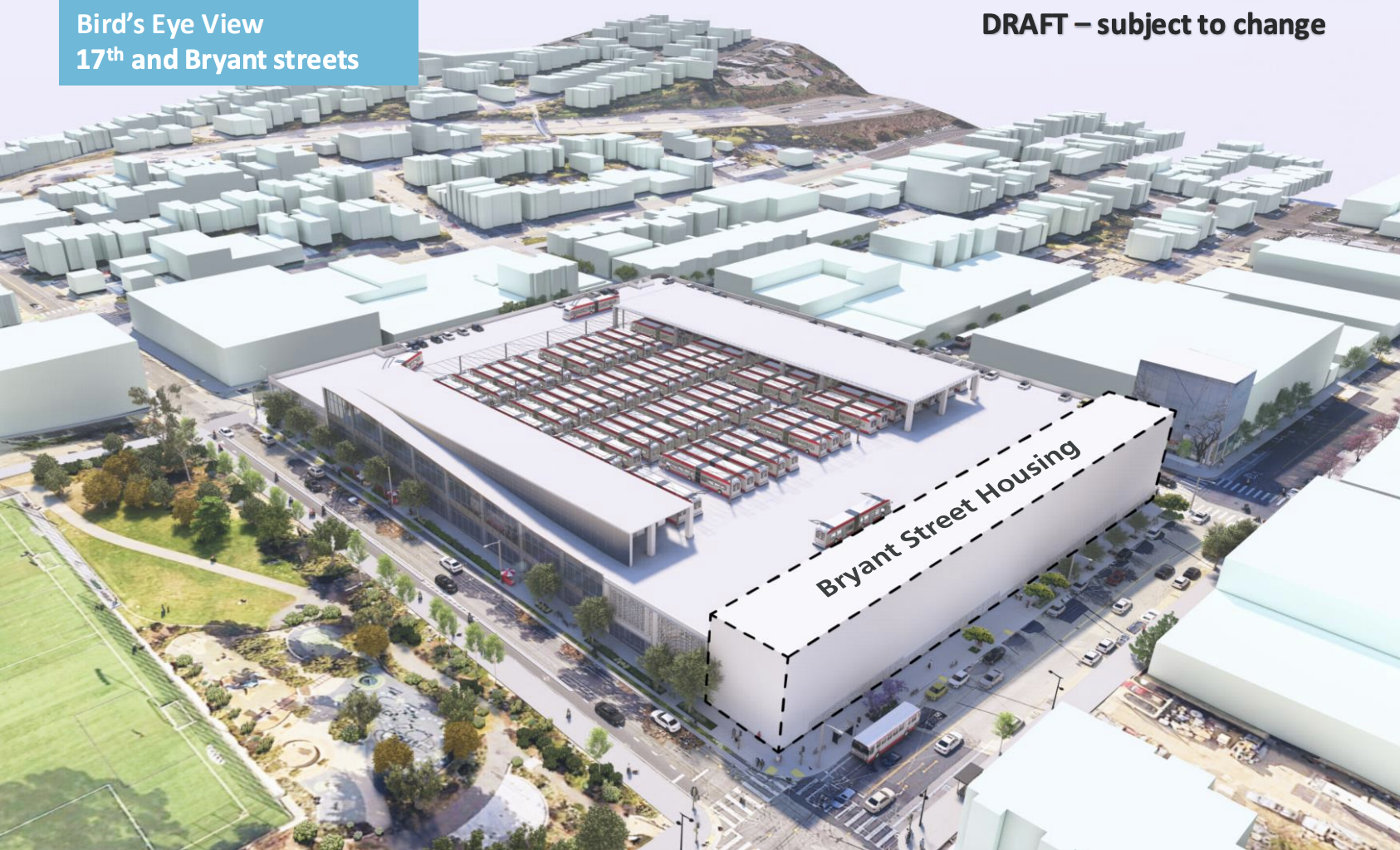
The board of the San Francisco Municipal Transportation Agency voted to dramatically downsize an affordable housing project in the Mission District that would have brought about 465 low- and moderate-income housing units to the neighborhood.
On Tuesday, the board approved a plan for just 100 units, despite opposition from advocates and community members.
“We feel a little used,” said Erick Arguello, Mission resident and president of Calle 24 Latino Cultural District. “We worked making sure this was all available for the community to give input, and then this is what we end up with.”
The transit agency said it reduced the scope due to Muni’s $307 million budget deficit, inflation and increased construction costs since the project started in 2018. The revised plan, which the SFMTA announced in September, downsized the project at Bryant Street between 17th and Mariposa from 465 units of affordable housing to just 100.
The project would sit alongside Potrero Yard in the Mission District, which houses dozens of buses. The plan includes a four-level bus storage and maintenance facility that would hold 68 percent more electric trolley buses.
Studio and three-bedroom apartments would be built along Bryant Street, reserved for households earning up to 80 percent of area median income, or $87,300 for a single person. But the plan no longer includes hundreds of additional units that would’ve been built on a reinforced podium above the facility.
Several Mission District residents and advocates were disappointed Tuesday.
Roberto Hernandez, founder of the Our Mission No Eviction group, told the board and a crowd of about 50 people gathered inside City Hall on Tuesday that he was part of an MTA working group focused on Potrero Yard for the past eight years. He said that the group was shocked when the agency told them it had downsized the project without involving them in the discussion or considering other options.
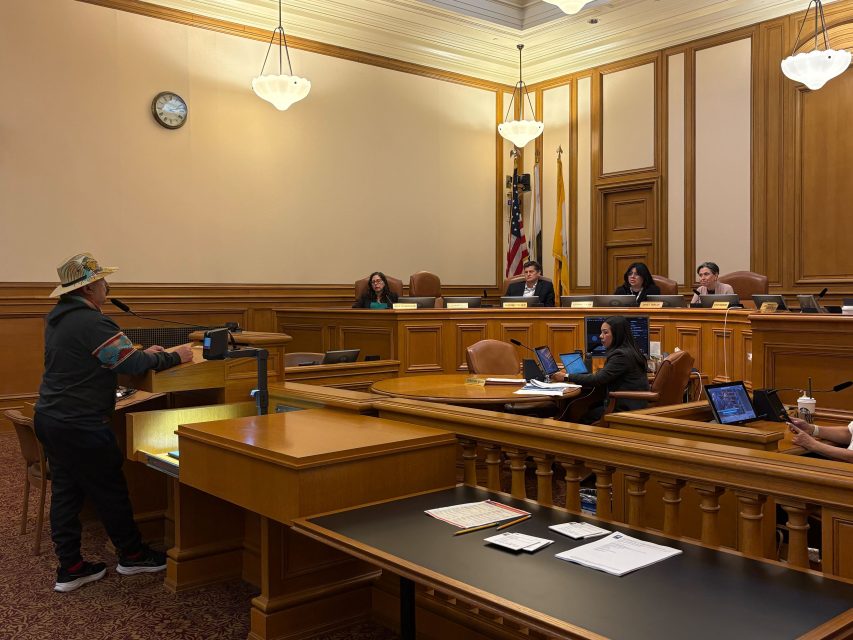 Roberto Hernandez addresses the SFMTA board at a March 3, 2026 meeting. Photo by Alice Finno.
“There is clearly poor planning on both the SFMTA and the Mayor’s Office of Housing,” he told Mission Local. “I just didn’t get a sense that they were even coordinating any kind of effort to get the financing.”
Julie Kirschbaum, the SFMTA’s director of transportation, apologized at the beginning of the meeting.“I know this community has been deeply affected by housing affordability issues and the resulting displacement for decades,” she said. “I know that losing the housing above the bus yard is a wound that will not easily heal.”
Tracy Gallardo, a longtime Mission resident and District 10 legislative aide, spoke at the meeting and asked the board to find a compromise and build the additional units in the future. “I urge you to make all those considerations,” she said, “and hope that you will move this project forward in a way that brings us all the housing that was promised to the community.”
Several others also asked to find a replacement site for the housing, but officials said funding was a challenge. Sean Kennedy, a senior SFMTA manager, said the agency cannot use its transit funds for housing.
These projects are extremely expensive and financing them remains the biggest constraint, Robert Baca from the Mayor’s Office of Housing and Community Development told the board. “We have thousands of units throughout a pipeline in the city that we would love to move forward if financing was available at the different levels.”
Members of the SFMTA board seemed empathetic about the loss of housing units, but they still largely voted in favor of the reduced project, saying it would improve transit conditions and safety for workers. The current bus yard is 110 years old and has been deemed seismically unsafe.
Of the seven commissioners, only vice chair Stephanie Cajina voted no, citing the failed commitment to building affordable housing for communities in the Mission and Bayview. “I’m sorry that I can’t do more today than just cast my one vote, but I’m very disappointed how this ended up,” she said.
The revised project is expected to cost $612 million. Demolition work for the bus yard is planned to start in 2027, and construction should be completed in 2030.
The project still needs to be approved by the Board of Supervisors, scheduled to vote on the matter on March 17.