
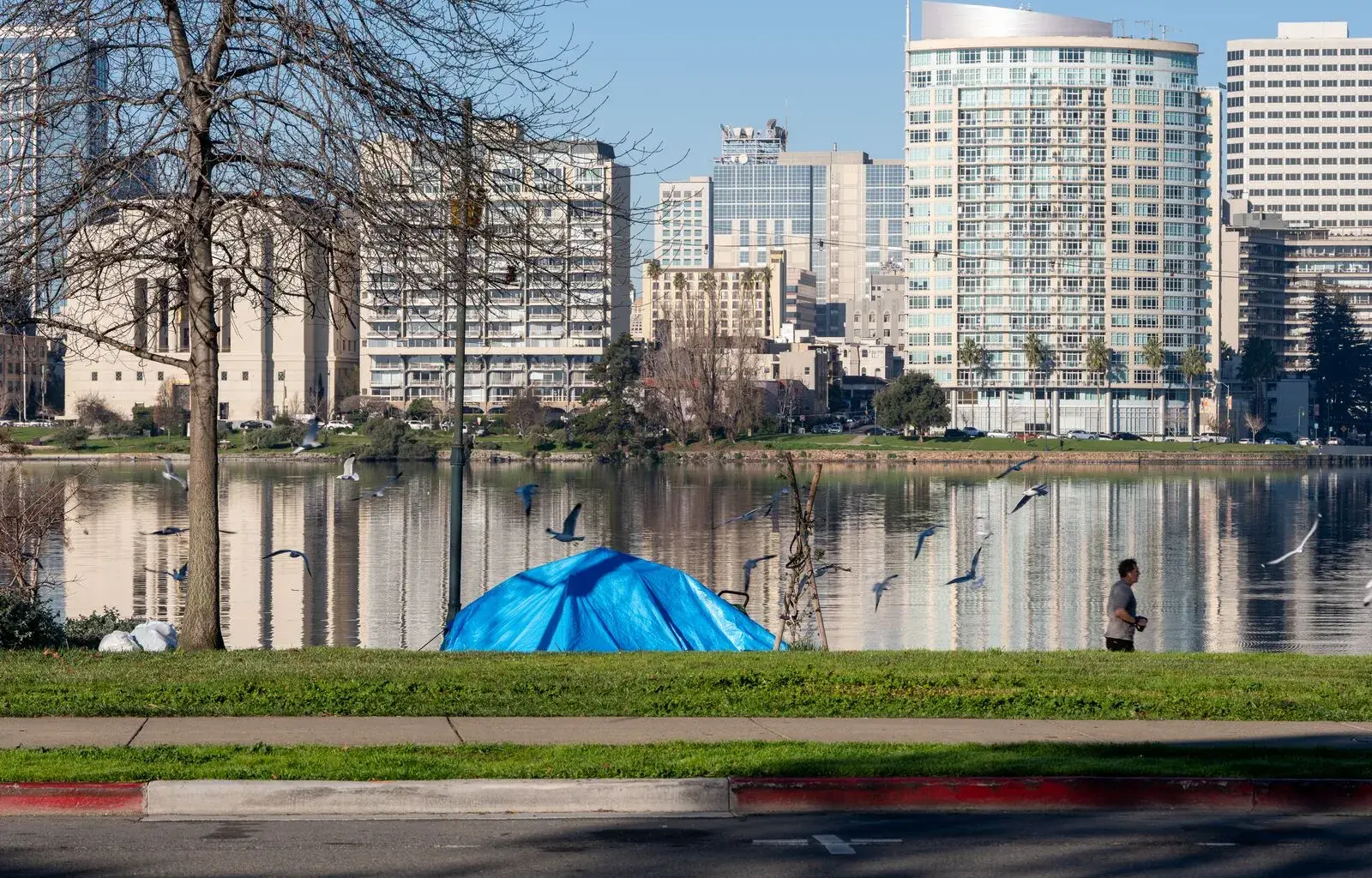
A few months into taking office, Mayor Barbara Lee created a new, high-level city office dedicated to one of Oakland’s most severe and persistent crises: homelessness.
Now that office has released its draft “strategic action plan,” with a goal of reducing unsheltered homelessness in Oakland by 50% in the next five years.
“I wish that we could have said we’re going to get to functional zero in the next five years,” said Sasha Hauswald, who leads the new Office of Homelessness Solutions, speaking at a February meeting of the city’s Commission on Homelessness. “Not to mince words, but we don’t have the resources.”
It would cost $3.2 billion beyond what the city and county already spends to abolish homelessness in five years, she said.
Hauswald was not available for an interview by publication time. A city spokesperson responded to questions we sent.
At last count, Oakland had an estimated 3,659 unsheltered residents and 5,485 homeless people overall — numbers that have grown dramatically over the past decade. But a tally conducted this year will offer an updated snapshot.
The plan identifies a roughly $284 million annual gap in funding, and suggests avenues to pursue to plump up city resources.
The vision laid out in the new 71-page document highlights strategies that have been successful, and calls for the city to double down on those programs in the coming years.
But it’s also not shy about weighing in on what hasn’t worked so far in Oakland and where priorities should shift, raising questions about how the administration’s approach will square with a more aggressive encampment policy the council is considering.
“Despite a substantially increased pace of encampment closures in 2025, reported encampments still rose,” the draft plan says. “The city lacks shelter and housing to meet the needs of unhoused individuals and without an indoor place to move, most individuals simply self-relocate to another Oakland location during encampment closures.”
The plan also lays bare the severe racial disparities in the homeless population in Oakland and calls for keeping equity at the forefront of all programs and policies.
Ramping up what’s working already
The mayor’s plan addresses five areas:
Preventing people from becoming homeless
Improving access to services
Managing homeless camps and neighborhood health
Improving interim housing
Building permanent housing
Last summer, the city held 10 general community feedback sessions and two focus groups with people who’ve experienced homelessness to inform the proposal.
Oakland’s “targeted prevention” program is held up as one of the city’s most successful strategies; the plan recommends expanding it significantly. Under this program, the city identifies households that face the greatest risk of homelessness. These risk factors, according to research, include prior homelessness, severe rent burdens, and involvement in the criminal justice system. Households with these characteristics are eligible for financial assistance, social services, and legal help.
More people enter homelessness each year in Oakland than leave it. Preventing inflow costs $6,000 to $10,000 per household, according to the city, but getting someone stable and housed once they are already homeless costs tenfold that, so it’s cheaper to nip the problem in the bud before it becomes a crisis. Even so, Oakland would be left with a $21 million annual shortfall by expanding the targeted prevention program to the size the plan suggests, according to the report.
Moving people from interim housing programs into permanent supportive housing also works, the city says. Most people remain housed after that step. But Oakland can’t do this at the level that’s needed.
“Shortages of effective emergency and transitional housing solutions, combined with scarcity of permanent affordable housing, have created bottlenecks where the street becomes a waiting room, and shelter becomes a long-term home,” the plan says.
“You get placed somewhere temporary and then forgotten,” says an unhoused person quoted in the report. “No plan, no timeline, no follow-up.”
The city recommends funding permanent housing — the subsidies that Oakland provides to developers and social service agencies — at a significantly higher rate.
Oakland needs “3,650 additional permanent, deeply affordable housing options” to cut unsheltered homelessness in half over five years, the plan says. Put in dollar figures, that’s roughly $217 million a year — or $169 million annually once you take into account existing city and county funds.
Accessing Measure W dollars and a new bond measure?
Cutting the size of the unsheltered population in half is an expensive endeavor, the plan makes clear.
The estimated $284 million annual shortfall for meeting this goal is paired with a dearth of external resources. The state is facing an extreme deficit, and the Trump Administration is poised to tighten limitations for using federal homelessness money.
One bright spot is the county’s $1.83 billion sales tax Measure W. Officials have decided that 80% of revenue will go toward homelessness, but big decisions remain on exactly how and where most of the money will be allocated.
The city says Measure W could cover 55-61% of the budget shortfall in the report, and the plan calls on Oakland officials to advocate fiercely at the federal, state, and local levels for funding. Oakland should also put forward a new bond measure for homeless housing development, it says.
Another controversial encampment policy already on the table
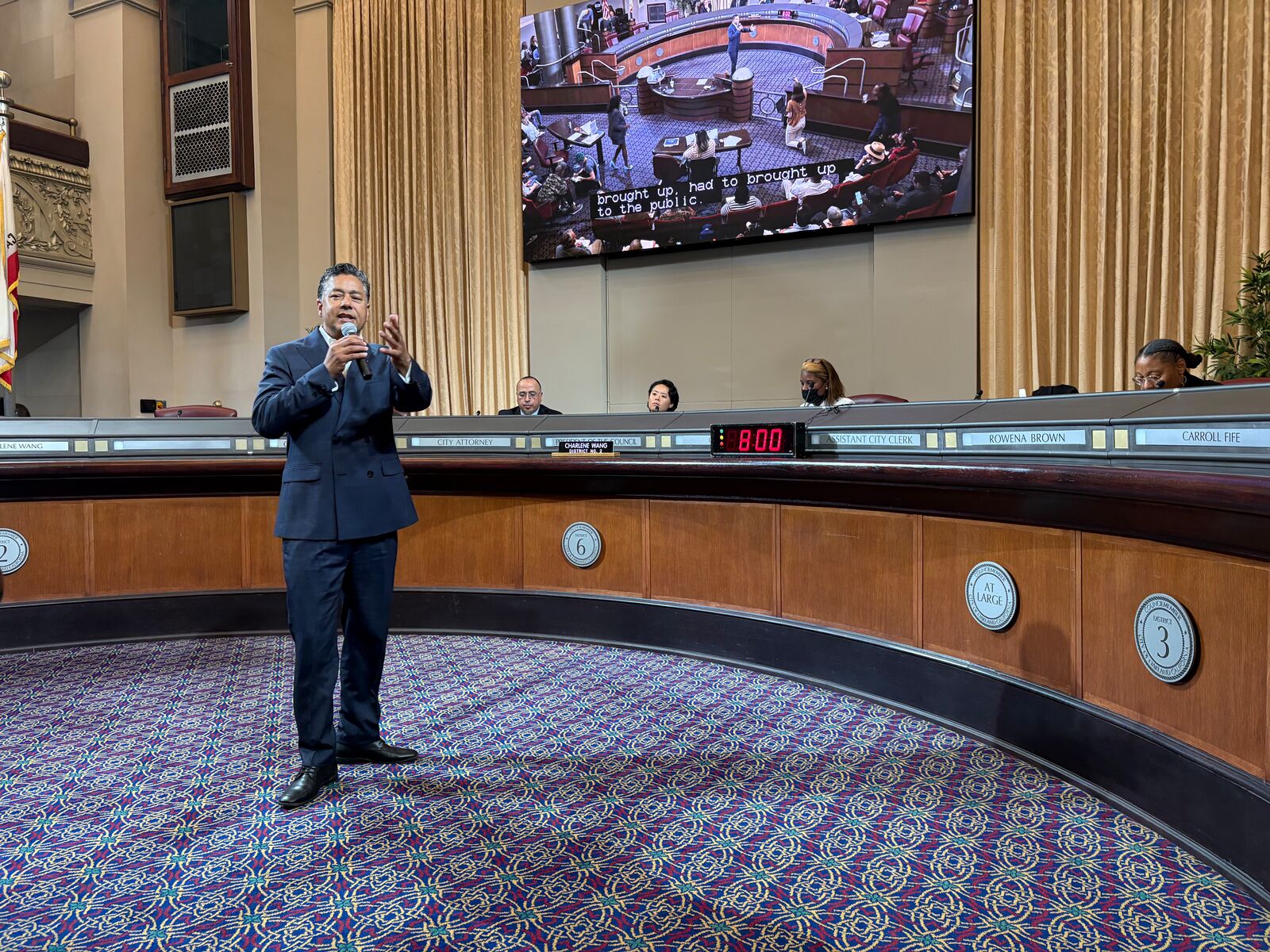 Councilmember Ken Houston presents his encampment policy in September 2025. Credit: Natalie Orenstein/The Oaklandside
How the city should handle homeless camps and treat people living in them has been one of the most engrossing and divisive debates in Oakland in recent years. Last year, Councilmember Ken Houston proposed legislation that would have the city crack down on unsheltered homelessness, towing vehicles people live in and closing more encampments, regardless of whether the city has available shelter beds.
Houston has repeatedly said that allowing encampments to remain is a safety issue for both housed and unhoused people. In response to criticism that his proposal was too aggressive, he updated the legislation to say Oakland should try to offer shelter before closing a location, but refrained from requiring it.
Houston’s proposal has been repeatedly tabled and rescheduled, but it recently cleared a hurdle when a state agency weighed in, saying his plan won’t imperil state funding.
When she spoke to the Commission on Homelessness last month, Hauswald said her office’s plan is not meant to counter Houston’s proposal. However, it paints a different vision for the near-future of Oakland encampments.
City closures of encampments have ballooned from 240 in 2024 to 1,212 in 2025, according to the report. This spike was due in large part to extra staff hired, large state funding awards, and priorities that shifted after Mayor Sheng Thao issued an executive order to clear more camps, the city told us.
However, the city estimates that while closures ramped up, encampments still grew, to over 1,900 locations.
“While encampment closures are necessary to maintain usability of Oakland’s parks, schools, businesses, and critical infrastructure, forced relocation has negative and racially disproportionate impacts on unsheltered people,” the plan says. Because the city has insufficient shelter beds — under 1,300 for over 5,000 homeless people — the closures often “force residents into more dangerous locations,” cut off their access to healthcare and service, increase the loss of critical paperwork and medications, and heighten the risk of fatal overdoses, the report says, referencing research.
“Every time they sweep the camp, you lose your place in line. You lose paperwork, you lose your worker, you start over,” a homeless person says in the report.
Because almost half of Oakland’s unsheltered residents are Black, compared to 22% of the city overall, the closures have racially disparate impacts, the plan says.
The document calls for the creation of more “low-sensitivity” zones where unhoused people can generally live without being rousted. Presenting the plan, Hauswald said Oakland should “pace” its closures based on available shelter. Oakland’s current rules, and Houston’s proposal, define most of the city as “high-sensitivity,” allowing camps to be closed more easily.
In the first year of the plan, the city should expand trash pick-up and sanitation services at camps — something homeless people have long called for — increase outreach, and reinforce expectations that unsheltered residents be “good neighbors” to surrounding businesses and people, the report says.
“We need to bring down the temperature, and bring a basic level of health and sanitation to our neighborhoods and to our unhoused neighbors,” Hauswald said at the February commission meeting.
She said the plan is “not intended to set a stake on one side of the convo. Nobody wants homelessness in Oakland…The polarizing nature of the convo is harming our ability to make practical progress.”
If both were adopted by the City Council, Houston’s legislation “would prevail over” the action plan, city spokesperson Jean Walsh said.
A representative for Houston, speaking at a council committee meeting last week, praised Hauswald’s commission presentation but said the councilmember was frustrated that he wasn’t briefed on it in advance.
“*” indicates required fields