
Read Mission Local often?
Help grow our newsroom, joining the 3,250 readers who support us by giving below.
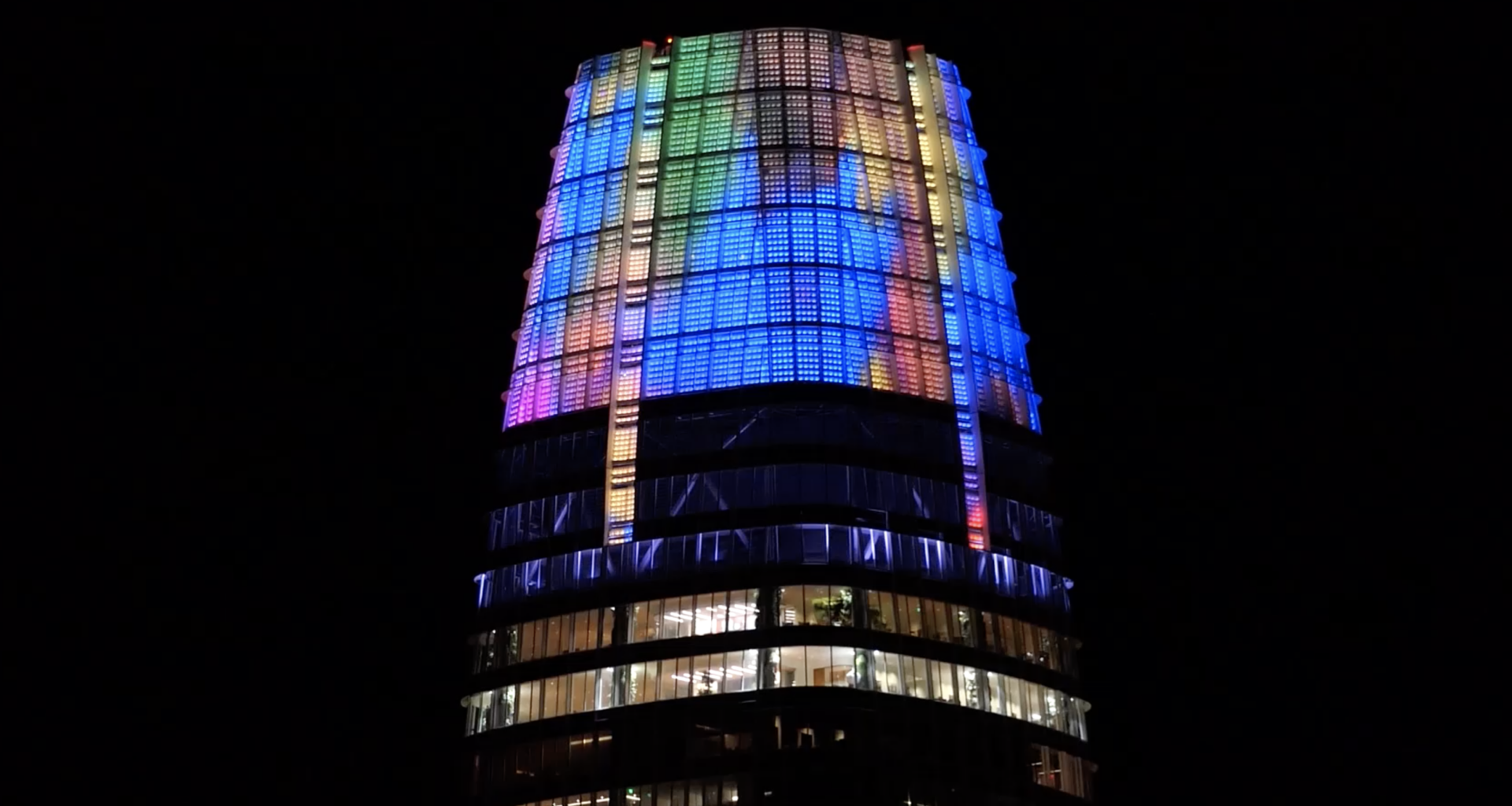
For the first time in its history, the LED crown atop San Francisco’s Salesforce Tower will feature a video installation celebrating Holi, the South Asian festival of colors, with digital palms tossing pixelated gulal, the vibrant colored powders central to the festival’s traditions. And it’s all thanks to the enterprising Seema Sri.
After Mayor Daniel Lurie proclaimed Oct. 20 as “Diwali day” last fall, followers of Sri’s Instagram reached out expecting more representation, especially around festivals like Holi and Diwali, the festival of lights, said Sri.
Sri, the co-founder of the arts group IDEATE SF, who has for close to two decades lived in the area where Salesforce Tower came up, had an idea: put the centuries-old holiday on the tallest building west of the Mississippi.
Want the latest on the Mission and San Francisco? Sign up for our free daily newsletter below.
“There’s so much talent, culture and beauty to South Asian themes,” Sri said. “We just need advocates to put it out there.”
It would be something different from hosting private, siloed events only for the South Asian community. It would include the whole city.
She shared her vision with Kudrat D. Kontilis, vice chair of the San Francisco Immigrant Rights Commission and its first South Asian member, and from there, the two moved quickly.
They reached out to Andrew Robinson, executive director of the East Cut Community Benefit District, who last fall connected Sri and Kontilis to Jim Campbell Studios, which creates the video installations for the Salesforce Tower crown. But it was too close to Diwali and the team did not have enough time to create a new installation before the late-October festival.
But in January, two months before Holi, things started falling into place.
Campbell was in 2017 commissioned by the tower’s landlord Boston Properties to create an art installation as part of the city’s “1 percent for art” program, which requires developers to spend at least one percent of the cost of each project on public art.
Campbell, famous for his LED light works, proposed installing an estimated 11,000 LED lights on the crown of the Salesforce Tower. When it went live in 2018, it was one of the world’s highest pieces of public art.
Campbell Studios looks for requests that represent a large community in the Bay Area, and does not charge the organizers. Boston Properties works with the studio to absorb the cost.
Holi is usually celebrated in large open spaces with brightly colored powders called “gulal.” People dress in white and playfully smear color on each other, dance and indulge in traditional drinks to mark the joyous arrival of spring.
Celebrating it in a city like San Francisco, with limited space, is prohibitive — it often requires a galore of permits. While Sri, Kontilis and their teams organize community events, they also wanted to create citywide representation for those who might not be celebrating it in the traditional format.
To design something that felt right, Sri and Kontilis sat down with Emma Strebel, Campbell studio’s in-house imagery collaborator.
Details were important. For example, it wouldn’t do to use just any colors in the graphics — it had to be primary colors because those are traditionally used during the festival. Common motifs of Holi, like gulal poppers that shoot bright colors into the air, were worked into the design.
Every few weeks the studio previews the test graphics directly on the tower. It helps artists tweak their final visuals, said Strebel. For Sri, who grew up in the United States, even a brief test of the Holi graphics last week stirred something in her.
“We were so taken aback when we saw the colors,” she said. “We felt like school girls seeing beautiful art come to life.”
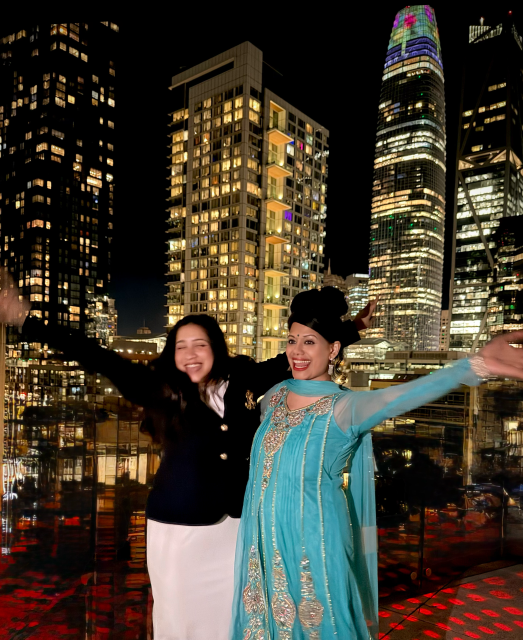 Kudrat D. Kontilis (left) and Seema Sri (right) after previewing the Holi test graphics on
Salesforce Tower. Photo by Priya Vij.
The LED crown on top of the tallest building in San Francisco is famous for displaying a rotating variety of visual art installations. Displays celebrating some cultural events, like the Lunar New Year, are yearly mainstays. But this is the inaugural installation celebrating any Indian festival.
Sri and Kontilis of the city’s immigration commission met at the commemorative ceremony recognizing South Asian American Heritage month last year, a resolution that Kontilis and Supervisor Bilal Mahmood had worked closely together on. San Francisco is one of the first major cities in the United States to do so.
After that, there was more momentum, Kontilis said, about pushing forward with this inaugural Holi project.
Anjali Rimi, president of Parivar Bay Area, a nonprofit working to provide legal aid to trans immigrants, said the display is a landmark moment.
“To see our sacred festival of colors shining across the skyline of this beautiful city reminds us that San Francisco truly embraces diversity,” she said.
The group isn’t done. Sri, Kontilis and Strebel want to work on a similar display for Diwali this November — the first year the festival will be recognized as an official state holiday in California — with a longer run time than the Holi installation, which is only five and a half hours.
Kontilis thinks that such a project moves the needle in the right direction.
“It’s more conversations about who we are, what we bring to the table,” said Kontilis. “What we are proud of and what we celebrate.”
Join the 3,250 readers who keep Mission Local free for all!
Because of you, Mission Local reached and surpassed our $300,000 year-end fundraising goal. All we can say is thank you.
Thank you for choosing to invest in a local newsroom rooted in San Francisco’s communities — one that listens first and reports deeply.
If you haven’t yet had a chance to give, it’s not too late to be part of this community. Your contribution today helps sustain the reporting our city relies on all year long.
We’re grateful you’re here — and we’d be honored to have you join our donors.