
BOISE, Idaho — Three thoughts on San Diego State’s 86-77 loss at Boise State on Tuesday night:
1. The future
As much as the first 30 minutes were an indictment of the present, the last 10 were a peek into the future.
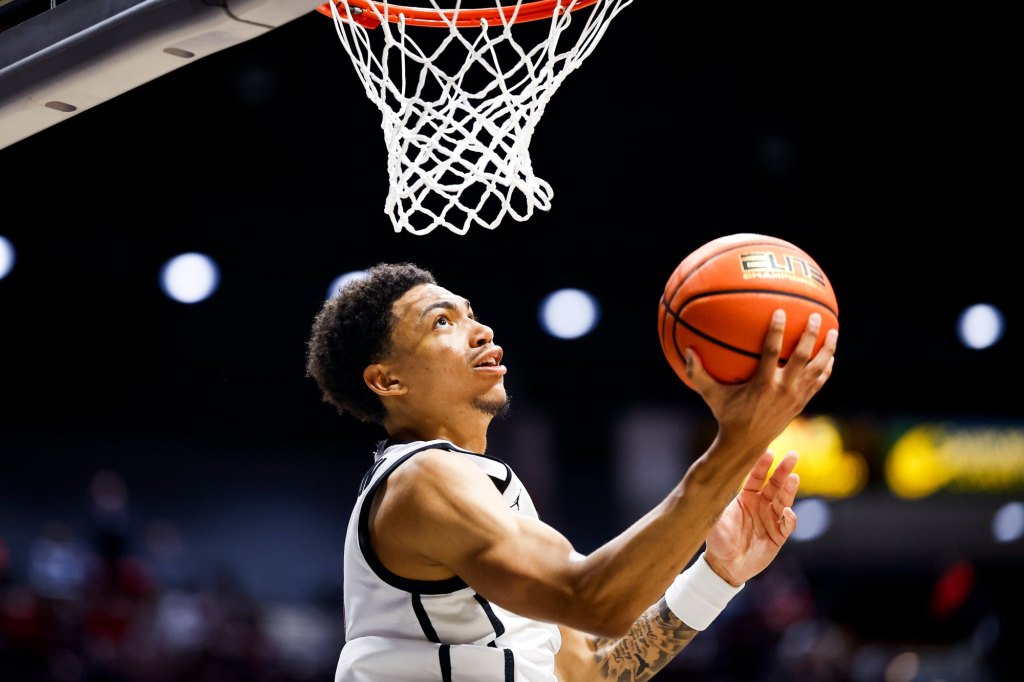
It was probably not a coincidence that the lineup down the stretch that trimmed a 21-point deficit to seven included the only two true freshmen on a veteran-laden roster. Elzie Harrington played the game’s final 11 minutes. Tae Simmons subbed in with 10:45 to go and played until he fouled out with 55 seconds left.
You’re looking at the program’s two pillars going forward, assuming San Diego State can keep them.
Practically everyone else in the rotation is either out of eligibility or expected to be part of a mass exodus to the transfer portal, either by personal choice or the coaching staff’s choice.
But if you’re building around redshirt guard Latrell Davis and two freshmen, Harrington and Simmons are not a bad place to start and provide hope in an anxious, uncertain spring. One oozes elegance and talent, the other energy and heart.
“If you can’t see they’re going to be very good players in our program and in the new Pac-12, then you’re not watching basketball,” Aztecs coach Brian Dutcher said. “They are very good freshmen.”
Added senior Reese Dixon-Waters: “Elzie was our best player in the summer, I can say that comfortably. Tae is giving it all he’s got. … He cares deeply. He’s emotionally passionate about the game. It’s something I respect about him.”
Simmons seems wholly invested in the program and has commanded more and more minutes as the season progresses, from third on the depth chart at power forward to Dutcher’s first choice in key moments over the past month.
Harrington could prove more complicated. There is a loyalty factor after how the staff helped him through the death of his father last summer and his stated hope not to gain a reputation as a program-hopper after committing to Harvard and then USC before landing at SDSU.
But he also will undoubtedly receive offers from power conference programs that could reach into seven figures, beyond what SDSU’s more modest revenue-sharing budget can afford.
There’s the matter of his leg injury, too, the extent of which SDSU has not publicly disclosed. It sidelined him for six games midway through the conference season and flared up again Tuesday morning. He still started and had nine points on 4 of 7 shooting in 24 minutes.
“Elzie gutted it out,” Dutcher said. “He couldn’t go through (the) walk-through today and then played in the game. Give a lot of credit to him for toughing it out.”
If rest isn’t the solution, offseason surgery might be the next consideration. That could enhance SDSU’s chances of keeping him, but the went through that Magoon Gwath and it didn’t go so well.
It’s a chance the Aztecs are likely willing to take, though.
“Especially as they get older, they’re going to be a problem (for opposing teams),” Dixon-Waters said. “Because they’re really good right now.”
2. The widening gap
The gap between power conferences and mid-majors has widened noticeably in the last few years as enormous sums of money have tilted the balance of power.
You can just look at the games themselves and see the massive disparity in talent, size and athleticism.
You can look at the results, with the Mountain West going 6-18 this season against the five power conferences (the Big East qualifies in basketball). And the wins were against teams currently in eighth, 11th, 12th, 13th, 16th and 17th place, and no one in the top 60 of Kenpom or the NET.
Or you can look at who’s doing well in the Mountain West and where they came from.
The latest example is Drew Fielder, a 6-foot-11 transfer forward who averaged 5.2 and 7.1 points in two seasons at Georgetown in the Big East and 14.5 points at Boise State after torching SDSU for a career-high 33. He shot 47.2% overall and 31.7% on 3s with the Hoyas, 54.4% and 42.4% when he dropped down a level.
The Mountain West’s leading scorer is UNLV junior guard Dra Gibbs-Lawhorn. He spent the two previous seasons unable to get off Illinois’ bench in the Big Ten, averaging 4.3 points and shooting 24.6% on 3s. With the Rebels, that’s up to 20.6 and 42.4%.
Utah State senior guard MJ Collins is fourth in scoring at 17.3 points after never averaging more than 7.4 in two years at Virginia Tech in the ACC and one at Vanderbilt in the SEC. His 3-point accuracy went from 28.1% in three years of power conference ball to 37.1% in the Mountain West.
Or take Jake Heibreder. He averaged 10.4 and 15.1 points in two seasons at Air Force, then 4.1 points at Clemson in the ACC, and now 17.0 at Fresno State.
Four other power conference transfers rank in the top 20 of Mountain West scoring: SDSU’s Dixon-Waters from USC, UNLV’s Kimani Hamilton after starting his career at Mississippi State before a stop at High Point, Boise State’s Dylan Andrews from UCLA and Colorado State’s Brandon Rechsteiner from Virginia Tech.
Mountain West teams might be raiding Illinois’ bench again this offseason. Beside Gibbs-Lawhorn, 6-10 Carey Booth went to Colorado State, where he’s averaging 10.6 points (and had a career-high 22 against the Aztecs) after 1.2 points in 5.1 minutes with the Illini last season.
3. The Miami conundrum
Aztecs fans no longer need to worry about the status of the NCAA Tournament bubble. It’s now conference tournament or bust (and all indications are SDSU will decline invitations to other postseason events like the NIT or The Crown).
But that doesn’t mean you shouldn’t pay attention on Selection Sunday.
One of the most intriguing decisions in the history of NCAA Tournament selection is brewing around Miami (Ohio). The Redhawks are 30-0 and could be 33-1 if they reach the Mid-American Conference tournament final next week and lose.
So they’d be in as an at-large, right?
It’s not a stretch to say the RedHawks are the worst 30-0 team in Division I history. They aren’t even the best Miami team this season (Miami of Florida is) and in some major metrics they’re not even the best team in their middling conference (Akron is).
But nobody with 28 or more wins has ever been left out of the NCAA Tournament since it expanded in 1985, or with four or fewer losses. And we live in a nation that loves the little guy.
Their resume tells a different story, though.
Quad 1: 0-0.
Quad 2: 1-0.
Quad: 3: 10-0.
Quad 4: 16-0.
Non-Division I: 3-0.
Their NET is 53, which is at least closer to at-large consideration. But their Kenpom is 89, ESPN’s BPI is 90, T-rank is 82, well out of the conversation.
How come? Because they played one of the easiest schedules in Division I. Their overall strength of schedule ranks 346th according to one metric. Their nonconference strength of schedule ranks 364th out of 365.
They opened 10-0 against all Quad 4 or non-Division I opponents: Old Dominion, NAIA Trinity Christian, Air Force, Mercyhurst, Arkansas-Pine Bluff, UNC Greensboro, NAIA Indiana University East, Maine, UNC Asheville and Eastern Kentucky.
Their only game that isn’t Quad 3 or below was Jan. 3 at home against Akron, which is 56th in Net and 62nd in Kenpom. The RedHawks won 76-73. The unbalanced MAC schedule doesn’t have them playing at Akron.
It’s easy to say they just played the schedule in front of them and that’s all they can control. Except they’re the ones who scheduled all those Quad 4 nonconference games.
So what does the selection committee do if the RedHawks lose next week and are 33-1? Succumb to sentiment while sending the message that nonconference scheduling doesn’t matter? Or take a team that, by objective standards, doesn’t belong while including yet another high-major program with a losing conference record?
RedHawks fans will be pulling for their team to win the MAC tournament and get the NCAA auto bid. So will the selection committee … so it doesn’t have to make that decision.