
Smaller stations, and building in the correct order.
That’s what the California High-Speed Rail Authority says is key to shaving another $2 billion off the cost of its initial Central Valley route, which it hopes to complete by 2032. The savings would bring the segment’s cost down to $34.76 billion, down from the $36.75 billion cost the rail authority projected last August and from the $51 billion it says the route would cost without its savings plan.
In a statement to The Fresno Bee late Monday evening, the rail authority said it’s going to change design plans for its four Central Valley stations — slated for Fresno, Merced, Hanford and Bakersfield — so that their sizes align with ridership demand expected when passenger service begins.
“We’re not overbuilding or over-maintaining, while delivering infrastructure in the correct sequence, so every available dollar goes further,” the agency said in a written response to emailed questions from The Bee.
The rail authority revealed its cost-saving hopes over the weekend in a draft of its 2026 business plan, which this year is required by a 2025 state law to show how the agency is going to clear previously identified financing gaps for the Central Valley segment.
The report says the agency has $39.3 billion available through 2045, enough to clear the $34.76 billion cost of the Central Valley segment even if $2 billion in borrowing costs were added to the total. To realize those cost savings, the rail authority will need a lot of support from the state.
The agency will need California’s Legislature to approve various laws that will grant it more power over land it needs and give it access to money faster, not just on an annual basis from the state. That would help reduce the type of construction delays and subsequent cost increases that have plagued the project’s past, the agency said.
But the list of requests may be too long, the California Legislative Analyst’s Office said in a report released Monday.
“The implications for these (cost and schedule) estimates if the Legislature were not to approve the proposed statutory changes are unclear,” the LAO report says.
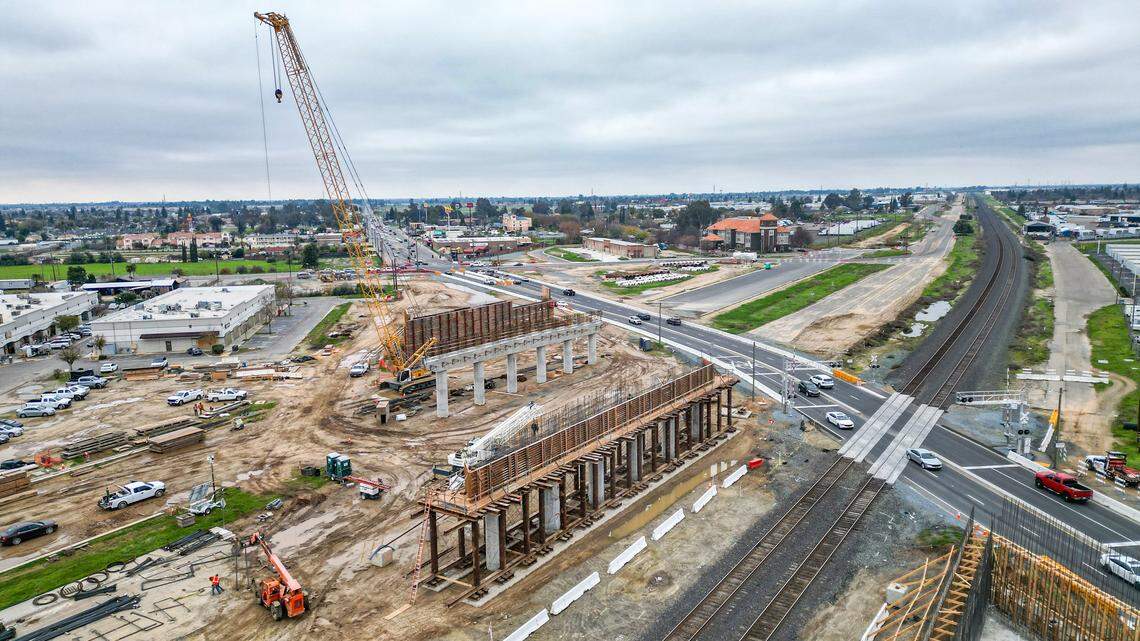
Traffic diverts around a detour at Shaw Avenue and Golden State in Fresno as construction on the California High-Speed Rail overpass gets underway on Monday, Dec. 29, 2025. CRAIG KOHLRUSS ckohlruss@fresnobee.com After feds pulled $4 billion, CA High-Speed Rail looked for new options
The project has grown controversial since California voters in 2008 approved $9.95 billion in bonds for a train that would connect the state’s major metro areas at a total cost of about $45 billion.
Today, state law requires that the rail authority focus on first completing the 171-mile Central Valley segment from Merced to Bakersfield, a line that is expected to lose money with low ridership. Historically critical of the project’s Central Valley focus, the Trump administration decided to pull $4 billion of the train’s federal money last summer.
The rail authority says that’s when it began to pitch more changes to design plans as it met with local governments. The agency had already announced last April it planned to reduce the size of its Central Valley stations with designs that would allow them to grow as ridership levels increase.
More recently the agency pitched changing the way the train will travel through Shafter to cut costs and two years of construction time, though that city rejected the proposal. It also has proposed a new station location in Merced, which the agency says will save $1 billion.
“We will be reaching out also to Bakersfield,” rail authority CEO Ian Choudri said during last month during a visit to the Central Valley. “We’ll just sit down and discuss through the planning process.”
The agency told The Bee its savings projection also accounts for a Central Valley construction cost increase of up to $573 million recently authorized by its board.
Though it has pitched delaying construction to Merced and building toward the Bay area first, the agency said Monday “there are no plans to defer the Merced station.” Doing so would require changes to the state law that mandates the rail authority build a Central Valley segment first, which Choudri told The Bee last fall he does plan to ask from the Legislature.
“The Authority’s strategy is clear: completion of the Merced – Bakerfield segment, expand service to major population centers, and early asset commercialization to generate additional revenue to support continued system build out,” the agency said Monday in its response to questions.
A table in the California High-Speed Rail Authority’s draft 2026 business plan shows where the agency’s potential cost savings in the Central Valley would be made. 2026 HSRA draft business plan
Related Stories from Fresno Bee

The Fresno Bee
Erik is a graduate of the Missouri School of Journalism, where he helped launch an effort to better meet the news needs of Spanish-speaking immigrants. Before that, he served as editor-in-chief of his community college student newspaper, Riverside City College Viewpoints, where he covered the impacts of the Salton Sea’s decline on its adjacent farm worker communities in the Southern California desert. Erik’s work is supported through the California Local News Fellowship program.