
By JOSE HERRERA | City News Service
A new survey of 92 hotels showed that 6% of jobs were eliminated after a minimum wage ordinance went into effect for tourism workers in the city, Hotel Association of Los Angeles officials said Wednesday.
The survey of 92 hotel owners — conducted by the Hospitality Education and Research Organization, a project of the association — found hotels lost 6% of jobs after the minimum wage ordinance went into effect in September 2025.
Of the 92 respondents, about 76 reported employment impacts. About 62% of surveyed hotels said they plan to reduce staff hours in 2026.
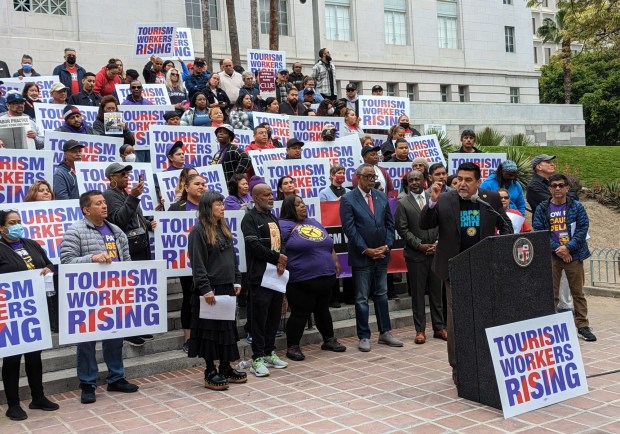 David Huerta, president of SEIU United Service Workers West, calls for the minimum hourly wage of hotel and airport workers in Los Angeles to increase to $25 during a press conference outside L.A. City Hall on Wednesday, April 12, 2023. (Photo by Linh Tat/SCNG)
Jackie Filla, president and CEO of the Los Angeles Hotel Association, told City News Service in a telephone interview the group commissioned the survey — with the findings compiled into a 22-page report — to document the impacts of the ordinance on hoteliers. She said the results showed that hotel owners are feeling strain from the “financial burden.”
Filla urged Mayor Karen Bass and the City Council to repeal or amend the wage ordinance and to work on initiatives to better promote tourism to Los Angeles.
“That would be helpful,” Fillia told CNS. “The living wage ordinance has a phased implementation, and we are just looking at the first phase. For hotels, the most expensive increase actually takes place in July. So looking at what we’re already seeing in impacts. We say this is a good opportunity for the city to take a pause, take a look and make adjustments.”
Key findings of the association’s report showed the following:
— Hotels reported the elimination or expected loss of 6% of positions, or about 650 jobs
— Hotels reported reduced operating hours with nearly two-thirds of survey respondents planning to reduce staff hours in 2026
— About 14 respondents said they expect to close down their hotel restaurants
— Parking operators at hotels expect to raise prices at least 10% to meet the requirements of the wage ordinance
— Half of respondents said they were likely to close food and beverage outlets, gift shops or other on-site businesses
Additionally, the report found that L.A. hotels entered 2026 with weak demand growth, limited pricing power and rising financial stress.
In December 2024, the L.A. City Council approved the Living Wage Ordinance and Hotel Worker Minimum Wage Ordinance, providing incremental wage increases for hotel and airport workers with the goal of reaching $30 per hour by July 1, 2028.
The Hotel Worker Minimum Wage Ordinance applies to hotels with 60 or more hotel rooms within the city limits, which covers approximately 150 hotels totaling 40,000 guest rooms.
Saba Waheed, director of the UCLA Labor Center, has 20 years of experience conducting research on working conditions in low wage industries. Waheed said tourism was seeing a rebound going into 2022 and 2023. The tourism industry was seeing a rise in employment coming out of the COVID-19 losses, as well.
Workers in L.A.’s tourism industry grew from 434,200 in 2021 to 547,500 in 2024, according to data from the Los Angeles County Economic Development Corporation. There was a contraction in 2025 when the figure declined to 536,000.
Waheed said the tourism industry experienced unprecedented events in 2025 that impacted the region, which included L.A.’s wildfires, federal immigration enforcement activity and general federal policies that deterred visitors.
State officials have forecasted a 4% decline in overseas visitors and an 18% drop in visitors from Canada.
“Yet, the state is still expecting a modest rise in total tourism in 2025, accelerating in 2026,” Waheed said in an email to City News Service, adding that hotel occupancy in major cities such as Los Angeles is expected to grow over the next few years due to mega events such as the World Cup and 2028 Olympic Games.
Several studies have found that employment effects are small from minimum wage increases, according to Waheed.
In 2024, California raised the fast-food minimum wage to $20 an hour. A report from the Institute for Research on Labor and Employment found there was no major impact on employment or number of fast food restaurants, though there were modest price increases.
“Regarding the HMWO, we need to see a more in-depth analysis similar to the fast food study that reviews employment data (and accounts for seasonal changes) and relevant industry data sources,” Waheed told CNS in an email. “That kind of rigorous methodology is important to adequately understand the impacts on employment and the industry, as well include the benefits of higher wages for workers and their communities, indirect and direct impacts, and local and community benefits.”
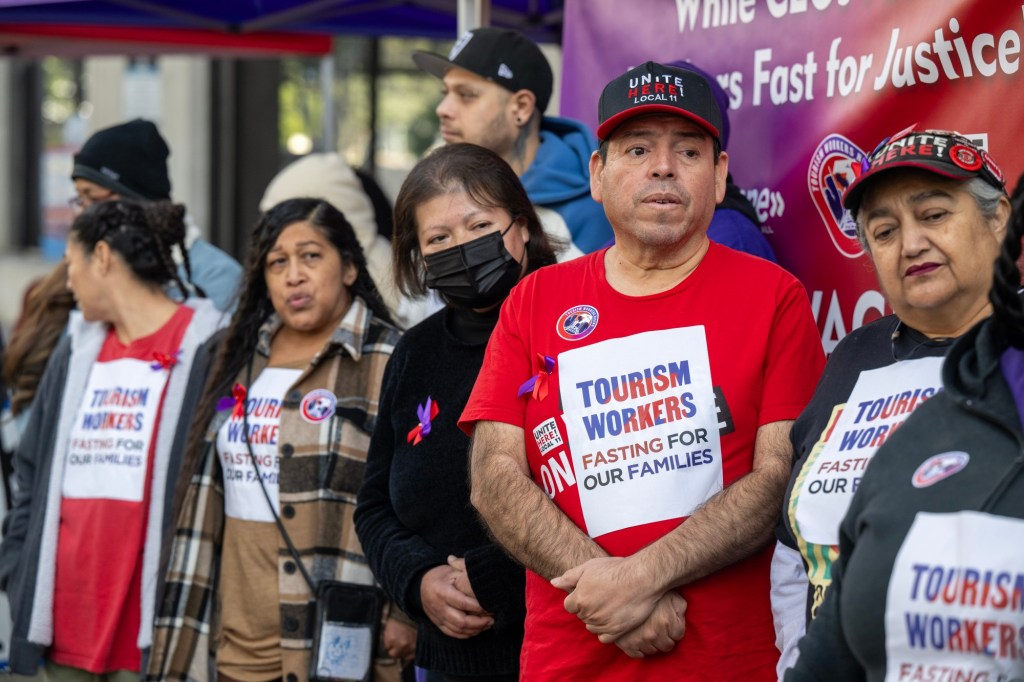
Meanwhile, Kurt Petersen, co-president of Unite Here Local 11, the labor union representing thousands of hotel workers, criticized the hotel association’s report and findings. The union lobbied the City Council to approve the wage ordinances.
“The claim that paying hotel workers $22.50 an hour — about $46,800 a year — is “destroying” the industry is absurd,” Petersen said in a statement.
“What’s truly out of whack is that CEOs of Delta Air Lines, Marriott, Hyatt Hotels, and Hilton each earn more than $30 million a year — over 500 times a hotel worker’s pay. If there’s pressure in this industry, it isn’t coming from housekeepers and cooks. It’s coming from runaway executive compensation and boardroom decisions made far from Los Angeles,” Petersen added.
Petersen noted the union’s data showed the opposite of the association’s study, finding that hotel employees are working more hours.
He said the L.A. region is expected to see an economic boom from mega events such as the eight World Cup games to be played in Inglewood’s SoFi Stadium over the summer, followed by the Super Bowl next year and the 2028 Olympics and Paralympics.
“Paying a living wage doesn’t close hotels. It stabilizes the workforce and strengthens our local economy. If overpaid CEOs choose to close properties instead of investing ahead of the biggest tourism surge in modern history, that’s a business decision — not a wage problem,” Peterson said in a statement.
Filla raised concerns about mega events coming to LA, citing potential boycotts. She emphasized that several hotels have reported their businesses lagging behind last January, which was impacted by the wildfires in Los Angeles County.
“We certainly haven’t seen an uptick. We were last in COVID recovery for the country as a tourism market. When you look at all these national trends, it’s a macro issue, but Los Angeles tends to be more dependent on the international customer than a lot of other markets,” Filla told CNS.
“So, when international travel for the nation sneezes, Los Angeles gets pneumonia,” Filla added.