
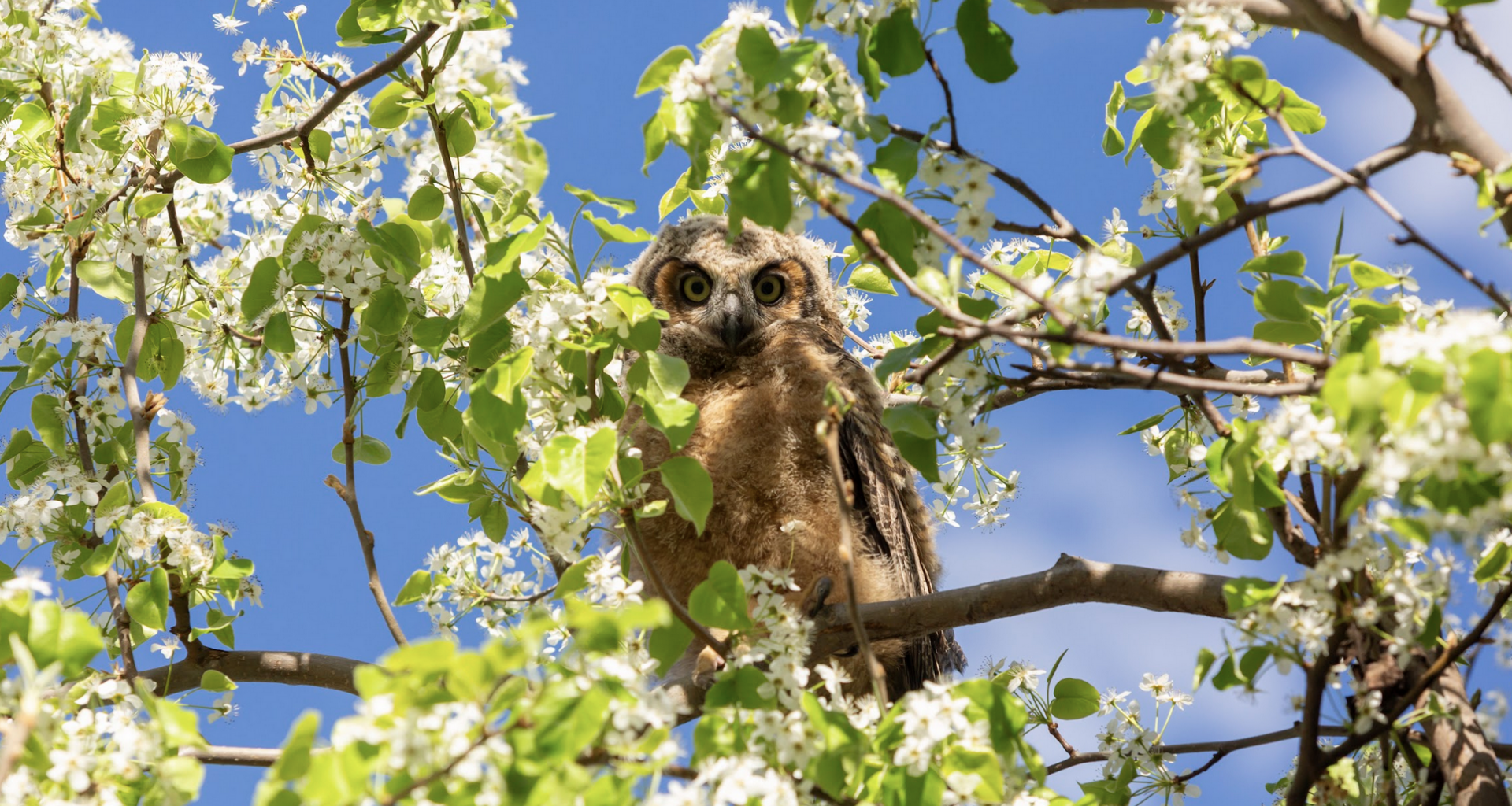
Two fledgling great horned owls were spotted early last week behind Placer Hall and drew attention from Sacramento State community members.
Great horned owls are found throughout North America and typically live in forests, but they also inhabit cities and suburban areas. They nest in cottonwood, pine and a variety of other trees, and sometimes in human-made spaces. They are also known to reuse abandoned nests from other bird species.
Sam Curtis, the instructional support technician for the Department of Biological Sciences, said that there has been an active nest in this spot on campus since 2021.
RELATED: Wildlife roaming Sacramento State: Beloved mascots or campus menace?
“Since I started in 2018, I’ve seen owl signs like pellets, dead animals that they’ve dropped,” Curtis said. “The adults live here year-round; this is their territory.”
Curtis said that once the owls are self-sufficient, and after a few weeks, they will leave the area. The campus is their parents’ territory, so the fledglings will have to find their own space.
As the owls begin leaving the nest, they may be spotted elsewhere on campus. Sandra Foreman, the director of the Wildlife Care Association in Sacramento, said that she expects the owls to fly properly within a week.
“When the owl was reported last week, I let them know that the owl will take flight literally any day,” Foreman said.
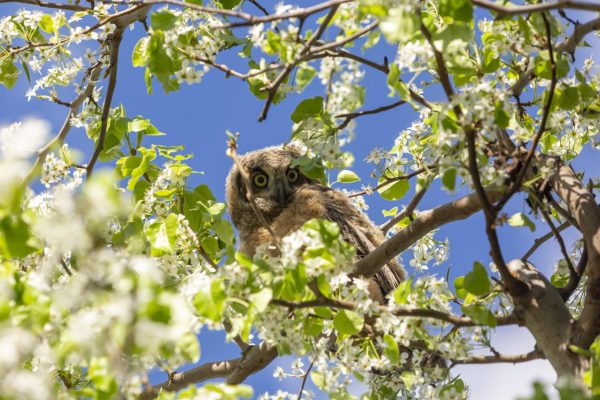 A fledgling great horned owl perched in a tree by Placer Hall Wednesday, Mar. 4, 2026. Fledgling owls can fly on their own but are still dependent on their parents for food (AJ Tinkess)
Despite the owls advancing quickly, Foreman said that they are still dependent on their parents for food and need to learn how to hunt.
The fledglings drew a crowd after students learned two owls were resting in adjacent trees. Many students who were watching the owls were also interested in birdwatching.
Mika Kula, a senior business major, said that one owl has often been seen in a redwood tree behind Placer Hall and spotted the other in a callery pear tree next to the building.
“I got into birding this year, and I never assumed that I’d be able to see an owl since they’re nocturnal,” Kula said. “The fact that this one is here is really awesome.”
Nathan Losasso, a junior geology major, said that he enjoys birdwatching at Effie Yeaw Nature Center and on campus. After seeing so much nature on campus, he said that he was inspired to buy a field guide for birds and a camera to continue learning about the diversity of species.
“I got into birdwatching last semester because there’s so much nature on campus, I wanted to learn more about it,” Losasso said.
Angelina Garcia, a senior biology major, said that she is interested in ornithology and had seen sparrows, crows and black phoebes on campus before. She said that she expanded her interest in the subject by taking an ornithology course at Sac State.
“I go birdwatching on campus a lot. I’ve never seen an owl here though, or ever, so I’m really excited,” Garcia said.
Many students heard about the owl after a video was posted to the university’s Instagram page on Tuesday, Feb. 24, showing two owls.
The older fledgling was first spotted on a low fence but has since moved higher up in a redwood tree. The younger owl has been seen by the adjacent flowering trees. Still, it is important to remember the owls are wild animals and to avoid interacting with them.
“For any animal that you’re observing, whether it’s birdwatching or you were out and saw a mammal, you want to keep a safe distance,” Curtis said. “If an animal is reacting to you, especially if it seems nervous, you’re almost certainly too close so you might want to take a step away.”
Ryan Todd, the director of energy and sustainability at Sac State, said in an email statement that the school is committed to protecting its wildlife.
“Sac State is actually certified as a wildlife habitat through the World Wildlife Federation, so we have a strong commitment to protecting local wildlife,” Todd said. “If folks are handling or feeding the animals, we are doing them a disservice and may do more harm than good.”
Students said that they heard about the owls in their classes, discussed it with their friends and would be returning often to watch their development.
“If there are any adults, or they develop into adults and then come back here, I’m definitely coming back for that,” Losasso said.