
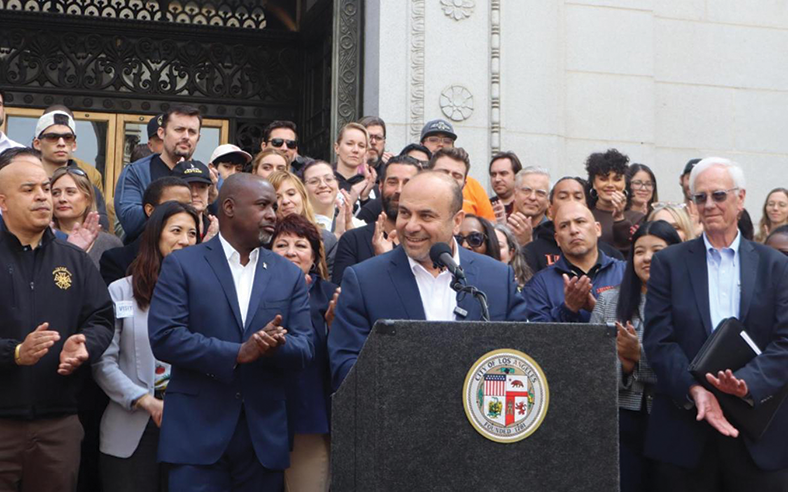
Los Angeles City Councilman Adrin Nazarian, center, celebrated the passage of a series of motions to bolster film and television production. (photo courtesy of the office of Councilman Adrin Nazarian)
The Los Angeles City Council passed a series of motions on March 4, put forth by Councilman Adrin Nazarian, 2nd District, that aim to making film and television production easier and less costly in the city. Nazarian described the ordinance as “game-changing,” with provisions that cut red tape with filming, including eliminating “dated and redundant” regulations, reducing fees and streamlining the permitting process.
A large contingent of industry workers gathered outside City Hall to celebrate the passage of the ordinances, which were the result of a year-long process. Nazarian began conducting meetings with local unions, students, auxiliary businesses and filmmakers in March 2025, as part of his Keep Hollywood Home initiative.
“Together, we are sending the world a message,” Nazarian said. “Los Angeles is not standing still. Los Angeles is not clinging to outdated systems. And we are not surrendering our signature industry without a fight … This victory belongs to the workforce. These are the people who don’t walk red carpets, but they make the magic happen. [The] votes say: We see you, we value you, and we are willing to fight for your jobs.”
“We aren’t just reclaiming our signature industry, we are reinvesting in the soul of our city and the hardworking Angelenos who make it the creative heartbeat of the world,” City Council President Marqueece Harris-Dawson, 8th District, said. “As we look toward the 2028 Summer Olympic and Paralympic Games, we are sending a clear signal to the world – L.A. will never stop innovating.”
The motions represent the most recent attempts to reestablish California’s competitiveness in the film and television industry. Considered home base for entertainment for over a century, Los Angeles has lost productions to other cities, states and countries in recent years due to lucrative tax incentives and lower costs offered by other locations. The situation was exacerbated by the pandemic and the concurrent 2023 WGA and SAG-AFTRA strikes. Following the January 2025 wildfires, local industry professionals banded together to rally studios and local officials behind supporting production in the state. Stay in LA is a grassroots organization that has led the charge.
“While many view the logistics and pricing of film permits as inconsequential and tedious, our industry has been systematically undermined by numerous setbacks,” Stay in LA co-founder Pamela Buzick Kim said. “While passing these motions won’t solve all our problems, it will contribute to reversing decades of red tape for all levels and types of production.”
The most significant win last summer was an increase to California’s film and television tax incentive, which is now capped at $750 million. Gov. Gavin Newsom has touted the number of productions that have been awarded tax credits since its passage, including a forthcoming revival of the iconic 1990s series “Baywatch.”
“California’s creative economy isn’t just part of who we are – it helps power this state forward,” Newsom said in November. “From the folks on the soundstage to the people designing the sets, these are jobs that anchor communities. And when we make smart investments like our film tax credit, we’re keeping talent here at home, supporting good-paying union jobs and strengthening an industry that defines the California brand. I’m proud to see the return of ‘Baywatch’ where it belongs – on sunny California shores, creating jobs and fueling the very entertainment economy that sets this state apart.”
U.S. Rep. Laura Friedman (D-Burbank), who has been working in Congress to establish a national tax credit program for production, also celebrated the motion.
“We need the jobs, tourism and economic benefits supported by film and TV production and should do everything we can to make Los Angeles the premier place to film,” Friedman said. “I commend Councilmember Nazarian for introducing this commonsense measure, which will make a real difference in our ability to retain and revitalize Hollywood. In Congress, I’ve been working around the clock on a national film tax credit with Sen. [Adam] Schiff and my colleagues on the other side of the aisle. We need to ensure that America’s story is always told by Americans and made in Hollywood with American talent.”