
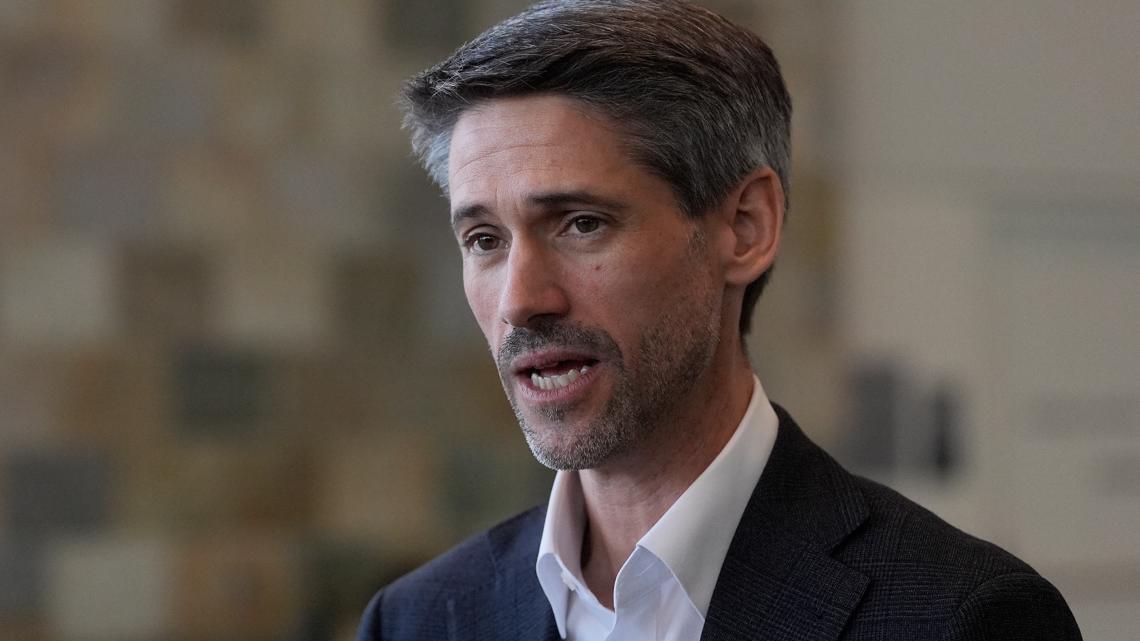
To the Point host Alex Bell sat down with California’s governor candidates to hear directly from them about their priorities and what they’d bring to the job.
SACRAMENTO, Calif. — This June, Californians will head to the polls to help decide who could become the state’s next governor. While the final decision comes in November, for now, nine leading Democratic hopefuls and several Republicans are in the race.
To help you get to know them and what they say they’d bring to the job, Alex Bell sat down with the candidates at this past weekend’s Democratic convention and will do the same with the Republican Party.
To keep things fair, names were drawn at random for these interviews. Interview responses have been cleaned up and slightly condensed for easier reading, while keeping the candidates’ words intact.
Matt Mahan
Q: For people who have never met you before, why did you decide to run for governor?
Matt Mahan: “I jumped into this race because we have to do better in California and I know that we can, because in San Jose, we have led the way for the state in reducing crime, reducing homelessness, and recently we have unblocked thousands of new homes that we had previously approved that simply weren’t penciling. And it was largely because of our own fees and processes. When we focus and hold ourselves in government accountable for embracing the policies and programs that work, we get better outcomes.
Like most Californians, I’m frustrated that over the last six years, spending in the state has gone up by 75% and the outcomes are not improved by 75%. In some areas, things have gotten worse. We have the highest unemployment rate in the country, highest housing costs, highest energy costs, nearly half of the unsheltered homeless population.
Other states that spend significantly less than we do are delivering better educational outcomes for their kids, particularly low-income students and students of color and it’s unacceptable. We have to do better. I know that we can, but it’s not easy. We have to build the political will to hold government accountable for reducing the bureaucracy, eliminating the programs and policies that don’t work, and make sure we’re delivering for working and middle-class families.”
Q: If elected, what would be your top three priorities your first year in office?
Matt Mahan: “My focus is on reducing costs and increasing incomes. On the cost side, largely because of the amount of bureaucracy, process, and fees that we have imposed in government, we have the highest housing costs and the highest energy costs in the country. We need to reduce the amount of bureaucracy and regulation in the state. We should only have regulations that actually produce positive outcomes. We can’t keep adding layers and layers of rules and bureaucracy.
We pass thousands of bills in Sacramento, and all they do is make things more expensive. So I’ll be focused on bringing down the cost of housing by capping fees and reforming building codes, so that it’s not driving up costs without making us safer. Same on energy.
On the income side, we need to demand that our public schools embrace best practices like teaching phonics, better teacher preparation, training and feedback. We have to get all of our kids on grade level for reading and math — back to basics. If you’re able to read and you’re on grade level in 3rd grade, you’re set up for success through the rest of your educational pathway. I know that as a former public school teacher.
We also have to attract investment and good, high-paying jobs. Right now, there is a real challenge in the state where we are over-regulating our industries — whether it’s agriculture, Hollywood, technology, or manufacturing. It is too hard to start a company and invest in California, and it is working people who are most hurt by that. We have the highest unemployment rate of the 50 states because it’s too expensive to do anything, so jobs are going elsewhere. We have to bring back jobs and increase incomes while reducing costs, particularly for housing and energy.”
Q: California has spent billions addressing homelessness, yet the problem persists. What would you do differently?
Matt Mahan: “We need to stop funding failure. In San Jose, we’ve taken a different approach and we have the results to show it. We’ve led the state in reducing unsheltered homelessness.
We’ve built a model around prevention — short-term rental assistance with case management to help people when they fall on hard times. Those are the best dollars we can spend. We’ve invested in shelter and interim housing, and when it’s available, we require that people use it and get stabilized indoors, connected to services sooner, so they don’t become chronically homeless.
Addiction may not be why someone becomes homeless, but it often is why someone remains trapped on our streets. We have to break that cycle earlier, get people connected to counseling, supportive services, job training, job placement, and reconnecting with family. When we intervene earlier and more effectively, we reduce suffering and save money.
We also need a fair share approach that holds every city and every county accountable for building housing and shelter capacity on the city side and treatment capacity on the county side. We need to build mental health hospitals again. When those are available, we must require that people at a minimum come indoors off our streets.
The state has to ensure that every city, every county, and nonprofit providers are held accountable for delivering outcomes cost-effectively. That’s what we’re doing in San Jose. I want to take that same spirit of focus and accountability to Sacramento.”
Q: Do you think California has gone too far, not far enough, or struck the right balance when it comes to criminal justice reform?
Matt Mahan: “It really depends on the crime. I don’t believe that our jails and prisons should be our de facto mental health hospitals. I do think we need to build mental health hospitals again, have inpatient treatment, and get people into the care that they need.
We have seen a pattern of repeat offenders — not a huge number of people in any given city — but people dealing with addiction and mental health issues, and also exhibiting criminal behavior and harming the broader community. We have not done a good job of breaking that cycle.
I think we did not take a balanced enough approach to decriminalization. We all realized that mass incarceration was unjust and disproportionately harmed communities of color and wasn’t very rehabilitative. But as we focused on reducing the jail population, we didn’t create effective alternatives. We have mental health diversion in the state that is not working very well, where people are being diverted into programs with very little accountability and we’re seeing repeat crime.
When someone is cycling through a second time, a third time, that should be a signal that something’s broken. We have a responsibility to keep people safe and rehabilitate those who are struggling, but first and foremost, our job is to keep the community safe. That doesn’t mean returning to mass incarceration, but it means holding government accountable for better interventions, better drug treatment, if necessary, mandated detox, job training, and jail re-entry programs. We need to help people turn their lives around and do a better job than we have been.”
More interviews with the candidates for governor will be posted as they air on ABC10.
Watch more: California Governor Race: 9 Top Democrats Reveal Their Priorities
ABC10: Watch, Download, Read