
Read Mission Local often?
Help grow our newsroom, joining the 3,250 readers who support us by giving below.
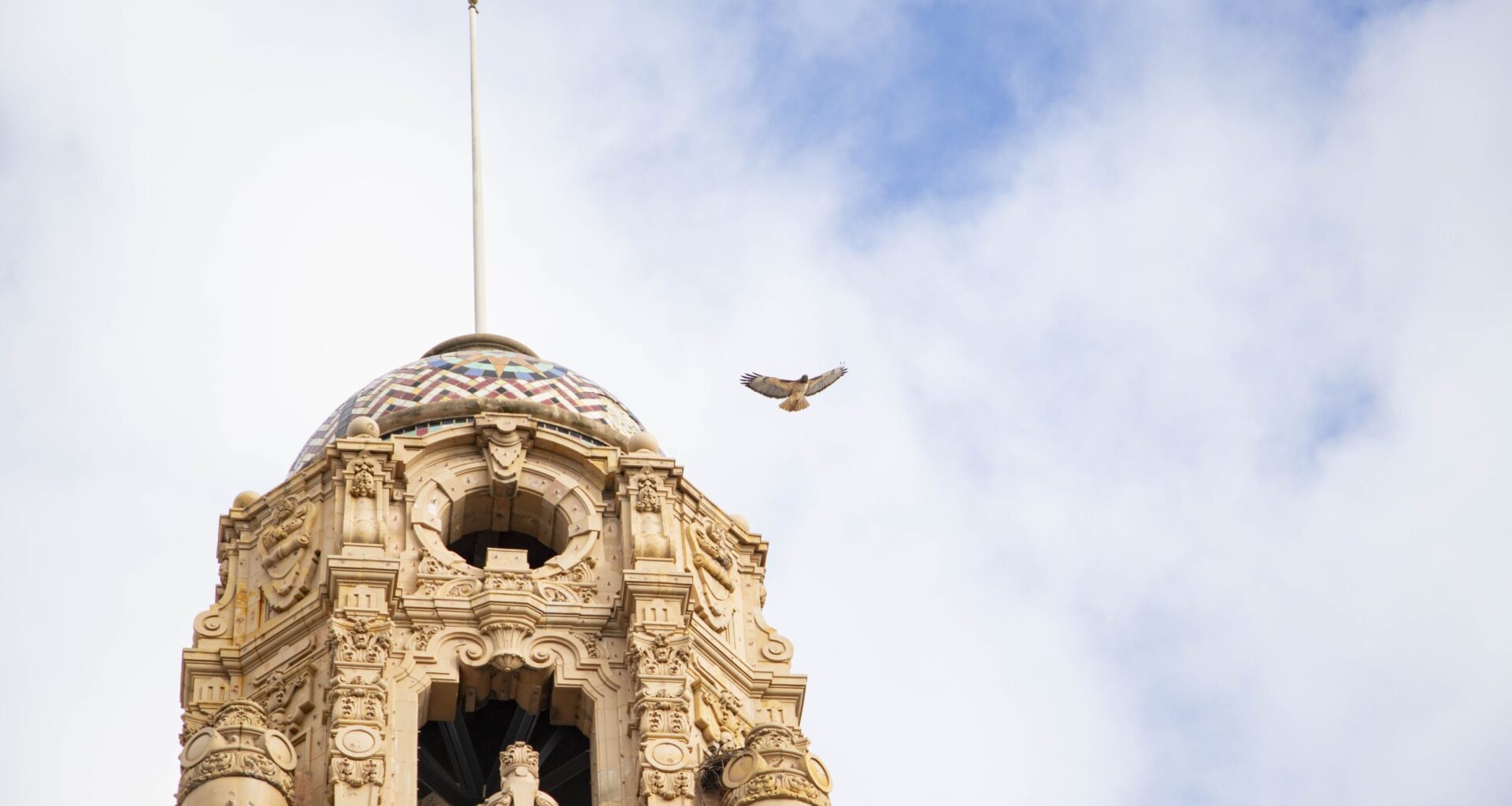
No one’s quite sure when the red-tailed hawks moved into the nest on Mission High School’s tower. Erick Masias, an avid birdwatcher, first saw the hawks when he moved to San Francisco in June of 2025, but it wasn’t until January that he spotted the actual nest.
When he asked about it in a bird forum, he discovered the nest had earlier occupants — someone shared a photo from 2012 that shows a family of ravens living in the nest.
It’s no surprise the spot is popular: The tower is one of the highest spots in the Mission District. The hawks have a sweeping view of Dolores Park and the prey that moves through it.

Want the latest on the Mission and San Francisco? Sign up for our free daily newsletter below.
“It’s a spectacular location,” said Allen Fish, director emeritus at the Golden Gate Raptor Observatory.
Red-tailed hawks — which get their name from the reddish-brown tail feather — like to nest near open meadows or grassy areas, he said. Before humans were around, they built nests in trees and on cliffs. “For these red-tailed hawks, the tower at Mission High School is a cliff,” Fish said.
Masias frequently goes to Dolores Park with a spotting scope on a tripod to observe the pair, inviting passersby to peer up at the nest.
“They’re always astounded because you can’t see the nest without the telescope,” he said, “so people are usually just like, ‘Wow I would have never seen that.’”
The hawks have also drawn attention at Mission High. Bill, a 16-year-old student, said they have seen the hawks since starting school in July 2024. They are now accustomed to seeing the birds soaring overhead and eating rats. Once, Bill said they saw a hawk eating a pigeon in the school courtyard.
Shannon Morris Lawson, an art teacher at Mission High, sees the hawks as “a protecting power.” She said she always spots them at big events, like the “No Kings” protest.
During the teachers’ strike last month, as educators picketing outside were eating their sandwiches, Morris Lawson said she looked up and saw one of the hawks on a nearby lamppost. “It had gotten a rodent out of the park,” she said, “and it was joyously eating it.” It felt like a moment of teacher-hawk solidarity. “It was like it was breaking bread with us, you know?”
But eating rats and mice can sometimes be a danger to hawks. Rodents that have ingested rodenticides will be extra slow and easy to catch, but eating them could poison the hawks too. Because red-tailed hawks aren’t an endangered species, their numbers aren’t carefully tracked, said Fish, so the scale of that danger is hard to measure.
Over the last several years, though, statewide restrictions on certain types of rat poisons that are more dangerous to wildlife seem to have lowered that risk, according to Lisa Owens Viani, director of Raptors Are the Solution.
“I haven’t heard any suspected cases of poisoning in the city over the past couple of years,” she said. “My hope is that those bills are really making a difference.”
The Mission High hawks are probably helping control the number of rats and mice in the park, Owens Viani said. “My guess is that they have found a good source of prey.”
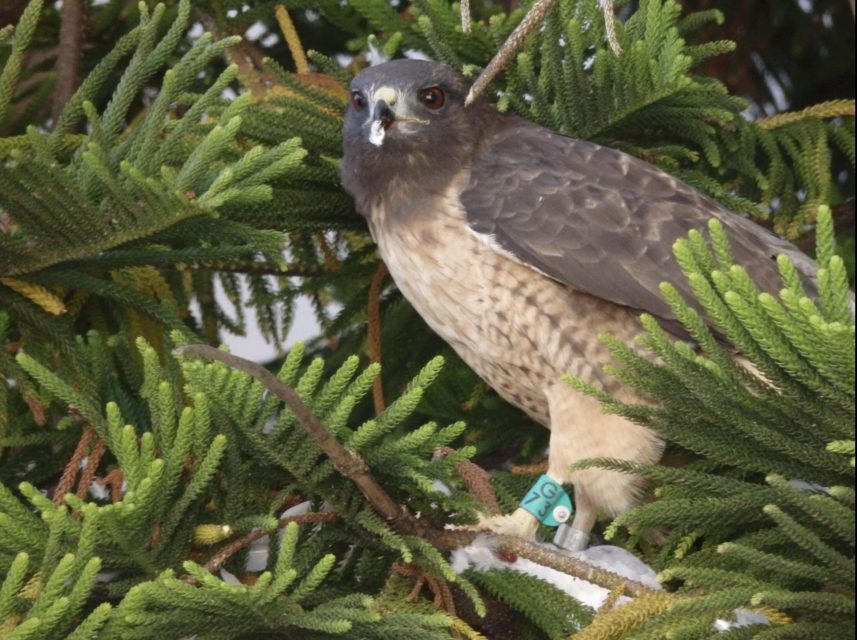 A hawk eats a pigeon in the pine tree in Mission High’s courtyard. Photo courtesy of Bill, Mission High School student.
The hawks are definitely a couple, said Masias, who has seen them copulating. He’s also seen them carry leaves to reinforce the nest, and expects them to lay eggs soon. “In California, it’s a little bit earlier than the rest of the country,” he said, adding that it’s likely they will lay eggs in early March and have chicks in early to mid-April.
The female hawk, which is slightly larger than the male, has a visible band on one leg. That allowed Masias to get a certificate which shows she was banded near Sausalito and hatched in 2021.
When the female begins spending more time on the nest and less flying around, that’s a sign that eggs have been laid. When that happens, Masias said he will start looking for signs of hatchlings 28 days later. Red-tailed hawks typically hatch their eggs between 28 and 35 days.
“I’ve never seen baby hawks,” he said, looking forward to the event.
“I’m excited,” Fish said. “Thousands who visit Dolores Park will hopefully get to see the whole nesting cycle.”
Masias said he’s hoping someone will hold a naming contest for the pair. So far, he said he has shown the nest to about 60 people in the park through the spotting scope, and roughly 460,000 have watched a video he posted on Instagram.
One of the things that he really likes about birding, Masias said, is the way that it feels like you’re seeing a whole new world for the first time.
“I hope that there’s people that are local and that saw the video that are looking up more often now too,” he said.

Join the 3,250 readers who keep Mission Local free for all!
Because of you, Mission Local reached and surpassed our $300,000 year-end fundraising goal. All we can say is thank you.
Thank you for choosing to invest in a local newsroom rooted in San Francisco’s communities — one that listens first and reports deeply.
If you haven’t yet had a chance to give, it’s not too late to be part of this community. Your contribution today helps sustain the reporting our city relies on all year long.
We’re grateful you’re here — and we’d be honored to have you join our donors.