
Sacramento’s Railyards District buzzed with activity in recent weeks. Cement trucks rolled in and out of the future site of Kaiser Permanente’s 310-bed hospital. The soil to the east was graded, where foundations will be laid for Sacramento Republic FC’s new soccer stadium.
And on the other side of B Street, just north of the cranes and portable trailers, new apartment complexes advertised available units.
The halting progress of development in Sacramento’s former railyard — which is now seeing some of its largest projects begin to crystallize after decades of environmental remediation and stalled plans — has been watched closely by investors just north, in the River District. They believe the eventual, planned buildout of the Railyards’ hospital, soccer stadium, retail and entertainment venues may draw new residents up into the expansive area on the other side of B Street.
“You’re going to have skyline views to the south. You’ve got river views to the north. The walking trail to the north along the river… Only a mile outside of downtown,” said Zach Shulruff, vice president of investments for 29th Street Development, the development arm of the firm behind the River District’s Township 9 project.
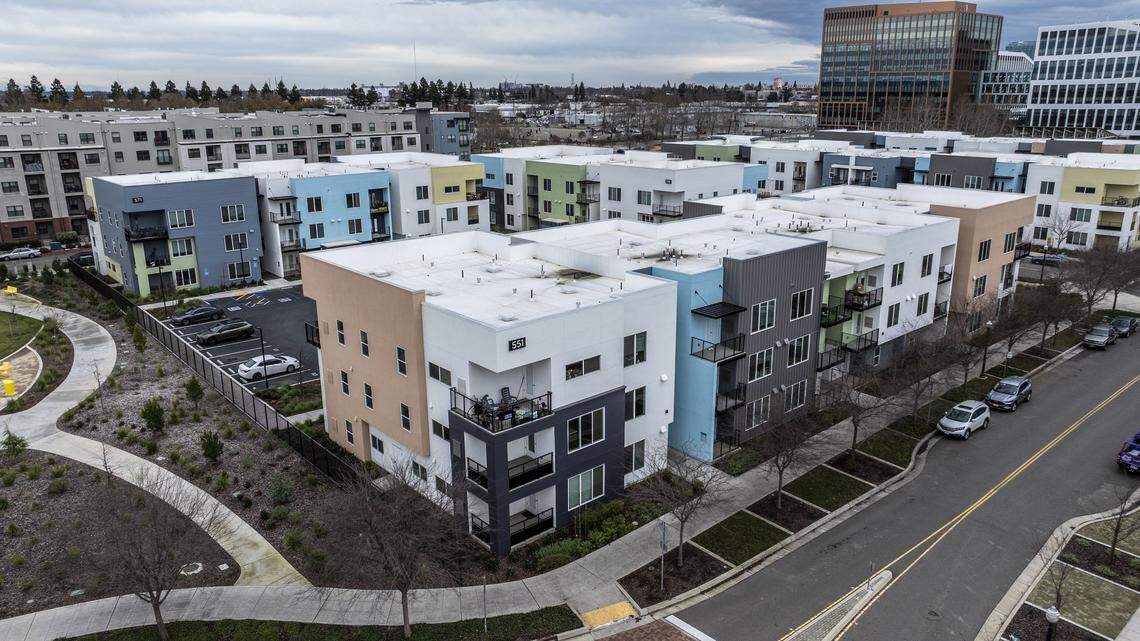
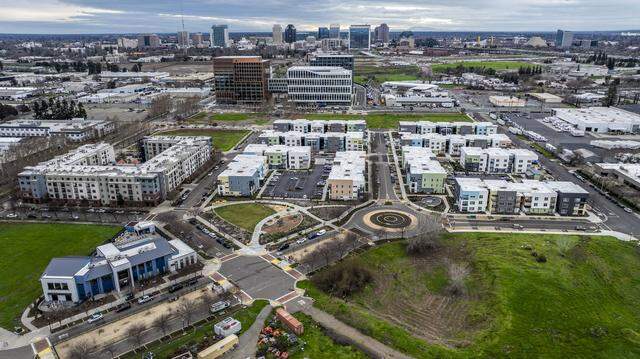 An aerial view of the Township 9 housing development in Sacramento’s River District in January. HECTOR AMEZCUA hamezcua@sacbee.com
“It just kind of has it all right now,” he said. “Or will, I guess.”
Developers have built a handful of new housing complexes there in recent years, and now the historically industrial area has more than 1,300 multifamily units, according to the River District’s property-based improvement district, whose territory extends north of the Railyards and midtown, roughly from the Sacramento River to 27th Street. There are nearly 3,400 more proposed.
At the same time, the city this year faces policy decisions about how to provide for the River District’s homeless residents, and advocates have cautioned that the area’s unhoused residents must be considered in any conversations about the district’s future.
Despite the wave of new construction over the past five years, experts said it’s unclear how quickly other proposed housing will advance. The River District’s expansive Township 9 housing development, for instance, was first proposed to Sacramento’s City Council in 2007, with construction expected to begin the following year. Two sections of Township 9 have been completed, but developers’ plans still include about 1,300 units additional there.
 Workers move construction equipment on the future grounds of the Kaiser Permanente Railyards Medical Center in March 2025. The center will feature a new eight-story hospital with 310 beds in private rooms. HECTOR AMEZCUA hamezcua@sacbee.com
Future housing development in the River District is not predicated upon the buildout of the Railyards, said Devin Strecker, executive director of the property-based improvement district. His district has already seen new apartment complexes built in recent years, plus the $1 billion May S. Lee State Office Complex that opened in 2024 and the $83 million science museum that opened in 2021. But the projects in the Railyards may bring more interest.
A handful of projects, some planned before the pandemic, have recently come to fruition. Strecker said officials are now “waiting for that next big wave.”
The River District has always appeared poised for change, said John Vignocchi, managing partner for the local development firm Urban Capital.
“You just don’t know when,” Vignocchi said.
New housing emerges
The River District was once considered too flood-prone for major construction. The American River cut through the district’s northwest corner.
Levees were built to protect the area in the early 20th century, so in the 1920s railroad spurs, canneries and other industrial facilities began moving into the River District’s newly-buildable land, said William Burg, president of Preservation Sacramento, a nonprofit historic preservation advocacy group.
Blue Diamond opened the first portion of its almond-shelling plant in 1914. The Bercut Richards cannery began operations in 1931. Highways and bridges were built, to bring workers to the factories, and some housing, like the residential blocks off 16th Street, and the former Dos Rios public housing complex off Richards Boulevard, Burg said.
Sacramento’s canning industry declined gradually, beginning in the 1960s. The Bercut Richards cannery was demolished in 2010, to make way for Township 9.
In more recent years, property owners in the district advocated for other types of development there. The city’s specific plan for the district, approved in 2011, envisioned growing the district’s housing inventory from hundreds of units to thousands, and adding retail and office space.
The Cannery Place Apartments — which are part of the Township 9 master plan, but are not owned by 29th Street Capital — opened there in 2015.
Last year the Sacramento Housing and Redevelopment Agency opened the final portions of the Mirasol Village development, the former site of the Twin Rivers public housing complex. The community has 381 affordable and 46 market-rate units.
Construction cost $230 million, plus $120 million for neighborhood improvements. The agency is also pursuing grant funding for environmental cleanup for a site on Sproule Avenue, where it proposes building affordable housing for seniors.
And to the west, a Hawthorne Suites hotel just east of Interstate 5 was converted into apartments. Known as Track 281, the former hotel became the River District’s first market-rate housing complex, Strecker said. It began leasing in late 2023. Studios start at $1,199.
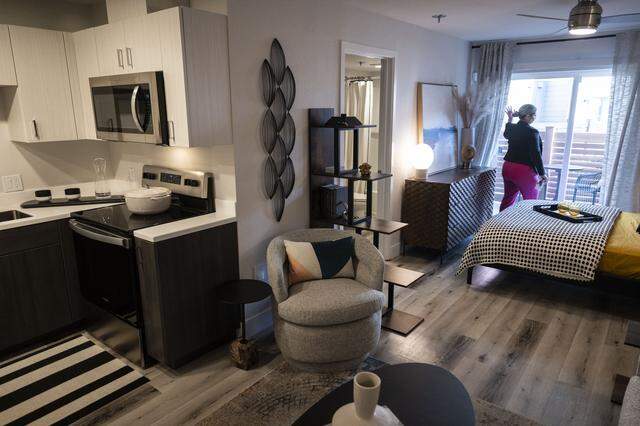 An employee gives a tour of the Track 281 housing complex, a former hotel in Sacramento’s River District, in January. HECTOR AMEZCUA hamezcua@sacbee.com
“We’ve had a huge amount of change in the last three years,” Strecker said.
The Township 9 project was acquired in 2020 by Chicago-based 29th Street Capital, after years of delays. The firm viewed the property as a “once-in-a-lifetime” opportunity for its size and proximity to the center of Sacramento, said Shulruff, the vice president of investments.
“There are not many sites across the country where you’ve got a very large developable site — downtown, effectively,” Shulruff said.
The firm opened a new section of Township 9 last year — a 372-unit luxury complex called “The Hayley” — and is planning more housing and a 200-room Hyatt hotel on the sprawling site.
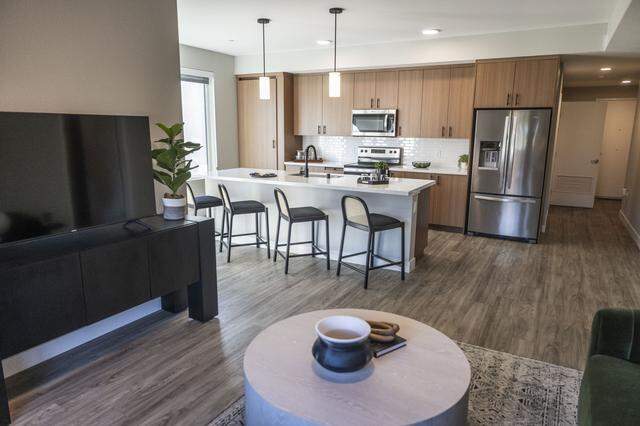 A model unit at The Haley, a luxury apartment complex within the Township 9 development in Sacramento’s River District, last month. HECTOR AMEZCUA hamezcua@sacbee.com The River District’s constituents
The River District has taken on a greater part of Sacramento discourse in recent weeks, as the city broke ground on a new safe camping site along Sequoia Pacific Boulevard, and as officials contemplated limiting the number of additional shelter beds in the area.
The city had a similar ordinance in place for decades, but it was rescinded last year after officials realized Sacramento had surpassed the previously prescribed cap, Councilmember Phil Pluckebaum said. Remaining out of compliance with the ordinance, he said, would have left the city vulnerable to a lawsuit.
Pluckebaum’s district — which includes downtown, midtown and East Sacramento — has 558 shelter beds, the highest number in the city. Of those, 526 are in the River District, according to a city staff report.
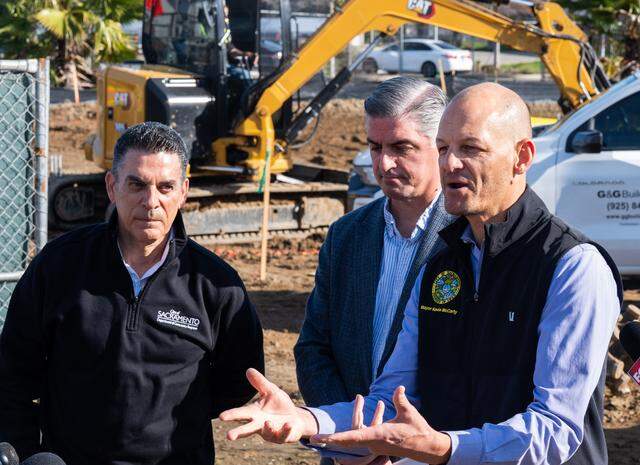 Sacramento Mayor Kevin McCarty, right, speaks as workers build a new safe camping site in the River District on Feb. 27. Department of Community Response Director Brian Pedro, left, and Council Member Phil Pluckebaum, center, joined him at the event. NATHANIEL LEVINE nlevine@sacbee.com
During a recent meeting of the City Council’s Law and Legislation committee, proponents of the proposal said the district has seen businesses leave or struggle to attract investment, and opponents argued that the city should in no way look to limit services for the homeless.
The committee voted 3-1 to bring the proposal to the full City Council. Councilmember Caity Maple argued that the city manager should have flexibility to select locations for shelters, and that the ordinance could open the door for other communities to propose similar limits. Councilmember Roger Dickinson said that the proposal was worth further discussion, regardless of the outcome, and that perhaps it would stimulate conversation about adding homeless services in other parts of the city.
In interviews with The Sacramento Bee, two advocates and service providers with experience in the River District said they opposed placing limits on shelter beds. And, critically, they said, the city needs more housing that is affordable enough for Sacramento’s poorest residents.
“Limiting our opportunities is not a solution,” said Niki Jones, director of the Sacramento Regional Coalition to End Homelessness, a group that provides research and education, and advocates with unhoused communities. “We need to be building out expansive systems of real support.”
Angela Hassell, executive director of Loaves and Fishes, said the neighborhood’s unhoused residents must be taken into account as the area changes.
“We have to somehow provide for the folks that are already living there, that already have communities, have support there, and are just waiting, just waiting for their housing opportunity to come through,” Hassell said. “They’re the constituents of the River District just as much as the business owners are. They just don’t have the platform or the financial ability to contribute in the same way. And they don’t get as much of the ear.”
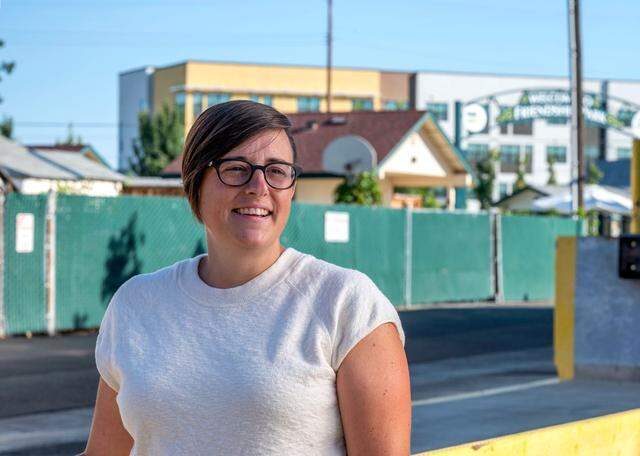 Angela Hassell, executive director of homeless services provider Loaves & Fishes, stands on the grounds of her organization near Friendship Park in Sacramento’s River District in 2022 as the then-new Mirasol Village housing complex rises in the distance. Hector Amezcua hamezcua@sacbee.com
The full council has not yet discussed the proposal, a city spokesperson confirmed Wednesday.
Bringing in services
Despite the new residential construction, few amenities remain within walking distance of the River District’s largest housing complexes. The nearest traditional grocery stores are across the river in Natomas.
Pluckebaum acknowledged the dilemma, terming it a “chicken-and-egg” scenario.
“Light rail is doing that, to a certain extent, where we’re building the transit in places, knowing the residents will come. And we can spread that cost out over a long time,” he said. “It’s harder for a retail operation — especially one with thin margins like grocery — where they can’t build a store that doesn’t have customers.”
The improvement district commissioned a study in 2024 that found the River District’s projected additional residents and businesses would support a smaller-format grocery store, Strecker said. That — rather than a big-box store — would be in line with the group’s long-term vision for the area, he said, as a dense, walkable neighborhood where people could walk or bike for groceries.
 Shana McDaniels, a River District tenant, walks her dog Winter on Wednesday. HECTOR AMEZCUA hamezcua@sacbee.com
Kesha Harris, who has lived in the River District since 2022, said she likes it for the natural beauty and proximity to the river. Grocery shopping, she acknowledged, requires a car ride or a delivery service.
But Harris said she walks to the Golden 1 Center for events. Her goal, living there, was to rely little on driving.
“There are still access issues,” Harris said. “But we’re making progress.”
The district won’t soon leave behind its industrial character — it’s economically vital to keep those businesses, Pluckebaum said. The challenges ahead will be in balancing those industrial sites with new residential, entertainment and commercial presences.
“That friction is what successful cities have to manage,” Pluckebaum said. “That’s probably the next 20, 30 years of River District-Railyards-downtown discussion. How do we manage parking on the street? How do we manage access to the rivers and public spaces? How do we manage noise?”
But he would have preferred to face those questions sooner.
“We’ve been talking about it for decades,” he said. “And it feels like it’s finally happening.”
Related Stories from Sacramento Bee

The Sacramento Bee
Annika Merrilees is a business reporter for The Sacramento Bee. She previously spent five years covering business and health care for the St. Louis Post-Dispatch.