
Health policy advocacy isn’t new to Dr. Candy Stockton.
After all, Stockton has been the health officer for California’s Humboldt County since 2022. And before she joined the county’s Department of Health and Human Services, she’d been a longtime family medicine physician and board-certified addiction counselor, where her work had become focused on working with and advocating for pregnant and parenting people with substance use disorders.
Last fall, as part of the Legislative and Public Policy Committee for American Society of Addiction Medicine, Stockton had been in the nation’s capital to talk with her county’s representatives about the needs of her patients struggling with addiction.
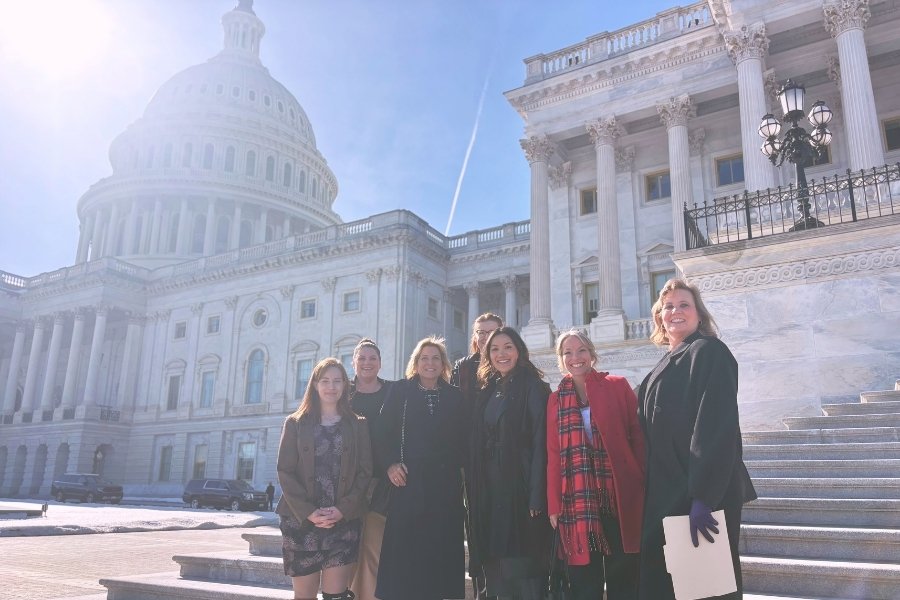
But on a trip to Washington, D.C., this February with the second cohort of UC Berkeley School of Public Health Rural Health Innovation (RHI) Policy Fellows, Stockton felt like she finally was able to meet with those who really hold the power in the capital: Congressional staff members.
“I realize it’s the staffers that do a lot of work researching and briefing and making suggestions,” she said recently.
“This was a different experience for me,” Stockton said. “This was a different experience to talk about the broader concerns that we have and raise points that I don’t think had been adequately thought about.”
“The more you can tie things together for the different groups that work in the federal government, the more chance you have of them making a plan that works in the long term,” she said.
Stockton was joined in post-deep freeze Washington by five other RHI Policy Fellows from rural communities across Montana, Georgia and California, to meet with UC Berkeley alum Lynn Barr, whose generous gift launched the RHI program—and partners at the Coalition for Rural Medicare Equality for a week of high-level policy engagement, including meetings with government staff and attendance at the National Rural Health Association Policy Institute.
The Fellows held meetings with staff at key federal agencies and congressional offices, including the Medicaid and CHIP Payment and Access Commission; the Medicare Payment Advisory Commission; the Health Resources and Services Administration’s Office of Rural Health Policy and Office of Planning, Analysis and Evaluation; the Office of Rural Health Transformation; the Senate Finance Committee; the House Energy and Commerce Committee; and both Majority and Minority staff of the House Ways and Means Committee.
This annual trip takes place during the second year of Policy Fellows’ 27-month UC Berkeley School of Public Health Online Master of Public Health program. As boots-on-the-ground rural health care professionals, the fellows are there to learn how federal policy is shaped, share their lived experiences serving rural communities, and advocate for policies that strengthen rural health care.
Stockton’s work is rooted in rural health. Not only does she serve one of the most rural counties in California, with about 136,000 inhabitants spread over 4,000 square miles, she’s also a fourth generation Humboldt native.
When she transitioned to public health, she decided that she should pursue training that would give her the academic framework and legislative fluency to match her clinical expertise.
“I do a lot of work with our healthy communities program helping to support treatment and work within the systems across Humboldt County,” she said. “I thought that if I was really going to commit I should go back and get some training. I wanted to go after both the education and the degree that would put me in rooms with people [who are decision makers] and allow me to be taken seriously when I talk for my local community.”
Someone sent her information about the program at UC Berkeley and she was sold.
While this D.C. trip put Stockton in a better position to reach government decision makers about issues that affect her local community, it wasn’t all hard work:
“While the schedule was packed with meetings and conference events, the group was able to experience the Walk for Peace which serendipitously ended in Washington D.C., while we were there,” said Ann Drevno, UC Berkeley public health fellowship manager, who accompanied the fellows on their trip. “Many of us had the opportunity to walk several miles behind the 19 monks who had walked across the country, and together with over 2,000 fellow walkers who joined in solidarity for their final walk as we marched from the Capitol Building to Lincoln Memorial.”