
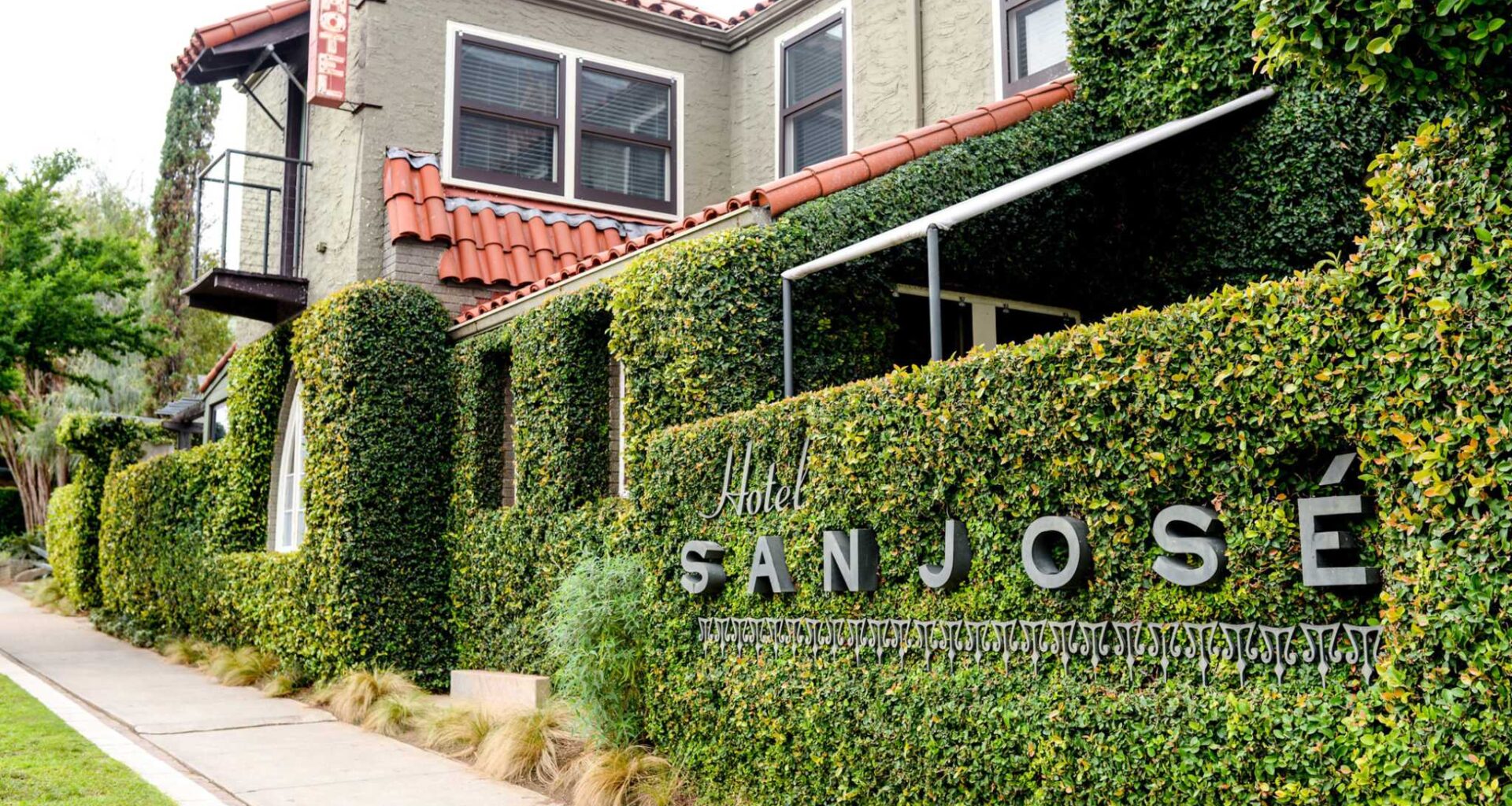
Once a flop house, the Hotel San José, redone by Liz Lambert, led the way for changes on South Congress Avenue.
Hannah Koehler
Jim Duncan, a retired city planner, has written more than 600 short histories of Austin businesses. We introduced him and this series, “Jim Duncan’s Austin,” on July 6. This week, we adapt four of his histories of Austin motels and motor lodges. — Michael Barnes

1930: Blue Bonnet Court
Of the many residents accommodated by the Blue Bonnet Court over the past century, few were more notable than Lester Joseph Gillis and Zelma O’Riley.
Article continues below this ad
For those who do not recognize their names, maybe their nicknames will help. Lester was the infamous bank robber “Baby Face Nelson,” and Zelma was better known locally as “Bicycle Annie.”
While Lester is only rumored to have stayed there, Zelma, who published an indie newspaper centered around the Drag in the 1940s and ran for U.S. president in 1948, died there in 1991 at the age of 94.
Originally named the Bluebonnet Tourist Camp, it is Austin’s oldest continuously operated motel.
In 1930, Joe Doyle and Beth Lucas built the 11-unit motel at 4407 Guadalupe St. on what was then the main road to Dallas. He hauled the façade granite from Marble Falls.
Article continues below this ad
Doyle sold the property to John Anthony Maige, who changed its name to Blue Bonnet Court and installed one of Austin’s first neon signs.
In 1958, Maige sold it to David Charles Woollet, who also owned the Alamo Hotel and was a historic preservationist. Woollet died in 2002, and the Blue Bonnet is still owned by his family.
It was admitted to the National Register of Historic Places in 1990 and now serves as short-term rental apartments.
1936: Hotel San José
Johnny Moreno looks at a flower stand at Hotel San Jose for an activation by Amazon Prime during day one of South by Southwest, on Friday, March 10, 2023. The Hotel uses its parking lots for concerts during festivals and special events.
Mikala Compton/American-Statesman
Built in 1936 as an “ultramodern” motor court on South Congress by George Foster Zimmerman, the San Jose Court has been transformed into an urban bungalow-style hotel tucked behind stucco walls and set amidst lush garden courtyards.
Article continues below this ad
Now hailed as one of the nation’s first true boutique hotels, the San José started life as a motor court and became a 1950s roadside motel before falling into disrepair in a bad part of town.
In 1994, Liz Lambert bought it and transformed it into a midcentury-inspired hot spot, the first of her Bunkhouse hotels. It is an example of the Texas Minimalist design style. Most of the furniture was made by local artisans from reclaimed wood and Texas leather, and the three most affordable rooms have a shared bath.
Lambert’s experience renovating the hotel and contributing to the neighborhood’s gentrification prompted her to make the documentary, “The Last Days of the San José,” which casts a revealing light on human relationships in gentrification and urban renewal.
In 2015, Standard International, which owns a string of boutique hotels, acquired a majority stake in Bunkhouse. In 2017, Sansiri, a Thai company that invested in Standard International, took control of Bunkhouse, hoping for rapid growth in revenue. After Lambert tried to buy back her company, she was effectively “fired.”
Article continues below this ad
In 2024, Hyatt Hotels Corporation acquired Hotel San José through its lifestyle group, but it is still managed by the Austin-based Bunkhouse Group.
Nowadays, SoCo is among the city’s top tourist attractions, and the San José is in the heart of the action, hosting local and touring bands in its courtyard and parking lot during festivals and special events.
1938: Austin Motel
The Austin Motel has a kidney-shaped pool on South Congress Avenue.
Provided by Nick Simonite / Austin Motel
Located at the entrance to the SoCo retail and entertainment district, the Austin Motel is within walking distance of Lady Bird Lake and the famous Bat Bridge.
Article continues below this ad
It was built by Ernest Calvin and Jennie Mae Stewart at 1220 South Congress Ave. as a 16-cabin “tourist camp” in 1938. During the 1930s, the number of motor hotels in Austin grew from seven to 44.
Over the years, the Austin Motel has had four main owners: the Stewarts (1938-1961), the Thompsons (1961-1993), the Deans (1993-2016) and Liz Lambert, who also owned the nearby Hotel San José. Both motels are now owned by Hyatt Hotel Corp., which purchased the Bunkhouse Group in 2024 for $335 million.
Reflecting the blended designs of several retro eras, the motel’s 41 rooms are decorated in bright shades of candy apple red and sunny yellow and filled with nostalgic touches like vibrating beds, vinyl records, music posters and kimono bathrobes.
The motel has a kidney-shaped pool, where it holds its float film series showing Austin-centric movies during the summer months.
Article continues below this ad
Its most recognized feature, however, is its glowing red, 25-foot-tall signature sign, which has towered over Congress for eight decades and is memorable for its resemblance to certain anatomical parts. At one point, Liz changed the slogan on the sign from “So Close, Yet So Far Out” to the even cheekier, “Let Love In.”
1942: Goodnight Court / Classic Inn
The former site of Hill’s Cafe is seen at 4700 South Congress Ave. It was part of a tourist complex developed by Austin’s Goodnight family.
Mikala Compton/American-Statesman
After opening a service station at 4700 South Congress Ave. in the 1930s, Charlie Goodnight Sr. added a grocery in 1938, a tourist court in 1942 and a cafe in 1947.
Article continues below this ad
Other than a rebranding from Goodnight Court to Classic Inn, little has changed over the past eight decades at the tourist court. Named for Goodnight’s partner, Samuel Ambrosia “Posey” Hill, Hill’s Café started as a small, 20-seat diner and eventually became one of Austin’s largest and most popular destinations for comfort food and country music.
After Charlie Goodnight and Hill retired, the businesses were managed by Charles Merle “Boomer” Goodnight Jr. from 1957 to 1989.
From 2003 to 2013, local radio host Bob Cole owned and operated the café.
In 2018, it was announced that the 15-acre property was to be redeveloped into a residential office project and would retain several of the historic structures and iconic signs and reincarnate the café and music venue space. The development, however, still looks undeveloped.
Article continues below this ad
Charlie Goodnight died in 1973, Hill in 1983 and Boomer Goodnight in 2010.
Sidebar: Charles S. Goodnight, the famed 19th-century West Texas rancher and cattle driver who founded the Goodnight-Loving Trail from Texas to Wyoming, is distantly related to Austin’s Goodnight family.
Recent histories in this series
Exploring Austin’s real-life castles and their colorful pasts
Article continues below this ad
Sordid tales from Hotel Vegas. Plus, which hotel hides a Cold War bunker?
Is Lammes Candies the oldest continuously operated business in town?
Please send tips and questions to mbarnes@statesman.com
Article continues below this ad