
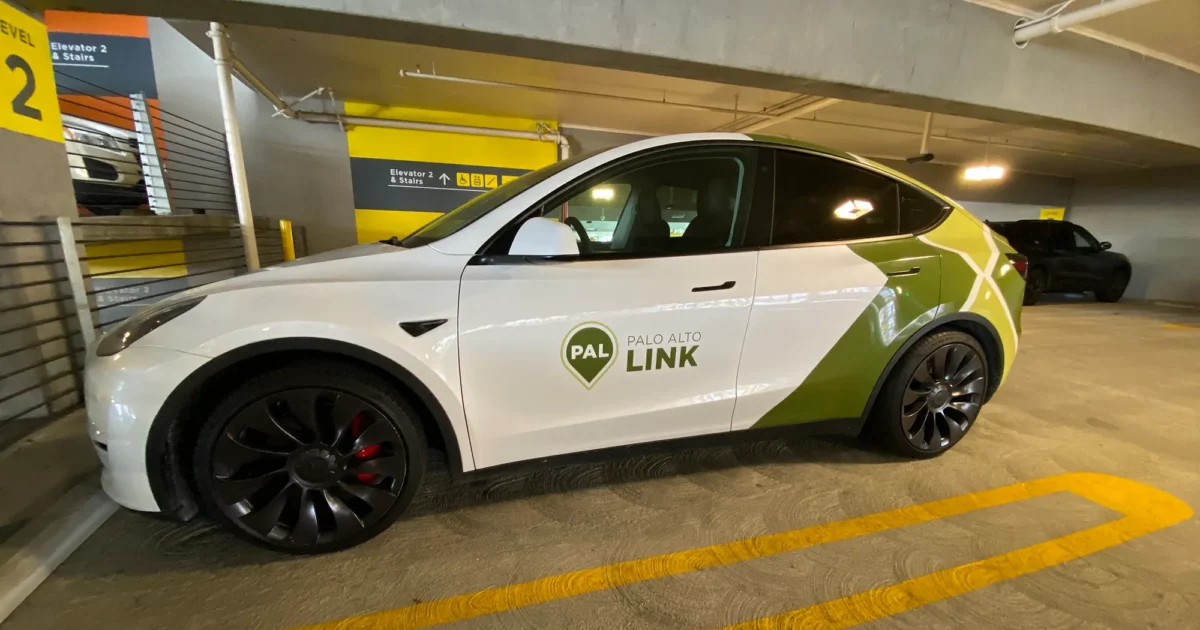
It’s been a year of change and uncertainly for Palo Alto Link, the ride-share service that the city launched in March 2023 and that continues to fight for its life in the face of an increasingly skeptical City Council.
Compared to private services like Uber and Lyft, Palo Alto’s nine-vehicle fleet remains a relative a bargain for users, with fares ranging from $2 for seniors, youths, low-income riders and individuals with disabilities to $4 for everyone else. Though it only runs on weekdays from 7 a.m. to 7 p.m., staff from the Office of Transportation note it has users in every part of the city.
According to Via, the contractor that operates the ride-share service, Palo Alto Link saw 1,426 unique riders since Sept. 1. It also has a segment of “power users” who use it multiple times per week.
Palo Alto Link functions like all the other major ride-share services, with rides summoned through a mobile app. It picks up and drops off riders at designated locations, but also offers door-to-door service for users who require additional assistance. However, its services are geofenced within Palo Alto borders, with schools excluded.
The council generally likes Palo Alto Link, which provides a valuable “last mile” service to vulnerable populations like seniors, youths and low-income residents. Yet for the past year, councilmembers have also been looking for ways to scale back or abolish the service.
If the city stays on its current course, the program will end June 30. While that decision won’t be made until this summer, most councilmembers indicated on March 2 that they would like to see significant changes in the program.
The main issue is the cost. When it made its debut in 2023, Palo Alto Link was funded through a VTA grant as an 18-month pilot program. As grant funding ran out, the city increased its subsidies for the ride-share program, which now amount to about $700,000 per year. It has also been receiving about $500,000 annually from Stanford Research Park so that the park’s employees could get unlimited rides.
Palo Alto Link barely avoided getting slashed during the last budget seasons, as councilmembers wrestled with decreasing revenues. The council ultimately agreed to amend the program — reducing driver hours and raising fares — and to give it a short-term extension.
Now that this extension is heading into its final months, the council is once again debating the future of Palo Alto Link. During the March 2 discussion, Councilmember Greer Stone lauded the ride-share service, which he said “addresses the last-mile problem in a really unique way.”
“But it was always designed to be a pilot program, and it made a lot of sense when we were getting the grant funding,” Stone said. “Now, looking at these deficits in the next few years, we’re going to have to make some challenging decisions.”
That said, he and others expressed support for continuing some sort of ride-share program, particularly for low-income residents. This could mean raising fares and further, further decreasing driver hours and restricting who can ride Palo Alto Link, measures that may reduce short-term costs but that would also make the program less attractive.
Some of that service degradation has already happened, according to staff. Since the council’s recent adjustments, waiting time for a ride has increased from 12-15 minutes to 18-25 minutes, according to staff. In the first 12 months, the program accommodated most riders, with between 3.8% and 9.1% getting a “seat unavailable” message when ordering a ride. Since late 2024, that has gone up to between 15.1% to 19.6%.
With the program expiring in four months, the council struggled to reach a consensus. Councilmember Ed Lauing suggested he would open to extending the program in its current form while the city looks for other ways to fund it.
“I don’t’ think $700,000 is a scary number for what we ‘re trying to accomplish here, to continue it as it is with a strong, big footnote that we need to find some funding,” Lauing said. “We need to find some partners in the city or outside the city.”
Councilmember Keith Reckdahl suggested a different path — ditching Palo Alto Link and creating a voucher program that would allow qualifying low-income residents to use existing ride-share services such as Uber or Lyft and have their ride partially subsidized by the city.
“I really don’t think it’s sustainable,” Reckdahl said.
The default option is to simply discontinue the program. But city staff note this could create disruption for the dependent populations with no public transportation options. A Via analysis cited by Office of Transportation staff showed only 6% of current Palo Alto Link trips could be replaced with existing transit services.
“Since many areas of the city are not covered by these services, many riders would need to discontinue their trips, shift their trips to walking, bicycling or driving, or pay substantially more to TNCs (like Uber, Lyft and Waymo) to be accommodated,” the report states.
This story originally appeared in Palo Alto Weekly. Gennady Sheyner is the editor of Palo Alto Weekly and Palo Alto Online. As a former staff writer, he has won awards for his coverage of elections, land use, business, technology and breaking news.